Stockton's port and Central Valley agriculture give restaurants access to cheap local produce, but distribution and delivery logistics across the city's spread-out layout add real cost.
How do Stockton food businesses get funded?
Stockton operators start with a free review with a specialist, share recent business bank statements, and are matched to the programs that fit the use of funds. Working capital funds in 1 to 3 business days after you choose an offer, equipment in 1 to 5, and buildout capital in 1 to 4 weeks.
Estimates, not offers: Amounts, terms, and funding times are estimates based on programs commonly available in food service. Actual terms vary by program, lender underwriting, time in business, revenue, and credit profile. Nothing here is an offer of credit or a guarantee of approval. See source and method.
How Stockton eats, and what that does to cash
01
Where Stockton eats
The Miracle Mile along Pacific Avenue carries the city's sit-down and brunch trade, drawing university crowds from University of the Pacific with coffee shops, wine bars, and mid-priced New American menus in the $15 to $25 entree range. Downtown around Weber Avenue and the Cal Water Ballpark corridor picks up before Ports games and stays quiet the rest of the week. Little Manila on El Dorado Street holds the city's Filipino food identity, with turo-turo steam-table counters and bakeries serving pandesal and ensaymada at low tickets. March Lane and the Weberstown Mall corridor carry chain casual dining and drive throughs serving commuters off I-5 and Highway 99. Waterloo Road and East Stockton hold taquerias and Mexican markets serving working-class families at counter-service prices under $12. Rent is cheapest in these outlying corridors, which is why operators there run thinner margins and feel every slow week in the register immediately.
02
What Stockton serves
Filipino food is the city's defining cuisine, with turo-turo counters, lumpia stands, and bakeries clustered in Little Manila, most tickets under $12. Taquerias and birria specialists serve the largely Mexican-American population citywide, with birria tacos and consomme sold at counter-service prices around $10 to $14. The Downtown Stockton Alliance's asparagus and food events reflect the region's agricultural supply chain, and several kitchens buy direct from San Joaquin County farms for produce-forward plates. Drive throughs dominate March Lane and Hammer Lane because Stockton is a car-commute city with long distances between residential tracts and job sites. Sit-down dinner service is thinner than in coastal California cities, with fewer $30-plus entree restaurants and more $12 to $20 family-style plates. Because agricultural supply pricing swings with harvest timing, kitchens sourcing local produce see direct ingredient cost volatility tied to the growing season.
03
Stockton's calendar
The Port of Stockton and San Joaquin County government are major employers, and payroll from these anchors supports steady weekday lunch traffic downtown year-round. University of the Pacific's academic calendar drives Pacific Avenue traffic, with September through May carrying business and June through August seeing a sharp falloff as students leave. The Stockton Ports minor league baseball season runs April through September at Banner Island Ballpark, filling nearby bars and quick-service spots on game nights. The San Joaquin County Fair each June brings a concentrated week of fairground food vendor volume. Summer heat above 95 degrees regularly cuts outdoor patio dining across the Miracle Mile from July through early September. The combined loss of student traffic and patio comfort means Stockton restaurants absorb a genuine summer revenue dip rather than a seasonal peak.
04
Growth and cost in Stockton
New restaurant activity concentrates along the Weston Ranch and Spanos Park growth corridors in south and north Stockton, where new housing tracts create fresh drive-through and strip-center demand. Commercial rent remains well below Bay Area and Sacramento levels, which draws operators priced out of those markets into Stockton buildouts. Labor costs track the broader Central Valley rate, lower than coastal California minimums in nearby counties but still subject to statewide California minimum wage law. Utility costs spike in July and August as walk-in coolers and HVAC run harder against valley heat that regularly tops 100 degrees. Buildout permitting through the city runs slower than in smaller San Joaquin County towns because of Stockton's larger planning department queue, and that permitting lag pushes back opening dates and delays first revenue by weeks to months.
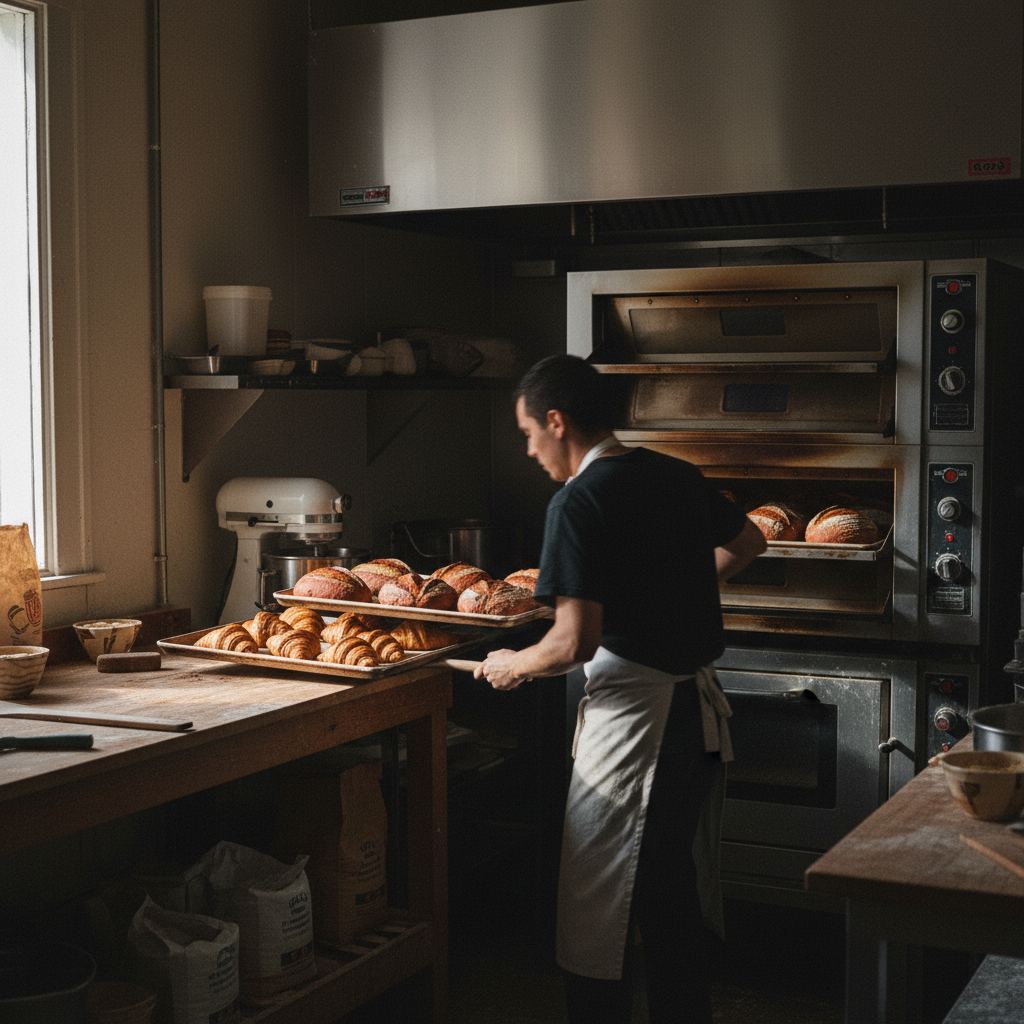
Stockton food service. Illustration generated with AI. Not a photograph of a Foody Finance client or location.
What drives financing conversations in Stockton
Capital here often supports delivery vehicles and cold storage that let a kitchen buy directly from nearby Central Valley growers instead of paying distributor markups. Downtown Stockton and Waterfront concepts also draw on buildout financing as revitalization continues along the waterfront corridor.
Revenue and seasonality in Stockton
Lincoln Village and Brookside carry steady middle-income residential traffic, while Downtown Stockton and the Waterfront depend more on office workers and periodic events. Access to Central Valley produce keeps some food costs lower, but thinner consumer spending in parts of the city means lower checks and a greater need for cash reserves.
What this does to your numbers
Lower spending power in parts of the city means smaller average checks, so the cash cushion needs to be bigger relative to sales.
Permitting in Stockton, and what it costs to wait
San Joaquin County Environmental Health issues food facility permits while alcohol sales require a separate California ABC license, and the two agencies do not coordinate scheduling. A concept planning to open with a full bar in the Waterfront district should budget financing that covers rent through however long the ABC review takes beyond the county's own timeline.
What the wait actually costs
The state alcohol license and the county health permit run on separate calendars, so plan for the slower of the two.
What raises the cost of capital here
01California ABC alcohol licensing timing runs independently of San Joaquin County's health permit process
02Lower average consumer spending in parts of Stockton compresses check averages compared to nearby Bay Area markets
03Access to nearby Central Valley growers can reduce produce costs but adds delivery logistics across a spread-out city footprint
Which program usually fits here
Equipment financing for cold storage or a delivery vehicle pays off if it lets the kitchen buy directly from local Central Valley growers.
California outline. Boundary data: US Census Bureau cartographic boundary files, public domain. Simplified for display.
The number of guests served. Lenders pair it with check average to judge how reliable a month really is.
equipment paper
A loan or lease tied to a specific machine. The machine itself is the security, so approval leans on the value of the hardware more than on your bank statements.
working capital
Cash for the everyday gaps: payroll, inventory, rent, and repairs. It is repaid out of daily or weekly sales rather than from one big event.
line of credit
A preapproved pool of money you pull from only when you need it, then pay back and reuse. You pay for what you draw, not for the full amount sitting there.
draw
Taking money out of an approved line or loan. Draws tied to construction milestones mean you only start paying interest on each piece as you use it.
hard credit pull
A formal credit check that shows on your report and can move your score a few points. It happens only after you pick a specific lender, not to get information.
buildout capital
Money for the work that turns a space into a working kitchen: plumbing, electrical, hoods, walls, and permits. It pays for labor and materials you cannot resell, so it is priced differently than money for a fryer.
underwriting
The lender reading your numbers to decide how much risk you are. Bank statements, time in business, and existing debt carry the most weight.
shoulder season
The in between weeks on either side of your busy season. Sales fall while rent, insurance, and salaried payroll do not.
term
How long you have to repay. A longer term lowers the monthly payment and raises what the money costs in total.
Does buying direct from Central Valley growers actually save Stockton restaurants money?
Sourcing produce directly from nearby Central Valley farms can lower per-unit food costs compared to standard distributor pricing, but it usually requires the restaurant to handle its own pickup or delivery logistics and cold storage. Equipment financing for a larger walk-in cooler or a delivery vehicle can make that direct sourcing arrangement pencil out over time.
Why do check averages run lower in parts of Stockton than in nearby Bay Area cities?
Stockton's overall consumer spending levels sit below many neighboring Bay Area markets, which keeps menu pricing and average checks lower even when ingredient costs are similar. A concept here typically needs a larger working capital cushion relative to revenue than a comparable Bay Area restaurant to absorb a slow month.
Why do so many Stockton restaurants close for a stretch in late summer instead of during winter holidays?
Stockton's heat routinely exceeds 100 degrees from July through early September, which shuts down patio seating and slows foot traffic during the hottest midday hours, right when University of the Pacific students are also away for summer break. That combination removes two demand drivers at once. Lenders reviewing a Stockton restaurant's bank statements should expect this specific summer trough rather than reading it as a warning sign, since December and the school-year months from September through May typically show stronger and steadier deposit activity for Miracle Mile and downtown operators.
How do Stockton food businesses start a financing conversation?
Start with a free review by a specialist. You share the basics of the business, the use of funds, and recent bank statements, and you see every program that fits before any credit application exists. Short term options commonly fund in 1 to 3 business days once you choose an offer.
Do you serve areas outside Stockton in California?
Yes. Every program is available statewide in California and nationwide.
What is working capital, and when does it fit a Stockton operator?
Cash for the everyday gaps, repaid out of sales on a set schedule instead of at the end of a project. Use it for payroll, inventory, a slow stretch, or a job you have to fund before the client pays you. Typical size is 10,000 to 500,000, funding runs 1 to 3 business days once you choose an offer, and you repay it as fixed daily, weekly, or monthly payment. You will be asked for: application, 3 to 6 months of bank statements.
What is equipment financing, and when does it fit a Stockton operator?
You borrow against a specific machine, and the machine is what backs the loan. Use it when a fryer, a walk-in, an oven, or a vehicle has to be replaced and you would rather keep the cash in the account. Typical size is 5,000 to 500,000, funding runs 1 to 5 business days once you choose an offer, and you repay it as fixed monthly payment. You will be asked for: application, equipment quote, bank statements.
What is business line of credit, and when does it fit a Stockton operator?
An approved limit you pull from only when you need it, then repay and reuse. Use it for a season you can see coming, so you draw before the peak and pay it back out of the peak. Typical size is 10,000 to 250,000, funding runs 2 to 7 business days once you choose an offer, and you repay it as interest on the drawn balance only. You will be asked for: application, bank statements.
Why does the Stockton calendar change what I should borrow?
Lower spending power in parts of the city means smaller average checks, so the cash cushion needs to be bigger relative to sales.
What does waiting actually cost me in Stockton?
The state alcohol license and the county health permit run on separate calendars, so plan for the slower of the two.
Which program do most Stockton operators end up using?
Equipment financing for cold storage or a delivery vehicle pays off if it lets the kitchen buy directly from local Central Valley growers. That is a starting point, not a decision. The specialist review looks at your deposits, your time in business, and what the money is for before anything is recommended.
Does asking about financing in Stockton affect my credit?
No. Getting information is a conversation, not an application. There is no credit application and no hard credit pull until you have picked a specific lender and want to move forward.
Start the conversation
Talk to a specialist before you fill out an application.
Start with a free, no-obligation review. We will send the right application only after we know what you actually qualify for.