OR metro

Restaurant financing in Portland.

Portland's cart pod culture means many operators start mobile and finance the jump to a permanent kitchen.

How do Portland food businesses get funded?

Portland operators start with a free review with a specialist, share recent business bank statements, and are matched to the programs that fit the use of funds. Working capital funds in 1 to 3 business days after you choose an offer, equipment in 1 to 5, and buildout capital in 1 to 4 weeks.

Estimates, not offers: Amounts, terms, and funding times are estimates based on programs commonly available in food service. Actual terms vary by program, lender underwriting, time in business, revenue, and credit profile. Nothing here is an offer of credit or a guarantee of approval. See source and method.

How Portland eats, and what that does to cash

01

Where Portland eats

The Pearl District and Northwest 23rd carry higher end restaurants and wine bars serving a professional crowd at 25 to 40 dollars an entree. Southeast Division Street and Alberta Arts District hold the city's dense cluster of chef driven independent restaurants, often small format with 20 to 40 seats, serving a younger local crowd at 18 to 30 dollars. Food cart pods, especially the ones downtown near Southwest 10th and Alder and in outer neighborhoods like Cully, serve counter service meals at 8 to 14 dollars from single operator carts with minimal overhead. St. Johns and outer Southeast Portland carry cheaper, more residential dining serving families priced below the inner eastside average. Old Town and downtown core have struggled with reduced office worker foot traffic on weekdays since 2020, thinning lunch business that used to support delis and quick service spots. Powell's City of Books and the surrounding downtown retail corridor once supported a denser lunch counter scene that has thinned along with office occupancy. A food cart operator with almost no fixed overhead survives slow months that would sink a full service restaurant carrying the same rent as the Pearl District.
02

What Portland actually serves

Food carts remain the city's signature format, with pods clustering a dozen or more single cuisine carts, serving everything from Korean tacos to Thai food at 9 to 14 dollars, and rent for cart space runs far below a storefront lease. Craft brewery taprooms, following Portland's outsized brewery count, pair simple pub food with beer sales as the primary margin driver. Farm to table restaurants on Southeast Division source seasonally from Willamette Valley farms, with menus that shift monthly and prices from 24 to 38 dollars an entree. Doughnut shops, led by the Voodoo Doughnut brand, draw tourist lines downtown at 3 to 5 dollars a doughnut. Coffee culture supports dense independent roaster cafes across nearly every neighborhood. Vegan and vegetarian focused restaurants remain more common here than in most comparable size American cities, reflecting the city's longstanding food politics. A seasonal farm to table menu built around Willamette Valley produce faces ingredient cost swings every time a crop comes in early, late, or short.

03

The calendar that runs Portland

The Rose Festival each June brings parades and waterfront crowds downtown for several weeks. Portland's rainy season, roughly October through April, cuts outdoor patio and food cart seating dramatically, since most carts have little indoor shelter. Summer, June through September, is the peak season for both tourism and outdoor dining, with food carts and brewery patios running near capacity. The Portland Trail Blazers play at the Moda Center from October through April, driving pregame traffic in the Rose Quarter and nearby Lloyd District. Timbers and Thorns soccer matches at Providence Park from spring through fall fill nearby Northwest Portland bars on match days. Portland International Airport's expansion and nearby Cascade Station development have begun pulling some quick service growth toward the airport corridor. A food cart with no indoor seating can lose most of its daily revenue during a wet October week when outdoor picnic tables sit empty.

04

Where Portland growth and costs land

New restaurant openings concentrate in Southeast Portland along Division and Foster Road, where buildout costs run lower than the Pearl District or Northwest 23rd, and in food cart pods that require minimal construction beyond utility hookups. Oregon has no state sales tax, but Portland's business license tax and Multnomah County's business income tax add cost layers unique to operators here. Commercial rent downtown has softened since 2020 due to reduced office occupancy, while Southeast neighborhood rents have climbed as demand shifts toward residential dining corridors. Labor costs run high relative to nearby Vancouver, Washington, just across the Columbia River, where no state income tax draws some workers to commute instead. New multifamily construction along inner Southeast Portland corridors continues to outpace commercial buildout, tightening available ground floor retail space for new restaurants. A downtown restaurant banking on office lunch traffic that has not returned to prior levels faces a structural gap no seasonal uptick will fully close.

Food service operation in Portland
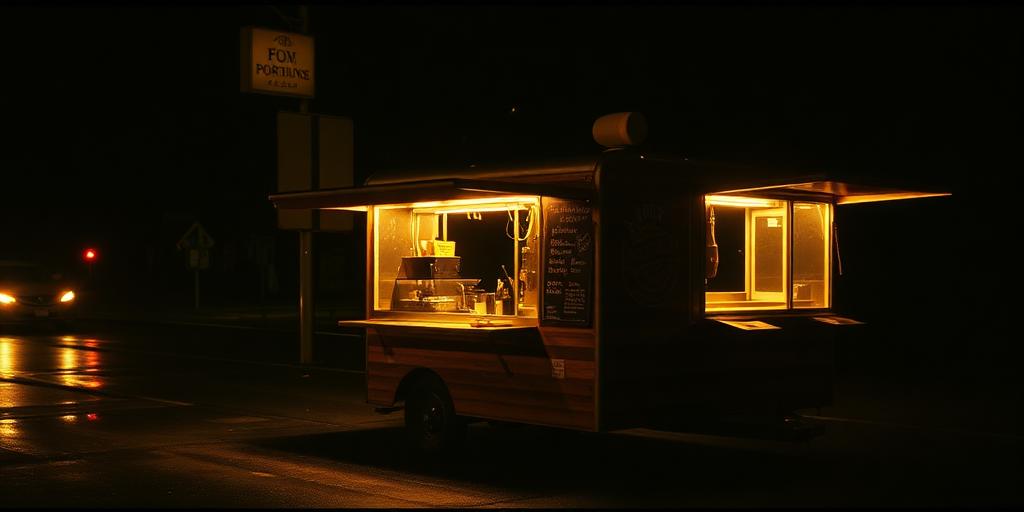
Portland food service. Illustration generated with AI. Not a photograph of a Foody Finance client or location.

What drives financing conversations in Portland

Cart and trailer equipment financing leads, followed by modest buildout requests as operators move indoors.

Revenue and seasonality in Portland

Year round dining with a strong summer patio lift, a cart and small format scene competing for the same dollars, and beverage programs carrying a large share of margin.

What this does to your numbers

Steady year round with a summer lift, and cart pod operations run on a different cost base than brick and mortar rooms.

Permitting in Portland, and what it costs to wait

City permitting and county health review can surface seismic and ventilation conditions mid project, and that unplanned scope is financed as buildout capital rather than paid out of operating cash.

What the wait actually costs

Cart siting and alcohol licensing follow their own paths, and either can hold an opening after the buildout is done.

What raises the cost of capital here

  • 01Food cart pods are a genuine business format here, with their own equipment and utility costs
  • 02Multnomah County health review applies to carts and brick and mortar on different tracks
  • 03Wet season length affects patio and outdoor revenue more than temperature does

Which program usually fits here

Carts finance closer to vehicles than to buildings, which changes the paperwork, the term, and the funding speed.

Portland
Oregon outline. Boundary data: US Census Bureau cartographic boundary files, public domain. Simplified for display.

Free review, no hard credit pull

Get funds now and review your options

Step 01 of 03 · Your operation

A specialist reviews every request and reaches out the same business day

Areas we serve

  • Downtown
  • Alberta
  • Division
  • Pearl District
  • Beaverton

Financing terms on this page

Definitions for the terms used above.

buildout capital
Money for the work that turns a space into a working kitchen: plumbing, electrical, hoods, walls, and permits. It pays for labor and materials you cannot resell, so it is priced differently than money for a fryer.
term
How long you have to repay. A longer term lowers the monthly payment and raises what the money costs in total.
equipment paper
A loan or lease tied to a specific machine. The machine itself is the security, so approval leans on the value of the hardware more than on your bank statements.
working capital
Cash for the everyday gaps: payroll, inventory, rent, and repairs. It is repaid out of daily or weekly sales rather than from one big event.
covers
The number of guests served. Lenders pair it with check average to judge how reliable a month really is.
draw
Taking money out of an approved line or loan. Draws tied to construction milestones mean you only start paying interest on each piece as you use it.
hard credit pull
A formal credit check that shows on your report and can move your score a few points. It happens only after you pick a specific lender, not to get information.
underwriting
The lender reading your numbers to decide how much risk you are. Bank statements, time in business, and existing debt carry the most weight.

Portland financing questions

Can a Portland food cart be financed?

Yes. Carts and trailers finance against the unit itself, similar to equipment paper, and pod utility hookups or covered seating can be added as a buildout component.

How do Portland operators plan around the wet season?

Covered seating is the usual answer, and it is financed as buildout capital in late summer so it is finished before October. Working capital covers the revenue dip while the work is underway.

Why does Portland's food cart model produce a different cash flow pattern than a typical storefront restaurant?

A food cart operator typically carries a fraction of the fixed rent, equipment financing, and buildout cost of a full storefront, so monthly break even sales sit far lower, but that same operator has almost no protection from the rainy season since most cart pods offer only outdoor seating and foot traffic drops sharply from October through April. Lenders looking at a Portland food cart's revenue history usually expect a pronounced seasonal dip that would look alarming for a storefront restaurant but is a normal, recurring pattern for this format given the city's climate and dining culture.

How do Portland food businesses start a financing conversation?

Start with a free review by a specialist. You share the basics of the business, the use of funds, and recent bank statements, and you see every program that fits before any credit application exists. Short term options commonly fund in 1 to 3 business days once you choose an offer.

Do you serve areas outside Portland in Oregon?

Yes. Every program is available statewide in Oregon and nationwide.

What is equipment financing, and when does it fit a Portland operator?

You borrow against a specific machine, and the machine is what backs the loan. Use it when a fryer, a walk-in, an oven, or a vehicle has to be replaced and you would rather keep the cash in the account. Typical size is 5,000 to 500,000, funding runs 1 to 5 business days once you choose an offer, and you repay it as fixed monthly payment. You will be asked for: application, equipment quote, bank statements.

What is buildout and expansion, and when does it fit a Portland operator?

Construction money for the work that turns a space into a working kitchen, usually released in stages as the job progresses. Use it for a second location, a remodel, a patio, or a kitchen conversion, and size it to cover the permit wait, not just the build. Typical size is 50,000 to 2,000,000, funding runs 1 to 4 weeks once you choose an offer, and you repay it as fixed payment, often with a draw schedule. You will be asked for: application, contractor bids, lease, financials.

What is working capital, and when does it fit a Portland operator?

Cash for the everyday gaps, repaid out of sales on a set schedule instead of at the end of a project. Use it for payroll, inventory, a slow stretch, or a job you have to fund before the client pays you. Typical size is 10,000 to 500,000, funding runs 1 to 3 business days once you choose an offer, and you repay it as fixed daily, weekly, or monthly payment. You will be asked for: application, 3 to 6 months of bank statements.

Why does the Portland calendar change what I should borrow?

Steady year round with a summer lift, and cart pod operations run on a different cost base than brick and mortar rooms.

What does waiting actually cost me in Portland?

Cart siting and alcohol licensing follow their own paths, and either can hold an opening after the buildout is done.

Which program do most Portland operators end up using?

Carts finance closer to vehicles than to buildings, which changes the paperwork, the term, and the funding speed. That is a starting point, not a decision. The specialist review looks at your deposits, your time in business, and what the money is for before anything is recommended.

Does asking about financing in Portland affect my credit?

No. Getting information is a conversation, not an application. There is no credit application and no hard credit pull until you have picked a specific lender and want to move forward.

Start the conversation

Talk to a specialist before you fill out an application.

Start with a free, no-obligation review. We will send the right application only after we know what you actually qualify for.

Start a free review

Prefer to call

(833) 505-1900