San Francisco's commercial rent per square foot outpaces nearly every other market on this list, so a delayed opening costs more here than almost anywhere else.
How do San Francisco food businesses get funded?
San Francisco operators start with a free review with a specialist, share recent business bank statements, and are matched to the programs that fit the use of funds. Working capital funds in 1 to 3 business days after you choose an offer, equipment in 1 to 5, and buildout capital in 1 to 4 weeks.
Estimates, not offers: Amounts, terms, and funding times are estimates based on programs commonly available in food service. Actual terms vary by program, lender underwriting, time in business, revenue, and credit profile. Nothing here is an offer of credit or a guarantee of approval. See source and method.
How San Francisco eats, and what that does to cash
01
Where San Francisco eats
The Mission carries the city's taqueria core, from 24th Street burrito counters to newer natural wine bars, drawing a mixed crowd of longtime residents and young tech workers at moderate prices. North Beach still runs on Italian red sauce houses and cafes near Washington Square, feeding tourists and North Beach families with $30 to $50 dinner checks. Chinatown holds dim sum parlors and barbecue shops along Stockton Street serving lunch crowds on tight margins. The Financial District and SoMa fill on weekday lunch from office workers, then go quiet at night except around Oracle Park on game days. Hayes Valley draws a higher-spending crowd for tasting menus and natural wine, while the Richmond and Sunset districts hold family-run Chinese and Vietnamese spots with $15 to $25 checks serving neighborhood regulars rather than visitors. Nob Hill and Pacific Heights carry white tablecloth rooms tied to hotel and residential wealth. This split between tourist-driven downtown blocks and resident-driven outer neighborhoods means a restaurant's traffic pattern depends entirely on which side of the city it sits, creating uneven weekday versus weekend cash flow across the two zones.
02
What the city actually eats
San Francisco is known for sourdough bread service, Mission burritos wrapped in foil, Dungeness crab in season, and cioppino tied to the Fisherman's Wharf fishing fleet. Dim sum counter service in Chinatown and the Richmond runs $12 to $20 per person, while tasting menu dining in Hayes Valley and the Mission runs $150 to $250 per person. Food hall formats like the Ferry Building marketplace charge premium rents reflected in $18 sandwich prices, and counter-only ramen and noodle shops in SoMa and the Mission keep labor lean with $16 to $22 bowls. Craft brewery taprooms cluster in Dogpatch and the Bayview, often with limited food service or rotating food trucks rather than full kitchens. Late night options are scarce outside the Mission and Tenderloin corridors because of the city's early closing culture, unlike other big West Coast cities. Coffee and pastry counters saturate every neighborhood commercial strip, competing on razor-thin per-cup margins. This concentration of high fixed rent formats next to low ticket counter service means restaurants must hit volume targets fast or absorb losses within the first few slow months.
03
The calendar that runs the year
Salesforce's Dreamforce conference each fall fills downtown hotels and restaurants for a single high-volume week, spiking demand around Moscone Center. Oracle Park's baseball season from April through September drives Giants game day traffic through China Basin and Mission Bay restaurants and bars. Chase Center's Warriors season from October through spring brings similar surges to Mission Bay on game nights. Fleet Week in October and the Chinese New Year parade in Chinatown each January or February draw crowds tied to specific weekends rather than sustained seasons. Summer tourist season, despite the city's famous fog and cool temperatures, still brings the highest hotel occupancy and Fisherman's Wharf foot traffic from June through August. Tech company campuses like Salesforce Tower and the Twitter and Square offices in Mid-Market anchor weekday lunch demand that collapses on weekends and during company-mandated office closures. Convention business at Moscone Center creates unpredictable multi-day spikes scattered through the year rather than a single peak season. This mix of event-driven spikes and weekday office lunch dependence means restaurant revenue swings sharply between convention weeks and the quiet stretches between them.
04
Growth and cost pattern
New restaurant openings concentrate in Dogpatch, the Outer Sunset, and the eastern Mission, where commercial rent runs lower than Union Square or the Financial District but foot traffic is still resident-driven. Ground floor retail space in older Victorian-era buildings often requires seismic retrofitting and ADA upgrades before a kitchen buildout can begin, adding months to permitting timelines. San Francisco's minimum wage and mandated health care spending requirement for employers push labor costs above most other California cities, squeezing margins on counter service concepts. Utility costs run high relative to inland California cities, and older buildings frequently need electrical panel upgrades to support commercial kitchen equipment. Buildout costs in converted retail spaces in neighborhoods like the Outer Richmond or Bernal Heights often exceed initial estimates once contractors uncover outdated wiring or plumbing behind original walls. Landlords in higher-demand corridors like Hayes Valley and the Marina often require key money or above-market deposits given competition for storefronts. These combined labor, retrofit, and deposit costs mean new operators frequently face buildout delays and higher upfront capital needs than their initial construction bids anticipated.
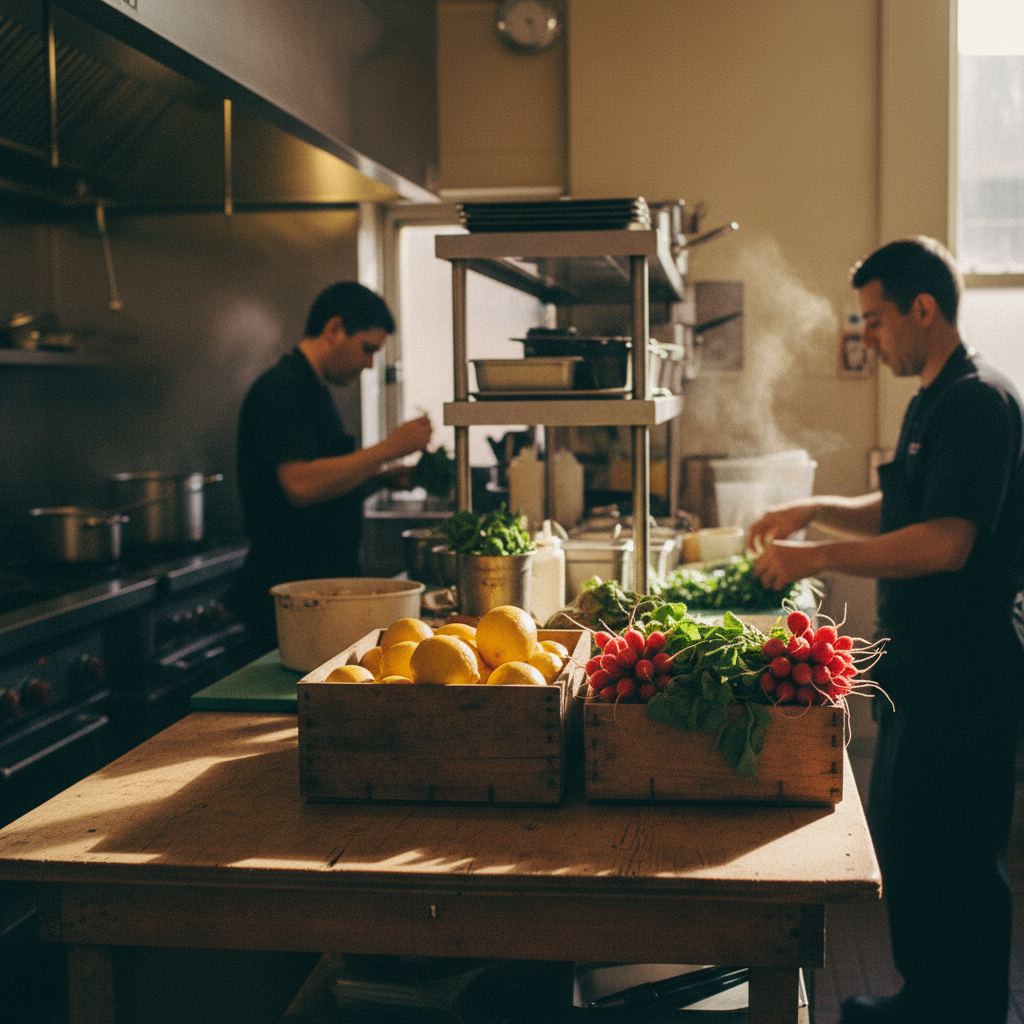
San Francisco food service. Illustration generated with AI. Not a photograph of a Foody Finance client or location.
What drives financing conversations in San Francisco
Buildouts in dense corridors like the Mission and North Beach often mean gutting decades-old kitchen infrastructure to meet current health and fire code, which raises construction costs well above a suburban comparison. Financing here has to absorb both high rent during permitting delays and equipment costs inflated by the same tight commercial real estate market.
Revenue and seasonality in San Francisco
Tech industry lunch traffic drives weekday revenue in SoMa and the Financial District, while tourist-heavy North Beach and Fisherman's Wharf lean on weekend and summer visitor volume. Office return-to-work patterns have made weekday lunch less predictable than before, so financing needs to cover a revenue base that shifts year to year rather than following a fixed seasonal pattern.
What this does to your numbers
High rent doesn't pause while you wait for permits, so every delayed month costs more here than most places.
Permitting in San Francisco, and what it costs to wait
The San Francisco Department of Public Health issues food facility permits, while separate Planning Department and Department of Building Inspection review covers construction and, in many neighborhoods, conditional use authorization before a restaurant can even file for a building permit. That conditional use step alone can add months on top of the standard health inspection, all while commercial rent keeps accruing on an empty space.
What the wait actually costs
Extra planning approval before you can even apply for a building permit means the timeline runs longer than most owners expect.
What raises the cost of capital here
01Conditional use authorization in many neighborhoods adds a planning review step before a building permit can even be filed.
02Commercial rent per square foot runs well above the national average, raising the cost of every month a buildout is delayed.
03Older building infrastructure in dense corridors often requires full kitchen system replacement to meet current code.
Which program usually fits here
An SBA loan suits a full buildout with a long permitting runway, while a credit line covers the rent gap while approvals move.
California outline. Boundary data: US Census Bureau cartographic boundary files, public domain. Simplified for display.
The number of guests served. Lenders pair it with check average to judge how reliable a month really is.
SBA loan
A bank loan partly guaranteed by the Small Business Administration. Lowest cost of the options, longest paperwork, and the slowest to fund.
buildout capital
Money for the work that turns a space into a working kitchen: plumbing, electrical, hoods, walls, and permits. It pays for labor and materials you cannot resell, so it is priced differently than money for a fryer.
draw
Taking money out of an approved line or loan. Draws tied to construction milestones mean you only start paying interest on each piece as you use it.
line of credit
A preapproved pool of money you pull from only when you need it, then pay back and reuse. You pay for what you draw, not for the full amount sitting there.
hard credit pull
A formal credit check that shows on your report and can move your score a few points. It happens only after you pick a specific lender, not to get information.
working capital
Cash for the everyday gaps: payroll, inventory, rent, and repairs. It is repaid out of daily or weekly sales rather than from one big event.
equipment paper
A loan or lease tied to a specific machine. The machine itself is the security, so approval leans on the value of the hardware more than on your bank statements.
shoulder season
The in between weeks on either side of your busy season. Sales fall while rent, insurance, and salaried payroll do not.
term
How long you have to repay. A longer term lowers the monthly payment and raises what the money costs in total.
Why does opening a restaurant in San Francisco take longer than in most cities?
Many San Francisco neighborhoods require conditional use authorization from the Planning Department before a restaurant can file for a building permit, which runs before the Department of Building Inspection review and the separate Department of Public Health food facility permit even start. Stacking those three tracks can push a timeline out by months, and rent on the space accrues the entire time.
How has hybrid work changed restaurant cash flow in San Francisco?
Weekday lunch volume in SoMa and the Financial District has become less predictable as office attendance patterns shifted, which means restaurants leaning on that traffic see more variable weekly revenue than before. Financing sized around a fixed monthly projection fits this market less well than a flexible structure that can absorb a slower-than-expected week.
Why do San Francisco restaurants close earlier than in other major cities?
San Francisco lacks a large late night entertainment district comparable to New York or Los Angeles, and residential zoning in most neighborhoods restricts noise and operating hours near housing. Public transit via BART and Muni also winds down by around midnight, reducing late night foot traffic. Most kitchens close by 10pm outside a handful of Mission and Tenderloin blocks. Lenders reviewing a San Francisco restaurant's numbers should expect revenue concentrated in lunch and early dinner hours rather than a late night bar or after-dinner drink cycle, which changes how nightly cash deposits are timed and sized compared to cities with an active midnight economy.
How do San Francisco food businesses start a financing conversation?
Start with a free review by a specialist. You share the basics of the business, the use of funds, and recent bank statements, and you see every program that fits before any credit application exists. Short term options commonly fund in 1 to 3 business days once you choose an offer.
Do you serve areas outside San Francisco in California?
Yes. Every program is available statewide in California and nationwide.
What is sba loans, and when does it fit a San Francisco operator?
A bank loan partly guaranteed by the Small Business Administration, which is why the payment is the lowest available. Use it when you can plan months ahead. It is the cheapest money on this page and the slowest to arrive. Typical size is 50,000 to 5,000,000, funding runs 3 to 12 weeks once you choose an offer, and you repay it as amortized interest, lowest payment of any program. You will be asked for: tax returns, interim financials, debt schedule, plan.
What is buildout and expansion, and when does it fit a San Francisco operator?
Construction money for the work that turns a space into a working kitchen, usually released in stages as the job progresses. Use it for a second location, a remodel, a patio, or a kitchen conversion, and size it to cover the permit wait, not just the build. Typical size is 50,000 to 2,000,000, funding runs 1 to 4 weeks once you choose an offer, and you repay it as fixed payment, often with a draw schedule. You will be asked for: application, contractor bids, lease, financials.
What is business line of credit, and when does it fit a San Francisco operator?
An approved limit you pull from only when you need it, then repay and reuse. Use it for a season you can see coming, so you draw before the peak and pay it back out of the peak. Typical size is 10,000 to 250,000, funding runs 2 to 7 business days once you choose an offer, and you repay it as interest on the drawn balance only. You will be asked for: application, bank statements.
Why does the San Francisco calendar change what I should borrow?
High rent doesn't pause while you wait for permits, so every delayed month costs more here than most places.
What does waiting actually cost me in San Francisco?
Extra planning approval before you can even apply for a building permit means the timeline runs longer than most owners expect.
Which program do most San Francisco operators end up using?
An SBA loan suits a full buildout with a long permitting runway, while a credit line covers the rent gap while approvals move. That is a starting point, not a decision. The specialist review looks at your deposits, your time in business, and what the money is for before anything is recommended.
Does asking about financing in San Francisco affect my credit?
No. Getting information is a conversation, not an application. There is no credit application and no hard credit pull until you have picked a specific lender and want to move forward.
Start the conversation
Talk to a specialist before you fill out an application.
Start with a free, no-obligation review. We will send the right application only after we know what you actually qualify for.