Oakland's restaurant scene draws on one of the most diverse food cultures in the country, but rising commercial rents and inconsistent foot traffic downtown make cash flow harder to predict than the menu suggests.
How do Oakland food businesses get funded?
Oakland operators start with a free review with a specialist, share recent business bank statements, and are matched to the programs that fit the use of funds. Working capital funds in 1 to 3 business days after you choose an offer, equipment in 1 to 5, and buildout capital in 1 to 4 weeks.
Estimates, not offers: Amounts, terms, and funding times are estimates based on programs commonly available in food service. Actual terms vary by program, lender underwriting, time in business, revenue, and credit profile. Nothing here is an offer of credit or a guarantee of approval. See source and method.
How Oakland eats, and what that does to cash
01
Where Oakland eats
Temescal along Telegraph Avenue carries the city's dense concentration of chef driven small plates rooms and natural wine bars, serving a customer base with disposable income at 30 to 50 dollar per person dinner checks. Fruitvale, centered on International Boulevard, is the city's Latino and Central American food corridor, with pupuserias and taco trucks like the ones clustered near the Fruitvale Public Market serving low ticket, cash heavy meals to a working class neighborhood. Jack London Square along the estuary has rebuilt around waterfront restaurants and cafes serving downtown office workers and weekend visitors, a shift from the chain heavy corridor it was a decade ago. Chinatown, adjacent to downtown, runs dim sum houses and barbecue counters serving both a longtime Chinese and Southeast Asian community and downtown lunch traffic. Uptown and downtown proper, near the Fox Theater and the Paramount, support a bar and late night dinner crowd tied to concert and event nights. Rockridge along College Avenue serves an affluent, food conscious residential customer with a slower, brunch heavy weekend pattern. The gap between Fruitvale's cash counter economy and Rockridge's reservation driven dinner economy means citywide averages hide two very different businesses operating a few miles apart.
02
What Oakland actually serves
Oakland's food identity runs through West Coast Chinese American and dim sum traditions in Chinatown, Central American pupusas and Mexican tacos in Fruitvale, and a chef driven small plates and natural wine format concentrated in Temescal, often at 30 to 45 dollar dinner checks. Counter service taco trucks and walk up stands along International Boulevard price meals at 8 to 12 dollars, running on cash and high volume. Craft brewery taprooms with attached kitchens cluster in the Jack London and West Oakland warehouse districts, serving a weekend and post work crowd. Detroit style pizza and other newer counter formats have found space in Jack London Square's rebuilt retail. Food truck and pop up culture, historically strong here, depends on event bookings and street closures rather than fixed dining rooms. Because a meaningful share of Fruitvale's food economy runs informally through trucks and cash stands, a permitting change to street vending rules can eliminate a location's entire customer flow overnight, a structural risk distinct from Temescal's lease dependent restaurants.
03
The Oakland calendar
The Port of Oakland and its logistics workforce, along with major employers like Kaiser Permanente headquartered downtown, anchor steady weekday lunch demand year round. Oakland Unified School District's calendar shapes Fruitvale and East Oakland family dining around the August start and June end of the school year. The Fox Theater and Paramount Theatre in Uptown drive concert night surges that vary week to week with the touring schedule rather than following a fixed season. Oakland's summer is famously cool and foggy near the bay, which pushes some patio dining traffic toward inland neighborhoods like Temescal and Rockridge during warmer afternoon hours rather than evenings. Lunar New Year in late January or February brings a significant surge to Chinatown's restaurants and markets. Warehouse district events and art walks in Jack London Square and Uptown draw first Friday crowds that vary in size month to month. A restaurant near the Fox Theater that staffs for a typical Tuesday will be short handed on a sold out concert night with little advance notice from the venue's booking calendar.
04
Growth and cost pattern in Oakland
New restaurant openings concentrate in rebuilt Jack London Square retail spaces, in Temescal's converted storefronts along Telegraph Avenue, and in Uptown near the Fox Theater where older commercial buildings are turning over. Rent runs below San Francisco across the bay but has risen fastest in Temescal and Uptown as those corridors draw spillover demand from displaced San Francisco operators. Labor costs are shaped by Oakland's citywide minimum wage ordinance, which runs higher than the California state minimum and applies to all hospitality workers regardless of neighborhood. Older commercial buildings in Fruitvale and West Oakland frequently require seismic and ADA upgrades before permits clear, adding buildout time that newer Jack London Square spaces avoid. Insurance costs have climbed in some commercial corridors tied to property crime concerns, a real line item landlords increasingly pass through in lease terms. The combination of Oakland's minimum wage ordinance and its commercial rent trajectory in gentrifying corridors means a Temescal or Uptown restaurant carries a materially higher fixed labor cost per shift than a comparable Fruitvale counter service operation, tightening margins fastest during slow midweek stretches.
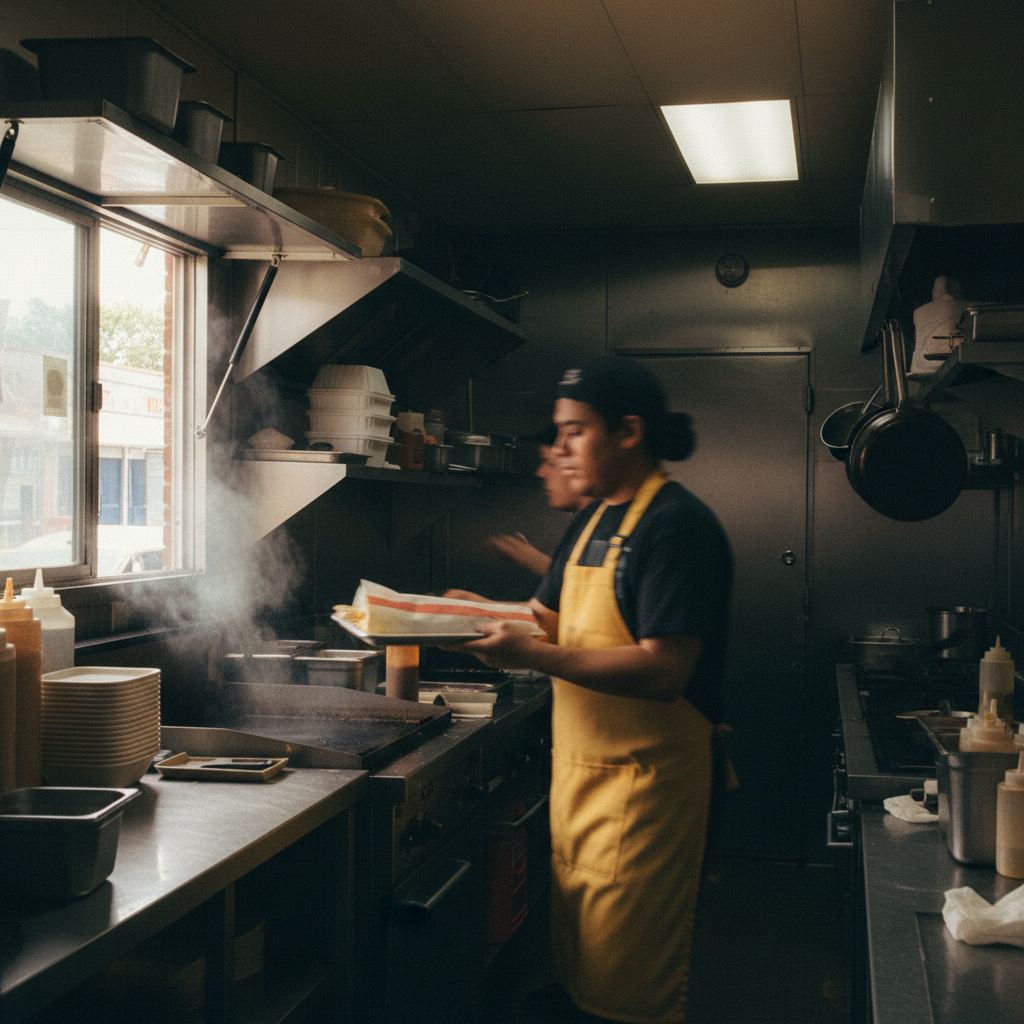
Oakland food service. Illustration generated with AI. Not a photograph of a Foody Finance client or location.
What drives financing conversations in Oakland
Financing often covers buildout costs in Temescal and Jack London Square spaces with older infrastructure, plus working capital to manage rent increases that have outpaced revenue for many independent operators. Restaurants near the port also use equipment financing for delivery vehicles serving corporate accounts.
Revenue and seasonality in Oakland
Neighborhood dining in Temescal, Rockridge, and Grand Lake holds fairly steady through the year, while downtown and Jack London Square traffic depends more on office worker presence, which has shifted since remote work became common. Card payments dominate, and catering invoices run on standard net terms.
What this does to your numbers
Rent has gone up faster than sales for a lot of Oakland restaurants, so a busy dining room does not always mean a comfortable bank balance.
Permitting in Oakland, and what it costs to wait
Alameda County Environmental Health handles food facility permitting and inspection for Oakland, while alcohol licensing goes through California's Department of Alcoholic Beverage Control on a separate statewide track. A Temescal or Fruitvale buildout that depends on both approvals should plan for the liquor license to move independently of the county inspection, with lease costs continuing throughout.
What the wait actually costs
A slow liquor license or buildout delay adds months of rent paid before any revenue from the new concept arrives.
What raises the cost of capital here
01Commercial rent increases across Oakland neighborhoods have outpaced revenue growth for many independent restaurants.
02Reduced downtown office worker presence has changed weekday lunch demand near Jack London Square.
03Fruitvale and East Oakland buildouts often involve older commercial buildings needing significant infrastructure upgrades.
Which program usually fits here
Working capital fits for managing rent pressure day to day, and buildout financing fits for renovating older commercial spaces in neighborhoods like Temescal.
California outline. Boundary data: US Census Bureau cartographic boundary files, public domain. Simplified for display.
Cash for the everyday gaps: payroll, inventory, rent, and repairs. It is repaid out of daily or weekly sales rather than from one big event.
buildout capital
Money for the work that turns a space into a working kitchen: plumbing, electrical, hoods, walls, and permits. It pays for labor and materials you cannot resell, so it is priced differently than money for a fryer.
line of credit
A preapproved pool of money you pull from only when you need it, then pay back and reuse. You pay for what you draw, not for the full amount sitting there.
equipment paper
A loan or lease tied to a specific machine. The machine itself is the security, so approval leans on the value of the hardware more than on your bank statements.
draw
Taking money out of an approved line or loan. Draws tied to construction milestones mean you only start paying interest on each piece as you use it.
hard credit pull
A formal credit check that shows on your report and can move your score a few points. It happens only after you pick a specific lender, not to get information.
covers
The number of guests served. Lenders pair it with check average to judge how reliable a month really is.
underwriting
The lender reading your numbers to decide how much risk you are. Bank statements, time in business, and existing debt carry the most weight.
shoulder season
The in between weeks on either side of your busy season. Sales fall while rent, insurance, and salaried payroll do not.
term
How long you have to repay. A longer term lowers the monthly payment and raises what the money costs in total.
How has downtown Oakland's office worker decline affected restaurant financing needs?
Restaurants near Jack London Square and downtown that built their model around weekday office lunch traffic have seen that base shrink as more companies allow remote work, pushing some owners toward menu and hours changes that require new equipment or buildout financing to execute. Working capital has also become more common simply to cover the gap while a concept repositions toward evening and weekend demand instead.
Why do rent increases matter so much for Oakland restaurant lending decisions?
Commercial rents in neighborhoods like Temescal and Rockridge have risen faster than many independent restaurants' revenue, which tightens margins even for busy, well-reviewed spots. Financing decisions here often weigh whether a loan or line of credit is covering a genuine growth opportunity or simply offsetting a rent increase that a lease renewal already locked in.
Why do restaurants near Fruitvale operate so differently on the books than those in Temescal or Rockridge?
Fruitvale's food economy runs heavily through cash based taco trucks, pupuserias, and street vendors with low fixed costs and thin paper trails, while Temescal and Rockridge restaurants operate as leased, card payment, reservation driven businesses with conventional bookkeeping. This split means citywide restaurant revenue figures for Oakland understate Fruitvale's actual food economy and overweight the documented, bankable side of the business concentrated in the wealthier corridors. Lenders reading Oakland numbers should treat neighborhood as a stronger predictor of financial documentation quality here than in most cities, since the gap between recorded and actual revenue can be wide in the cash heavy corridors.
How do Oakland food businesses start a financing conversation?
Start with a free review by a specialist. You share the basics of the business, the use of funds, and recent bank statements, and you see every program that fits before any credit application exists. Short term options commonly fund in 1 to 3 business days once you choose an offer.
Do you serve areas outside Oakland in California?
Yes. Every program is available statewide in California and nationwide.
What is working capital, and when does it fit a Oakland operator?
Cash for the everyday gaps, repaid out of sales on a set schedule instead of at the end of a project. Use it for payroll, inventory, a slow stretch, or a job you have to fund before the client pays you. Typical size is 10,000 to 500,000, funding runs 1 to 3 business days once you choose an offer, and you repay it as fixed daily, weekly, or monthly payment. You will be asked for: application, 3 to 6 months of bank statements.
What is equipment financing, and when does it fit a Oakland operator?
You borrow against a specific machine, and the machine is what backs the loan. Use it when a fryer, a walk-in, an oven, or a vehicle has to be replaced and you would rather keep the cash in the account. Typical size is 5,000 to 500,000, funding runs 1 to 5 business days once you choose an offer, and you repay it as fixed monthly payment. You will be asked for: application, equipment quote, bank statements.
What is buildout and expansion, and when does it fit a Oakland operator?
Construction money for the work that turns a space into a working kitchen, usually released in stages as the job progresses. Use it for a second location, a remodel, a patio, or a kitchen conversion, and size it to cover the permit wait, not just the build. Typical size is 50,000 to 2,000,000, funding runs 1 to 4 weeks once you choose an offer, and you repay it as fixed payment, often with a draw schedule. You will be asked for: application, contractor bids, lease, financials.
Why does the Oakland calendar change what I should borrow?
Rent has gone up faster than sales for a lot of Oakland restaurants, so a busy dining room does not always mean a comfortable bank balance.
What does waiting actually cost me in Oakland?
A slow liquor license or buildout delay adds months of rent paid before any revenue from the new concept arrives.
Which program do most Oakland operators end up using?
Working capital fits for managing rent pressure day to day, and buildout financing fits for renovating older commercial spaces in neighborhoods like Temescal. That is a starting point, not a decision. The specialist review looks at your deposits, your time in business, and what the money is for before anything is recommended.
Does asking about financing in Oakland affect my credit?
No. Getting information is a conversation, not an application. There is no credit application and no hard credit pull until you have picked a specific lender and want to move forward.
Start the conversation
Talk to a specialist before you fill out an application.
Start with a free, no-obligation review. We will send the right application only after we know what you actually qualify for.