HI metro

Restaurant financing in Honolulu.

Every case of imported product on Oahu carries shipping cost before it reaches a Honolulu kitchen, which makes food cost management tighter here than almost anywhere on the mainland.

How do Honolulu food businesses get funded?

Honolulu operators start with a free review with a specialist, share recent business bank statements, and are matched to the programs that fit the use of funds. Working capital funds in 1 to 3 business days after you choose an offer, equipment in 1 to 5, and buildout capital in 1 to 4 weeks.

Estimates, not offers: Amounts, terms, and funding times are estimates based on programs commonly available in food service. Actual terms vary by program, lender underwriting, time in business, revenue, and credit profile. Nothing here is an offer of credit or a guarantee of approval. See source and method.

How Honolulu eats, and what that does to cash

01

Where Honolulu eats

Waikiki carries the highest-volume tourist dining in the state, with hotel restaurants, poolside bars, and beachfront steakhouses charging resort prices to visitors staying along Kalakaua Avenue. Chinatown, centered on Hotel Street and Maunakea Street, mixes old-school dim sum houses, Vietnamese pho shops, and a growing cluster of chef-driven restaurants that opened after 2010, with a late-night bar scene on First Fridays. Kaimuki's Waialae Avenue draws local diners to a walkable strip of izakayas, bakeries, and coffee shops at moderate prices, mostly residents rather than tourists. Kakaako, rebuilt around Ward Village, pairs food trucks and a Saturday farmers market with newer mid-rise condo retail aimed at young professionals. Ala Moana Center anchors mall-based food courts and sit-down chains serving both tourists and locals shopping between Waikiki and downtown. Downtown Honolulu's Fort Street Mall serves office workers with fast lunch counters that go quiet by 2pm and stay quiet on weekends, a pattern that leaves downtown operators with a five-day, midday-only revenue window and empty evenings to cover fixed rent against.
02

What Honolulu actually orders

Plate lunch, built around two scoops of rice, macaroni salad, and a protein like kalbi or chicken katsu, remains the default weekday lunch format across the island, typically 10 to 14 dollars from counter-service spots. Poke bowls, sold by the pound at markets like Foodland or from dedicated poke counters, run 12 to 18 dollars a bowl. Loco moco, saimin, and malasadas fill the local comfort-food category, with saimin shops often open past midnight to catch service industry workers coming off shift. Izakaya-style small plates with shochu and beer service cluster in Kaimuki and Mo'ili'ili, appealing to a younger local crowd, typically 30 to 45 dollars a person. Waikiki's high-end dining, oceanfront and hotel-anchored, runs 60 dollars and up per person for dinner with a view. Food trucks parked near Kakaako and the University of Hawaii at Manoa serve plate lunch and shave ice at lower price points to a student and commuter crowd. This spread between 10-dollar plate lunch and 80-dollar tourist dinners means two restaurants a mile apart can have entirely different supplier and staffing needs.

03

The Honolulu calendar

Tourism drives the base load, with visitor arrivals peaking in summer months, June through August, and again around the winter holidays from mid-December through early January, when mainland and Japanese visitors both travel. The Honolulu Marathon in December fills Waikiki hotels and their attached restaurants for a single high-volume weekend. University of Hawaii football games at the Clarence T.C. Ching Athletics Complex draw modest crowds compared to mainland college towns, a minor factor rather than a major one. The Hawaii Convention Center in Waikiki books groups through spring and fall, adding weekday dinner volume outside peak tourist season. Cherry blossom and Golden Week travel from Japan in late April and early May brings a secondary visitor bump distinct from the American summer season. September and October see the steepest drop in visitor counts between summer and holiday peaks, and restaurants built primarily around Waikiki foot traffic see their slowest six to eight weeks of the year land in that window, straining payroll built for peak staffing levels.

04

Growth and cost pattern

New restaurant openings concentrate in Kakaako, where Ward Village's ongoing condo development keeps adding ground-floor retail space, and in Chinatown, where older commercial buildings offer lower rent than Waikiki but require electrical and fire suppression upgrades common in structures built before 1950. Waikiki commands the highest rent per square foot in the state, and most of that space sits inside hotel or resort leases with revenue-share terms rather than flat rent. Nearly everything used in a Honolulu kitchen beyond local fish and produce arrives by container ship, so shipping delays or port slowdowns directly affect inventory in a way mainland cities rarely experience. Labor costs run high relative to mainland cities of similar size, driven by Hawaii's cost of living, and many workers hold second jobs across the tourism industry. Buildout costs also run above mainland norms because contractors and materials often ship in as well. A single delayed container of imported equipment or finish materials can stall a Kakaako or Chinatown buildout by weeks while rent continues to accrue with no revenue offsetting it.

Food service operation in Honolulu
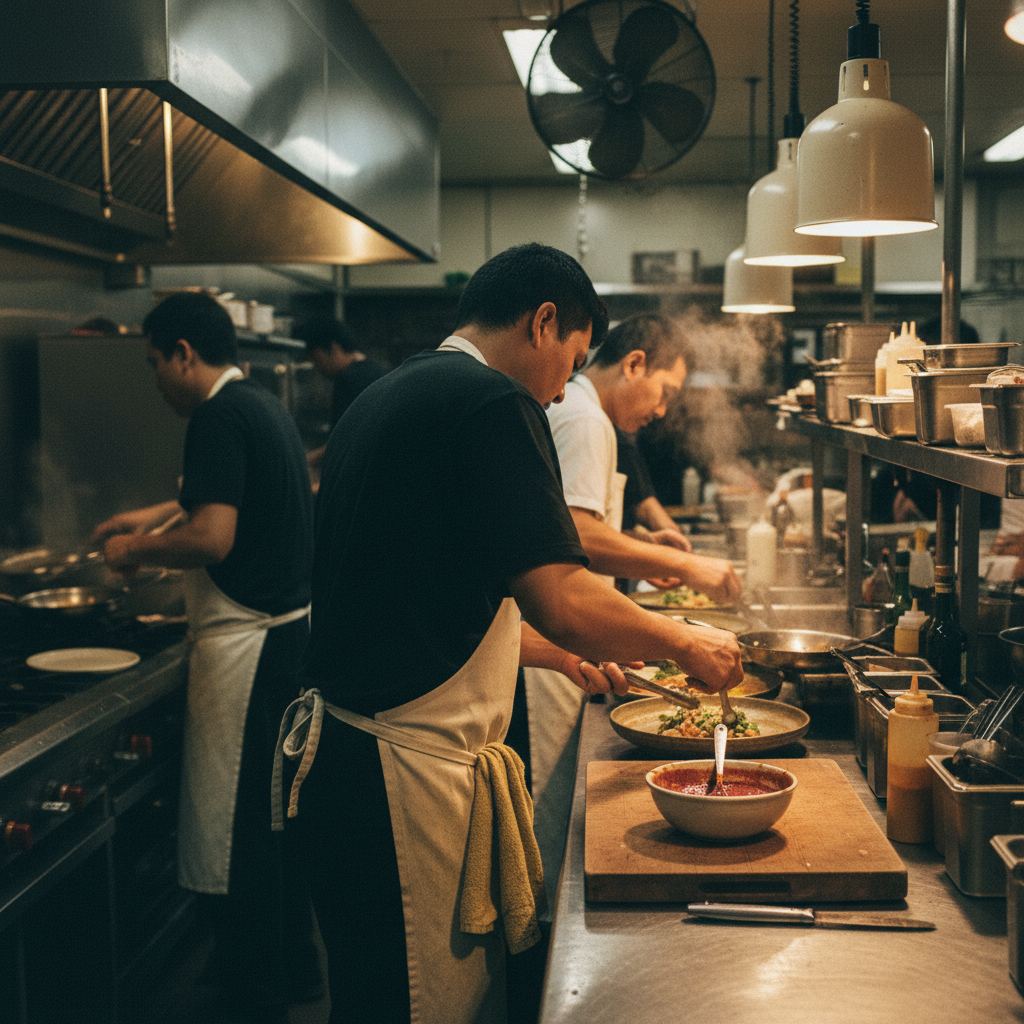
Honolulu food service. Illustration generated with AI. Not a photograph of a Foody Finance client or location.

What drives financing conversations in Honolulu

Capital often goes toward larger dry storage and freezer capacity so operators can order in bulk and absorb barge shipping schedules instead of paying premium small-batch freight rates. A second common use is bridging payroll through the slower shoulder months between peak visitor seasons.

Revenue and seasonality in Honolulu

Visitor spending in Waikiki drives high average checks but fluctuates with mainland and Japan travel seasons, while Kaimuki and Kalihi lean on local resident traffic with steadier weekday patterns. Shipping delays force short-notice menu substitutions, and a shortfall in visitor arrivals during shoulder months can strain payroll without a reserve.

What this does to your numbers

Ingredient costs run higher here because everything from outside the island travels by barge or plane before it reaches the kitchen.

Permitting in Honolulu, and what it costs to wait

The Hawaii Department of Health issues food establishment permits statewide, while liquor licensing runs through the City and County of Honolulu Liquor Commission on its own separate application and hearing schedule. A Waikiki concept planning a full bar should budget financing that covers rent through both approval tracks rather than assuming they clear together.

What the wait actually costs

The liquor commission's hearing schedule can run well past the health permit, so a bar opening can sit waiting on approval it can't rush.

What raises the cost of capital here

  • 01Barge and air freight costs for imported goods raise food cost baselines above mainland comparables
  • 02Honolulu Liquor Commission review runs separately from Hawaii DOH's statewide health permitting
  • 03Visitor arrival swings between peak and shoulder travel seasons create wider revenue gaps in Waikiki than in local neighborhoods

Which program usually fits here

A working capital line built for bulk ordering and freight timing beats a loan sized for mainland-style weekly deliveries.

Honolulu
Hawaii outline. Boundary data: US Census Bureau cartographic boundary files, public domain. Simplified for display.

Free review, no hard credit pull

Get funds now and review your options

Step 01 of 03 · Your operation

A specialist reviews every request and reaches out the same business day

Areas we serve

  • Waikiki
  • Chinatown
  • Kaka'ako
  • Kalihi
  • Kaimuki

Financing terms on this page

Definitions for the terms used above.

covers
The number of guests served. Lenders pair it with check average to judge how reliable a month really is.
shoulder season
The in between weeks on either side of your busy season. Sales fall while rent, insurance, and salaried payroll do not.
working capital
Cash for the everyday gaps: payroll, inventory, rent, and repairs. It is repaid out of daily or weekly sales rather than from one big event.
equipment paper
A loan or lease tied to a specific machine. The machine itself is the security, so approval leans on the value of the hardware more than on your bank statements.
line of credit
A preapproved pool of money you pull from only when you need it, then pay back and reuse. You pay for what you draw, not for the full amount sitting there.
draw
Taking money out of an approved line or loan. Draws tied to construction milestones mean you only start paying interest on each piece as you use it.
hard credit pull
A formal credit check that shows on your report and can move your score a few points. It happens only after you pick a specific lender, not to get information.
buildout capital
Money for the work that turns a space into a working kitchen: plumbing, electrical, hoods, walls, and permits. It pays for labor and materials you cannot resell, so it is priced differently than money for a fryer.
underwriting
The lender reading your numbers to decide how much risk you are. Bank statements, time in business, and existing debt carry the most weight.
term
How long you have to repay. A longer term lowers the monthly payment and raises what the money costs in total.

Honolulu financing questions

How does shipping to Oahu affect restaurant financing needs compared to a mainland city?

Most non-local ingredients arrive by barge or air, which adds freight cost and lead time that a mainland kitchen never has to plan around. Financing that supports larger bulk orders and backup freezer or dry storage capacity lets an operator buy ahead of price swings and avoid paying rush freight when a shipment runs late.

Does a Waikiki restaurant need financing that covers the Honolulu Liquor Commission's timeline separately from the health permit?

Yes. The Hawaii Department of Health handles the food establishment permit while the City and County of Honolulu Liquor Commission reviews alcohol applications on its own hearing calendar, and the two do not track each other. A concept counting on full bar sales from day one needs financing that covers rent and staff through whichever approval finishes last.

How does Honolulu's island geography change what lenders look for in a restaurant's supply chain?

Every non-local ingredient and most equipment arrives by container ship through Honolulu Harbor, so a restaurant's cost structure depends partly on shipping schedules rather than just supplier pricing. Lenders reviewing a Honolulu restaurant's financials look for evidence of inventory buffers and supplier diversification, since a single delayed shipment can force a menu change or a temporary closure of certain dishes. Restaurants built around fresh local fish and produce, which move through Honolulu's own distribution rather than ocean freight, generally show steadier cost patterns than concepts dependent on imported specialty goods, and that distinction shows up in how consistent their monthly margins look.

How do Honolulu food businesses start a financing conversation?

Start with a free review by a specialist. You share the basics of the business, the use of funds, and recent bank statements, and you see every program that fits before any credit application exists. Short term options commonly fund in 1 to 3 business days once you choose an offer.

Do you serve areas outside Honolulu in Hawaii?

Yes. Every program is available statewide in Hawaii and nationwide.

What is working capital, and when does it fit a Honolulu operator?

Cash for the everyday gaps, repaid out of sales on a set schedule instead of at the end of a project. Use it for payroll, inventory, a slow stretch, or a job you have to fund before the client pays you. Typical size is 10,000 to 500,000, funding runs 1 to 3 business days once you choose an offer, and you repay it as fixed daily, weekly, or monthly payment. You will be asked for: application, 3 to 6 months of bank statements.

What is equipment financing, and when does it fit a Honolulu operator?

You borrow against a specific machine, and the machine is what backs the loan. Use it when a fryer, a walk-in, an oven, or a vehicle has to be replaced and you would rather keep the cash in the account. Typical size is 5,000 to 500,000, funding runs 1 to 5 business days once you choose an offer, and you repay it as fixed monthly payment. You will be asked for: application, equipment quote, bank statements.

What is business line of credit, and when does it fit a Honolulu operator?

An approved limit you pull from only when you need it, then repay and reuse. Use it for a season you can see coming, so you draw before the peak and pay it back out of the peak. Typical size is 10,000 to 250,000, funding runs 2 to 7 business days once you choose an offer, and you repay it as interest on the drawn balance only. You will be asked for: application, bank statements.

Why does the Honolulu calendar change what I should borrow?

Ingredient costs run higher here because everything from outside the island travels by barge or plane before it reaches the kitchen.

What does waiting actually cost me in Honolulu?

The liquor commission's hearing schedule can run well past the health permit, so a bar opening can sit waiting on approval it can't rush.

Which program do most Honolulu operators end up using?

A working capital line built for bulk ordering and freight timing beats a loan sized for mainland-style weekly deliveries. That is a starting point, not a decision. The specialist review looks at your deposits, your time in business, and what the money is for before anything is recommended.

Does asking about financing in Honolulu affect my credit?

No. Getting information is a conversation, not an application. There is no credit application and no hard credit pull until you have picked a specific lender and want to move forward.

Start the conversation

Talk to a specialist before you fill out an application.

Start with a free, no-obligation review. We will send the right application only after we know what you actually qualify for.

Start a free review

Prefer to call

(833) 505-1900