Sacramento's farm-to-fork identity draws diners year round, but state government schedules and legislative recesses still create real swings in weekday lunch traffic downtown. Owners plan payroll around it.
How do Sacramento food businesses get funded?
Sacramento operators start with a free review with a specialist, share recent business bank statements, and are matched to the programs that fit the use of funds. Working capital funds in 1 to 3 business days after you choose an offer, equipment in 1 to 5, and buildout capital in 1 to 4 weeks.
Estimates, not offers: Amounts, terms, and funding times are estimates based on programs commonly available in food service. Actual terms vary by program, lender underwriting, time in business, revenue, and credit profile. Nothing here is an offer of credit or a guarantee of approval. See source and method.
How Sacramento eats, and what that does to cash
01
Where Sacramento eats
Midtown Sacramento, laid out in a numbered grid east of downtown, carries the city's densest restaurant row along J Street and 20th Street, with farm to fork bistros and cocktail bars serving state workers and young professionals at 25 to 40 dollars a plate. The Handle District and R Street corridor mix breweries and warehouse converted food halls at 12 to 20 dollars. East Sacramento and the Fab Forties neighborhood carry quieter, family oriented dining near 30 dollars per person. Downtown near the Capitol and the Golden 1 Center arena draws lunch crowds of legislative staff and pre game diners on Kings game nights, spending 15 to 30 dollars. Oak Park, once overlooked, has drawn newer counter service and coffee focused openings tied to nearby medical campuses. West Sacramento across the river holds industrial brewery and taproom space at lower rents. This spread of price points across a compact core means a Midtown opening competes on ambience while an Oak Park opening competes on value, and misjudging which lane a block sits in stalls opening week traffic.
02
Dishes and formats Sacramento is known for
Sacramento markets itself as America's Farm to Fork Capital, and menus built around Central Valley and Delta produce, with seasonal tasting menus at 40 dollars and up, are the city's signature format in Midtown and downtown. Farmers markets, including the certified market under the freeway on weekends, feed a produce forward casual dining scene. Craft brewery kitchens are common in the Handle District and along R Street, pairing pub food with house beer at 14 to 18 dollars. Food halls, including converted warehouse spaces, host multiple vendors under one roof at 10 to 16 dollars a plate. Vietnamese and Hmong food is strong in the Stockton Boulevard corridor, reflecting Sacramento's large refugee resettlement history, at 8 to 14 dollars. Patio dining runs nearly year round given the Central Valley climate outside of a short winter fog season. Because the farm to fork identity depends on produce availability tied to nearby growing seasons, a poor harvest year or early frost directly raises ingredient costs for the restaurants built around that seasonal sourcing story.
03
Sacramento's calendar
The State Capitol and state government offices anchor steady weekday lunch demand downtown year round, with a noticeable slowdown when the legislature recesses in September. The Golden 1 Center hosts the Sacramento Kings from October through April and concerts and events beyond that, driving pre and post event traffic downtown on game nights. UC Davis Medical Center and Sutter Health campuses support consistent demand near midtown and East Sacramento regardless of season. The Sacramento Farm to Fork Festival each September closes streets downtown for a multi day celebration built directly around the city's dining identity. Summer heat, June through August, pushes diners toward air conditioned indoor seating during peak Delta breeze evenings that still support patio hours after sunset. Winter tule fog, arriving December and January, can suppress evening turnout on the worst visibility nights. Because state government activity and the farm to fork tourist calendar both run heaviest outside of summer's hottest weeks, restaurant owners see their strongest months cluster in spring and fall rather than summer.
04
Growth and cost pattern in Sacramento
New restaurant openings concentrate in Midtown infill lots and the R Street Corridor's former rail and warehouse buildings, alongside continued build out in West Sacramento's Bridge District. Rent sits below the Bay Area but has risen steadily as remote California state workers and Bay Area transplants move inland, pushing Midtown lease rates above older east side neighborhoods. Older Midtown Victorian era buildings require electrical and accessibility upgrades that add unplanned buildout costs compared to newer West Sacramento shells. Labor costs track California's state minimum wage schedule, among the highest baseline wage floors in the country, which raises payroll costs uniformly regardless of neighborhood. Utility costs rise sharply in July and August as Central Valley heat drives air conditioning loads, coinciding with the state legislature's fall recess slowdown rather than offsetting it. Delta water availability affects landscaping and patio irrigation costs for outdoor seating buildouts. This combination of statewide wage floors and older building retrofit costs means Sacramento buildouts often run longer and more expensive than the moderate base rent alone would suggest.
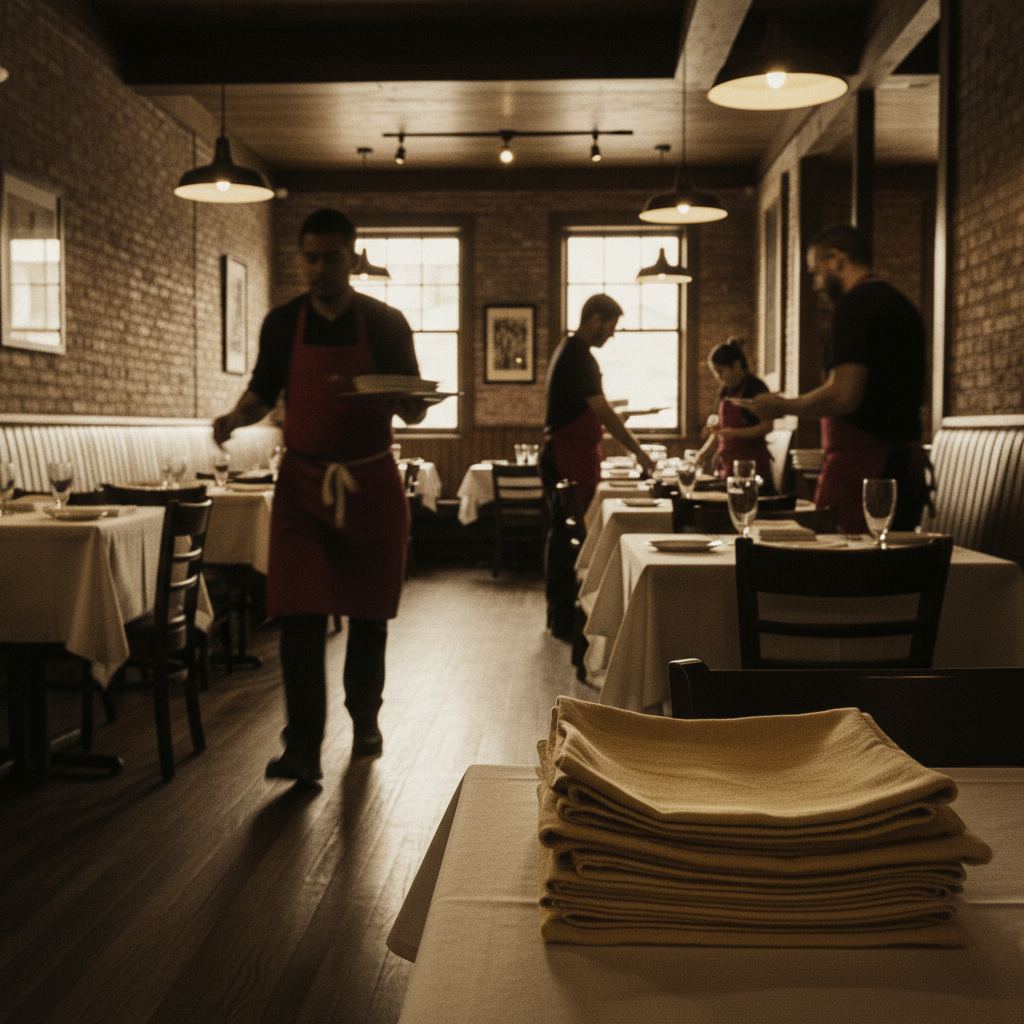
Sacramento food service. Illustration generated with AI. Not a photograph of a Foody Finance client or location.
What drives financing conversations in Sacramento
Owners often use capital to build out patio and rooftop space that takes advantage of the region's long dry season, and to cover payroll during the slower stretches when the legislature is out of session. Restaurants sourcing directly from Sacramento Valley farms also need working capital to manage seasonal produce pricing swings.
Revenue and seasonality in Sacramento
Weekday lunch near the Capitol and state office buildings holds steady most of the year, while legislative recesses and summer state holidays thin that crowd out noticeably. Dinner and weekend brunch in Midtown and East Sacramento carry more even traffic, with card payments dominating and catering invoices running on standard net terms.
What this does to your numbers
Lunch business downtown rises and falls with the state legislature's schedule, so slow recess weeks can catch a restaurant off guard.
Permitting in Sacramento, and what it costs to wait
Sacramento County Environmental Management inspects and permits food facilities, while alcohol licensing runs through the state Department of Alcoholic Beverage Control on its own separate schedule. A Midtown buildout that depends on a full liquor license should plan for that approval to trail the health permit by weeks, with rent due regardless of which one clears first.
What the wait actually costs
An older building can hide plumbing or electrical problems that stall a buildout for weeks past the original plan.
What raises the cost of capital here
01State legislative recess periods create predictable weekday lunch dips downtown.
02Older Midtown Victorian and commercial buildings often require electrical and plumbing upgrades before a kitchen buildout passes.
03Farm-to-fork sourcing from Central Valley growers means produce costs shift with harvest timing.
Which program usually fits here
A line of credit fits for smoothing out recess-driven slow weeks, while buildout financing fits for renovating an older Midtown space with unknowns built in.
California outline. Boundary data: US Census Bureau cartographic boundary files, public domain. Simplified for display.
A preapproved pool of money you pull from only when you need it, then pay back and reuse. You pay for what you draw, not for the full amount sitting there.
buildout capital
Money for the work that turns a space into a working kitchen: plumbing, electrical, hoods, walls, and permits. It pays for labor and materials you cannot resell, so it is priced differently than money for a fryer.
working capital
Cash for the everyday gaps: payroll, inventory, rent, and repairs. It is repaid out of daily or weekly sales rather than from one big event.
SBA loan
A bank loan partly guaranteed by the Small Business Administration. Lowest cost of the options, longest paperwork, and the slowest to fund.
draw
Taking money out of an approved line or loan. Draws tied to construction milestones mean you only start paying interest on each piece as you use it.
hard credit pull
A formal credit check that shows on your report and can move your score a few points. It happens only after you pick a specific lender, not to get information.
covers
The number of guests served. Lenders pair it with check average to judge how reliable a month really is.
equipment paper
A loan or lease tied to a specific machine. The machine itself is the security, so approval leans on the value of the hardware more than on your bank statements.
shoulder season
The in between weeks on either side of your busy season. Sales fall while rent, insurance, and salaried payroll do not.
term
How long you have to repay. A longer term lowers the monthly payment and raises what the money costs in total.
How does the state legislative calendar affect restaurant cash flow downtown?
Restaurants near the Capitol see a real lunch bump when the legislature is in session from January through the fall, then traffic drops during recess periods and summer. Owners in that footprint sometimes use a line of credit to smooth those gaps rather than cutting staff they will need again once session resumes.
What financing issues come up with older Midtown building conversions?
Many Midtown and East Sacramento spaces sit in Victorian-era or early 20th century commercial buildings, and converting one into a restaurant often uncovers electrical, plumbing, or grease trap work that was not part of the original plan. Buildout financing that accounts for this kind of surprise cost tends to hold up better than a budget built only around the visible renovation.
Why does the state legislature's schedule matter for Sacramento restaurant cash flow near the Capitol?
Sacramento's downtown core depends heavily on legislative staff, lobbyists, and state employees for weekday lunch and after work drink revenue. When the legislature is in session, typically January through early September with breaks, downtown restaurants see reliable weekday crowds tied to hearing schedules and floor sessions. During the fall recess and around major holidays, that foot traffic drops noticeably even though the physical office population barely changes, since fewer visitors and lobbyists come downtown. Lenders reviewing a downtown Sacramento restaurant's monthly revenue should expect a visible dip tied to the legislative calendar rather than assume it reflects declining business fundamentals.
How do Sacramento food businesses start a financing conversation?
Start with a free review by a specialist. You share the basics of the business, the use of funds, and recent bank statements, and you see every program that fits before any credit application exists. Short term options commonly fund in 1 to 3 business days once you choose an offer.
Do you serve areas outside Sacramento in California?
Yes. Every program is available statewide in California and nationwide.
What is working capital, and when does it fit a Sacramento operator?
Cash for the everyday gaps, repaid out of sales on a set schedule instead of at the end of a project. Use it for payroll, inventory, a slow stretch, or a job you have to fund before the client pays you. Typical size is 10,000 to 500,000, funding runs 1 to 3 business days once you choose an offer, and you repay it as fixed daily, weekly, or monthly payment. You will be asked for: application, 3 to 6 months of bank statements.
What is sba loans, and when does it fit a Sacramento operator?
A bank loan partly guaranteed by the Small Business Administration, which is why the payment is the lowest available. Use it when you can plan months ahead. It is the cheapest money on this page and the slowest to arrive. Typical size is 50,000 to 5,000,000, funding runs 3 to 12 weeks once you choose an offer, and you repay it as amortized interest, lowest payment of any program. You will be asked for: tax returns, interim financials, debt schedule, plan.
What is buildout and expansion, and when does it fit a Sacramento operator?
Construction money for the work that turns a space into a working kitchen, usually released in stages as the job progresses. Use it for a second location, a remodel, a patio, or a kitchen conversion, and size it to cover the permit wait, not just the build. Typical size is 50,000 to 2,000,000, funding runs 1 to 4 weeks once you choose an offer, and you repay it as fixed payment, often with a draw schedule. You will be asked for: application, contractor bids, lease, financials.
Why does the Sacramento calendar change what I should borrow?
Lunch business downtown rises and falls with the state legislature's schedule, so slow recess weeks can catch a restaurant off guard.
What does waiting actually cost me in Sacramento?
An older building can hide plumbing or electrical problems that stall a buildout for weeks past the original plan.
Which program do most Sacramento operators end up using?
A line of credit fits for smoothing out recess-driven slow weeks, while buildout financing fits for renovating an older Midtown space with unknowns built in. That is a starting point, not a decision. The specialist review looks at your deposits, your time in business, and what the money is for before anything is recommended.
Does asking about financing in Sacramento affect my credit?
No. Getting information is a conversation, not an application. There is no credit application and no hard credit pull until you have picked a specific lender and want to move forward.
Start the conversation
Talk to a specialist before you fill out an application.
Start with a free, no-obligation review. We will send the right application only after we know what you actually qualify for.