CA metro

Restaurant financing in Modesto.

Central Valley harvest cycles set the pace for local dining, and a kitchen that can't staff up fast in late summer leaves money on the table during the busiest weeks of the year.

How do Modesto food businesses get funded?

Modesto operators start with a free review with a specialist, share recent business bank statements, and are matched to the programs that fit the use of funds. Working capital funds in 1 to 3 business days after you choose an offer, equipment in 1 to 5, and buildout capital in 1 to 4 weeks.

Estimates, not offers: Amounts, terms, and funding times are estimates based on programs commonly available in food service. Actual terms vary by program, lender underwriting, time in business, revenue, and credit profile. Nothing here is an offer of credit or a guarantee of approval. See source and method.

How Modesto eats, and what that does to cash

01

Where Modesto eats

Downtown Modesto along Tenth Street and J Street holds the city's densest restaurant cluster, mixing wine bars and Mexican restaurants that draw county employees and courthouse staff for lunch and a modest evening crowd on weekends. McHenry Avenue carries a strip of chain casual dining and drive-throughs serving suburban families north of downtown, priced in the 12 to 20 dollar range. The Modesto Junior College area near Coffee Road supports a student-priced cluster of taquerias and sandwich shops. Vintage Faire Mall on the north end anchors a food court and nearby chain restaurant pad sites catering to shopping traffic. The Graceada Park and College neighborhoods hold older, family-owned Italian restaurants reflecting the city's historic Central Valley agricultural immigrant base. Modesto's restaurant economy depends heavily on a car-commuting population rather than walkable foot traffic, which pushes most independent operators toward suburban strip-mall locations with attached parking rather than downtown storefronts.
02

What Modesto actually eats

Modesto sits in California's Central Valley almond and dairy belt, and farm-to-table restaurants downtown market direct sourcing from nearby growers as a selling point, with entrees running 18 to 28 dollars. Mexican food, particularly Michoacan-style birria and taco trucks parked along Crows Landing Road, serves the city's large Latino population at 2 to 3 dollars per taco. Drive-through chains dominate McHenry Avenue, reflecting the city's spread-out, car-dependent layout. Basque-influenced steakhouses, a legacy of Central Valley sheepherding history, still operate in the area and serve family-style dinners. Breweries have opened downtown in the last decade, running kitchens serving pub food to an evening crowd on weekends. Full-service dining rooms depend heavily on Friday and Saturday night volume since weeknight downtown traffic thins out once county offices close at 5pm, concentrating most weekly revenue into a two-day window.

03

The Modesto calendar

The almond and walnut harvest from August through October drives seasonal agricultural worker payroll through Stanislaus County, lifting weekday lunch demand at counter-service spots near packing facilities. E&J Gallo Winery, headquartered in Modesto, anchors year-round corporate lunch demand downtown, with a visible dip during the last two weeks of December when the company and county offices close. The Stanislaus County Fair each July draws crowds to the fairgrounds, spiking demand for fried food vendors for its multi-day run. Modesto Junior College's fall and spring semesters support student-area restaurant traffic, dropping off during the summer break in June and July. Central Valley summer heat from June through September pushes outdoor patio dining down sharply, shifting demand toward air-conditioned dining rooms and drive-throughs and raising utility costs at the same time revenue from patio seating disappears.

04

Growth and cost in Modesto

New restaurant growth concentrates along the McHenry Avenue corridor and near Vintage Faire Mall, where large retail pad sites offer easier buildout and parking than downtown's older storefronts. Downtown Tenth Street has seen smaller independent openings tied to city redevelopment incentives, though older building stock often requires electrical and seismic upgrades that extend permitting timelines. Commercial rents remain lower than the Bay Area, roughly two hours west, but agricultural sector wage competition during harvest months from August through October pushes kitchen labor costs up as packing houses compete for the same hourly workforce. Summer utility costs spike with Central Valley heat driving air conditioning demand for dining rooms. Water costs and restrictions tied to Central Valley drought cycles have also periodically raised landscaping and outdoor patio maintenance costs for restaurants built around outdoor seating, adding an unpredictable expense line for operators depending on patio capacity.

Food service operation in Modesto
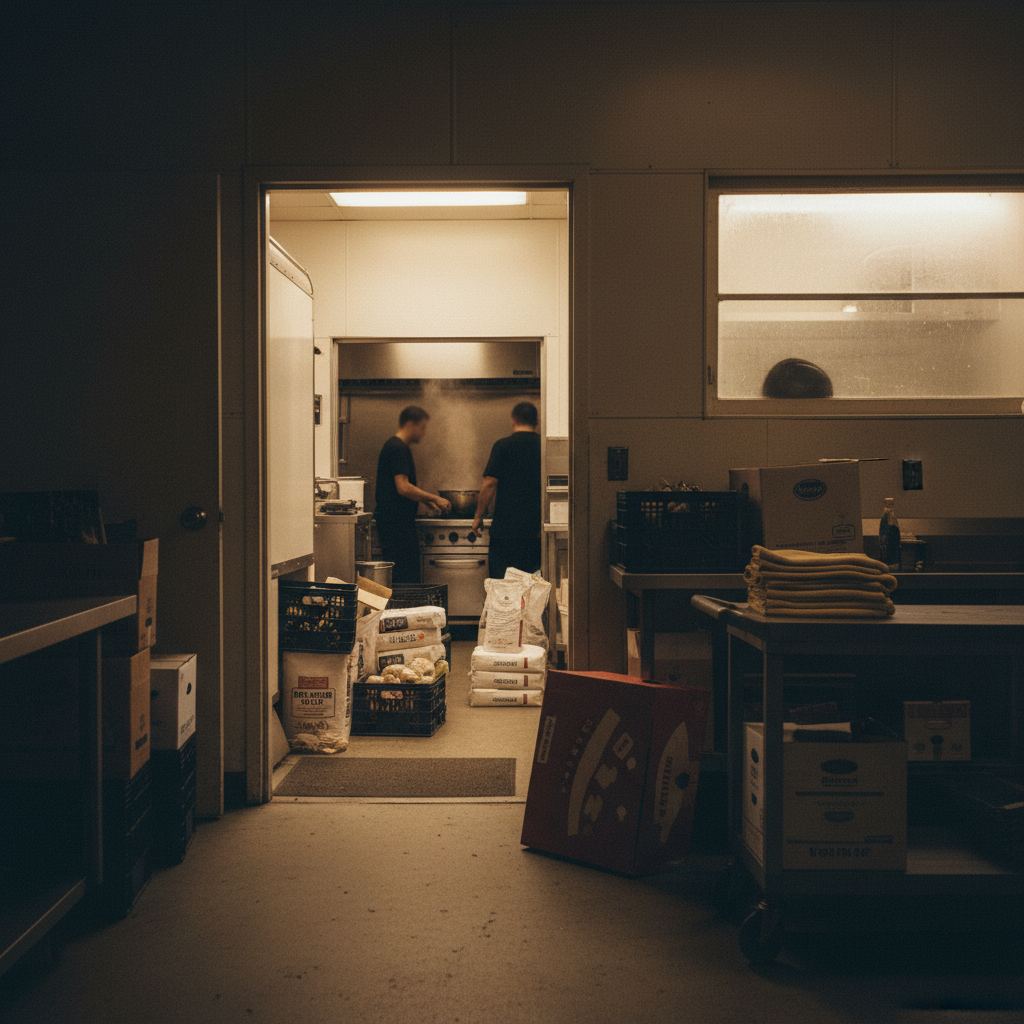
Modesto food service. Illustration generated with AI. Not a photograph of a Foody Finance client or location.

What drives financing conversations in Modesto

Financing here often funds refrigerated storage and staffing surges tied to almond and tomato harvest season, when ag workers and buyers fill local counters. Restaurants supplying banquet halls for harvest-related events also need working capital to cover payroll before those larger checks clear.

Revenue and seasonality in Modesto

Local spending follows agricultural cycles, with harvest season and almond bloom bringing seasonal workers and ag business travel that lift weekday lunch traffic. Winter months slow down outside of holiday banquet bookings, so cash flow planning has to bridge the gap between a strong August and a quiet February.

What this does to your numbers

Business picks up hard during harvest season and slows down in winter, so you need to save some of that summer money to get through the quiet months.

Permitting in Modesto, and what it costs to wait

Stanislaus County Environmental Health issues and inspects food facility permits, running independently from City of Modesto planning and fire review for tenant improvements. A build-out in an older downtown storefront can face plumbing or grease trap retrofits that surface only after county inspection, adding cost mid-project that a financing plan should anticipate.

What the wait actually costs

If an inspector finds an old plumbing problem in your building, you keep paying rent while it gets fixed before you can open.

What raises the cost of capital here

  • 01Harvest season staffing surges strain payroll cash before ag-linked revenue arrives
  • 02Older downtown buildings often need grease trap or plumbing retrofits county inspectors catch late
  • 03Winter slowdown outside holiday banquets requires reserves built during harvest peaks

Which program usually fits here

A cash advance or working capital loan helps you staff up fast before harvest season hits, since regular loan approval can be too slow to catch the rush.

Modesto
California outline. Boundary data: US Census Bureau cartographic boundary files, public domain. Simplified for display.

Free review, no hard credit pull

Get funds now and review your options

Step 01 of 03 · Your operation

A specialist reviews every request and reaches out the same business day

Areas we serve

  • Downtown Modesto
  • McHenry Village
  • Village One
  • Sylvan
  • Riverbank border

Financing terms on this page

Definitions for the terms used above.

merchant cash advance
You sell a slice of future card sales for cash today. Fastest money available, and the most expensive, so it fits an emergency rather than a plan.
working capital
Cash for the everyday gaps: payroll, inventory, rent, and repairs. It is repaid out of daily or weekly sales rather than from one big event.
buildout capital
Money for the work that turns a space into a working kitchen: plumbing, electrical, hoods, walls, and permits. It pays for labor and materials you cannot resell, so it is priced differently than money for a fryer.
equipment paper
A loan or lease tied to a specific machine. The machine itself is the security, so approval leans on the value of the hardware more than on your bank statements.
factor rate
A flat multiplier instead of an interest rate. Borrow 50,000 at a 1.25 factor and you repay 62,500 total, no matter how fast you pay it off.
hard credit pull
A formal credit check that shows on your report and can move your score a few points. It happens only after you pick a specific lender, not to get information.
draw
Taking money out of an approved line or loan. Draws tied to construction milestones mean you only start paying interest on each piece as you use it.
covers
The number of guests served. Lenders pair it with check average to judge how reliable a month really is.
underwriting
The lender reading your numbers to decide how much risk you are. Bank statements, time in business, and existing debt carry the most weight.
term
How long you have to repay. A longer term lowers the monthly payment and raises what the money costs in total.
shoulder season
The in between weeks on either side of your busy season. Sales fall while rent, insurance, and salaried payroll do not.

Modesto financing questions

Why does harvest season change how a Modesto restaurant should finance staffing?

Almond and tomato harvest brings a temporary population of ag workers and buyers who eat out more, and restaurants near processing routes see a real lunch and dinner bump for a few months. Working capital that lets an owner add cooks and servers ahead of that bump, rather than after ticket counts already climbed, captures more of the season.

What permitting surprise hits older downtown Modesto buildings?

Storefronts converted decades ago for other uses often lack a code-compliant grease trap or adequate sewer line for food service, and Stanislaus County Environmental Health flags this during inspection rather than during city permitting. Buildout financing should include a contingency for plumbing work discovered after the lease is already signed.

How does the almond and walnut harvest season affect Modesto restaurant staffing?

Stanislaus County's almond and walnut harvest runs roughly August through October and draws a large temporary agricultural workforce into Modesto and surrounding towns, and this workforce competes directly with restaurants for hourly kitchen and prep labor during those months. Some counter-service operators near packing facilities see a lunch traffic bump from harvest workers, while others struggle to staff shifts as wages rise seasonally to match agricultural pay. Lenders should expect Modesto restaurant labor costs to show a measurable seasonal spike from August through October distinct from the broader summer heat pattern affecting utility costs across the same period.

How do Modesto food businesses start a financing conversation?

Start with a free review by a specialist. You share the basics of the business, the use of funds, and recent bank statements, and you see every program that fits before any credit application exists. Short term options commonly fund in 1 to 3 business days once you choose an offer.

Do you serve areas outside Modesto in California?

Yes. Every program is available statewide in California and nationwide.

What is working capital, and when does it fit a Modesto operator?

Cash for the everyday gaps, repaid out of sales on a set schedule instead of at the end of a project. Use it for payroll, inventory, a slow stretch, or a job you have to fund before the client pays you. Typical size is 10,000 to 500,000, funding runs 1 to 3 business days once you choose an offer, and you repay it as fixed daily, weekly, or monthly payment. You will be asked for: application, 3 to 6 months of bank statements.

What is equipment financing, and when does it fit a Modesto operator?

You borrow against a specific machine, and the machine is what backs the loan. Use it when a fryer, a walk-in, an oven, or a vehicle has to be replaced and you would rather keep the cash in the account. Typical size is 5,000 to 500,000, funding runs 1 to 5 business days once you choose an offer, and you repay it as fixed monthly payment. You will be asked for: application, equipment quote, bank statements.

What is merchant cash advance, and when does it fit a Modesto operator?

You sell a slice of future card sales for money today, repaid as the card volume arrives. Use it only when speed decides the outcome. It is the fastest option here and the most expensive one. Typical size is 5,000 to 250,000, funding runs 1 to 3 business days once you choose an offer, and you repay it as factor rate, highest total cost. You will be asked for: application, bank and processing statements.

Why does the Modesto calendar change what I should borrow?

Business picks up hard during harvest season and slows down in winter, so you need to save some of that summer money to get through the quiet months.

What does waiting actually cost me in Modesto?

If an inspector finds an old plumbing problem in your building, you keep paying rent while it gets fixed before you can open.

Which program do most Modesto operators end up using?

A cash advance or working capital loan helps you staff up fast before harvest season hits, since regular loan approval can be too slow to catch the rush. That is a starting point, not a decision. The specialist review looks at your deposits, your time in business, and what the money is for before anything is recommended.

Does asking about financing in Modesto affect my credit?

No. Getting information is a conversation, not an application. There is no credit application and no hard credit pull until you have picked a specific lender and want to move forward.

Start the conversation

Talk to a specialist before you fill out an application.

Start with a free, no-obligation review. We will send the right application only after we know what you actually qualify for.

Start a free review

Prefer to call

(833) 505-1900