Glendale's dense mix of Armenian, Filipino, and Korean dining traditions gives the city an unusually specific customer base, and equipment sourcing for those cuisines often costs more than a generic kitchen build.
How do Glendale food businesses get funded?
Glendale operators start with a free review with a specialist, share recent business bank statements, and are matched to the programs that fit the use of funds. Working capital funds in 1 to 3 business days after you choose an offer, equipment in 1 to 5, and buildout capital in 1 to 4 weeks.
Estimates, not offers: Amounts, terms, and funding times are estimates based on programs commonly available in food service. Actual terms vary by program, lender underwriting, time in business, revenue, and credit profile. Nothing here is an offer of credit or a guarantee of approval. See source and method.
How Glendale eats, and what that does to cash
01
Where Glendale eats
The Americana at Brand and adjacent Brand Boulevard carry Glendale's highest-visibility retail dining, with chain and upscale-casual restaurants paying mall-anchored rent and drawing shoppers and families on weekend outings. Downtown Glendale's Brand Boulevard core also holds a dense strip of Armenian, Middle Eastern, and Persian restaurants and bakeries serving the city's large Armenian population, with lunch counters and bakeries doing steady weekday trade rather than weekend spikes. Kenneth Village, a smaller commercial strip near Glenoaks and Kenneth Road, holds neighborhood cafes and family-run restaurants at lower rent than Brand Boulevard. Montrose, technically part of Glendale, runs its own walkable strip on Honolulu Avenue with a farmers market on Sundays and boutique restaurants catering to a foothill-adjacent, higher-income crowd. Adams Hill and the area near Glendale Community College draw a student and staff lunch crowd on weekdays. A restaurant on Brand Boulevard near the Americana competes for foot traffic against national chains with corporate lease terms, while a Kenneth Village storefront runs on thinner margins but faces less rent pressure, a split that shapes which format an operator can actually afford to open.
02
What Glendale orders
Armenian and Middle Eastern food defines Glendale's specific identity: lahmajun, soujouk, and kebab plates from bakeries and grills along Brand Boulevard and Colorado Street, many run as counter-service operations with 10 to 15 dollar plate pricing. Raffi's Place and other rotisserie chicken spots built the Glendale-style whole-chicken-and-rice format that has since spread across Los Angeles County. Persian restaurants serving koobideh and joojeh kebab cluster near the civic center. The Americana at Brand carries food-hall-adjacent quick-service chains and sit-down restaurants with patio seating built around the central fountain, aimed at a family and date-night crowd. Bakery cases with Armenian pastries like gata and paklava turn over as much on takeout dessert orders as on sit-down traffic. Counter-service Armenian grills depend on rotisserie and charcoal-grill equipment that runs continuously through lunch and dinner, and a broken rotisserie motor or grill line during a Friday dinner rush costs a full night of the week's highest-margin sales rather than a slow trickle.
03
The calendar that runs Glendale
Disney's Grand Central Creative Campus and other entertainment-industry offices in Glendale, along with Nestle USA's former headquarters presence and DreamWorks Animation nearby, anchor weekday lunch demand tied to studio production schedules rather than tourism seasons. Glendale Community College's fall and spring semesters drive a campus-adjacent lunch crowd that drops off in summer and over winter break. Armenian community calendar dates, including Armenian Genocide Remembrance Day on April 24 and Armenian Christmas in early January, bring family gatherings and catering orders to Armenian restaurants and bakeries that outside operators do not see reflected in national holiday calendars. The Americana at Brand runs a heavy holiday season from Thanksgiving through New Year's with extended mall hours pulling evening dinner traffic. Summer brings fewer swings than in tourist-dependent cities, since Glendale's dining base is largely local and office-driven. A studio production hiatus or a slow development season at nearby entertainment offices can quietly thin out weekday lunch covers for restaurants that built their staffing around a five-day office crowd.
04
Growth and cost pattern
New restaurant space in Glendale opens most often in mixed-use developments along Brand Boulevard and around the Americana, where landlords require build-to-suit finishes and often ask for percentage rent tied to sales on top of base rent. Kenneth Village and Montrose offer older, smaller storefronts with lower base rent but frequently need full kitchen retrofits since many buildings previously housed retail rather than food service. Los Angeles County health permitting and Glendale's own fire and building inspections add review cycles that can stretch a buildout timeline by several months beyond the contractor's original schedule. Labor costs track the broader Los Angeles County minimum wage and health-care ordinance requirements, which run higher than in most of California's inland cities. Parking is scarce on Brand Boulevard outside the Americana's structured garage, and restaurants without dedicated parking often pay for validation deals with nearby lots, an ongoing operating cost rather than a one-time buildout expense. A percentage-rent lease tied to a slow opening quarter means the landlord's share rises just as the new restaurant's own cash reserves are lowest.
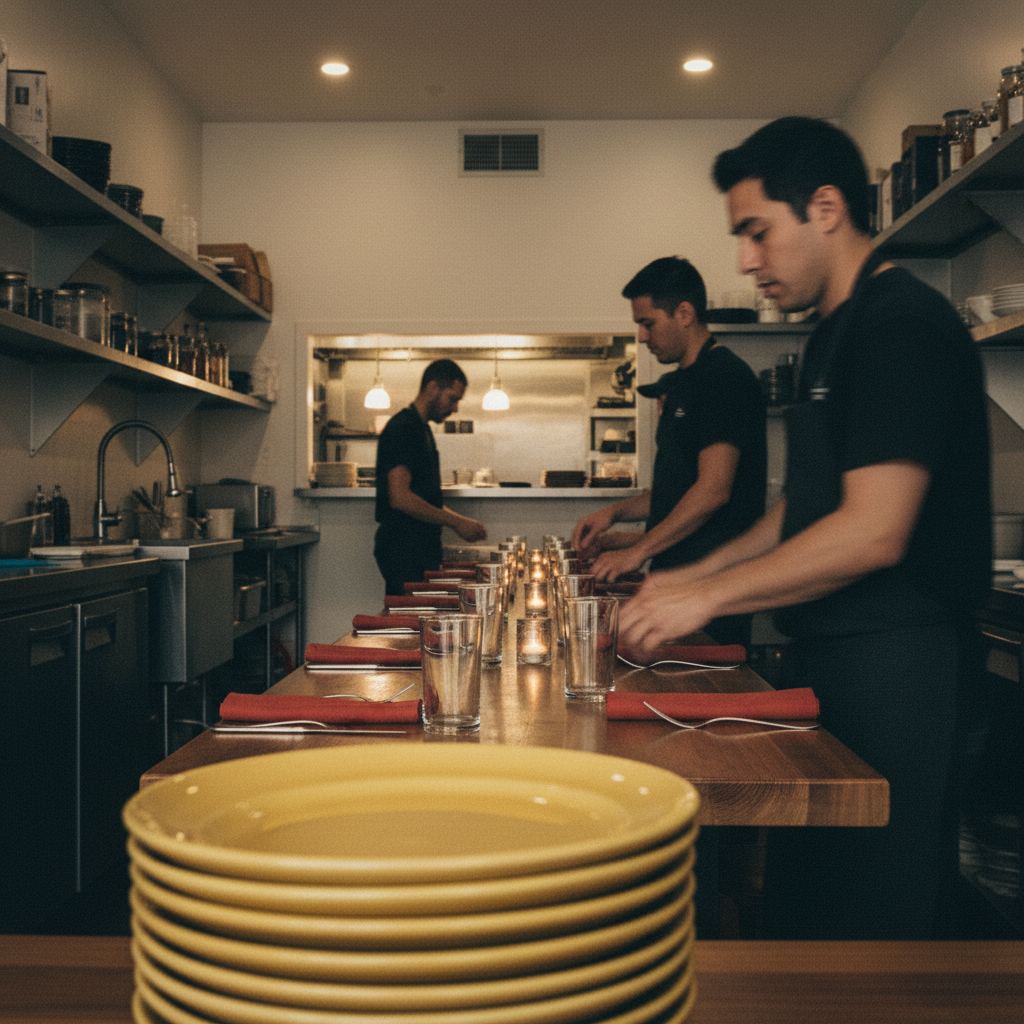
Glendale food service. Illustration generated with AI. Not a photograph of a Foody Finance client or location.
What drives financing conversations in Glendale
Financing here frequently covers specialty equipment such as tandir ovens, Korean barbecue ventilation systems, or larger walk-in storage for cuisine-specific ingredient sourcing that a standard kitchen buildout doesn't include. Restaurants near the Americana at Brand and downtown Glendale also need working capital to staff up for evening and weekend retail-driven foot traffic.
Revenue and seasonality in Glendale
Foot traffic around the Americana at Brand and downtown retail corridors drives strong evening and weekend volume, while neighborhood spots in areas like Montrose rely more on steady local repeat business. Specialty grocery and ingredient costs for Armenian, Korean, and Filipino menus can run higher than a generic American concept, which tightens margins even when ticket counts are strong.
What this does to your numbers
Evenings and weekends near the shopping district bring in the most business, while ingredient costs for specialty menus can eat into what you keep.
Permitting in Glendale, and what it costs to wait
Los Angeles County Environmental Health issues and inspects food facility permits for Glendale, apart from city planning and fire review for tenant improvements, and specialty ventilation systems for barbecue or wood-fired cooking often require additional fire department sign-off beyond a standard hood system. A buildout involving custom ventilation should budget extra weeks for that added fire review before opening.
What the wait actually costs
Installing special ventilation for barbecue or wood-fired cooking can add extra fire department review time before you can open.
What raises the cost of capital here
01Specialty ventilation for barbecue or wood-fired cooking requires added fire department sign-off
03Americana at Brand foot traffic concentrates revenue into evening and weekend hours
Which program usually fits here
Equipment financing fits best for the specialized ovens or ventilation these cuisines need, since that equipment costs more than a standard kitchen build.
California outline. Boundary data: US Census Bureau cartographic boundary files, public domain. Simplified for display.
A loan or lease tied to a specific machine. The machine itself is the security, so approval leans on the value of the hardware more than on your bank statements.
buildout capital
Money for the work that turns a space into a working kitchen: plumbing, electrical, hoods, walls, and permits. It pays for labor and materials you cannot resell, so it is priced differently than money for a fryer.
draw
Taking money out of an approved line or loan. Draws tied to construction milestones mean you only start paying interest on each piece as you use it.
working capital
Cash for the everyday gaps: payroll, inventory, rent, and repairs. It is repaid out of daily or weekly sales rather than from one big event.
hard credit pull
A formal credit check that shows on your report and can move your score a few points. It happens only after you pick a specific lender, not to get information.
covers
The number of guests served. Lenders pair it with check average to judge how reliable a month really is.
underwriting
The lender reading your numbers to decide how much risk you are. Bank statements, time in business, and existing debt carry the most weight.
shoulder season
The in between weeks on either side of your busy season. Sales fall while rent, insurance, and salaried payroll do not.
term
How long you have to repay. A longer term lowers the monthly payment and raises what the money costs in total.
Why does a Korean barbecue restaurant in Glendale need different equipment financing than a typical restaurant?
Tabletop grill ventilation systems for Korean barbecue require higher-capacity exhaust than a standard kitchen hood, and installing one often triggers additional fire department review beyond the county health permit. Equipment financing for this kind of buildout should account for both the higher equipment cost and the extra weeks that added fire sign-off can add.
Does being near the Americana at Brand actually help a nearby restaurant's revenue?
Restaurants within walking distance of the Americana and downtown Glendale retail corridor see a real lift in evening and weekend foot traffic from shoppers and moviegoers, but that traffic is concentrated in specific hours rather than spread evenly across the week. Staffing and inventory financing should be sized around those peak windows rather than an average daily estimate.
How does Glendale's Armenian business community affect restaurant financing?
Many Glendale restaurants are family-owned businesses with capital and labor drawn from an extended Armenian community network rather than institutional financing alone, and some carry informal family loans alongside bank debt. Lenders evaluating these businesses should expect co-signers or guarantors who are relatives rather than business partners, and should ask directly about any informal debt outstanding, since it may not appear on a standard credit pull but still affects the household's true monthly obligations and the restaurant's real capacity to take on additional debt.
How do Glendale food businesses start a financing conversation?
Start with a free review by a specialist. You share the basics of the business, the use of funds, and recent bank statements, and you see every program that fits before any credit application exists. Short term options commonly fund in 1 to 3 business days once you choose an offer.
Do you serve areas outside Glendale in California?
Yes. Every program is available statewide in California and nationwide.
What is equipment financing, and when does it fit a Glendale operator?
You borrow against a specific machine, and the machine is what backs the loan. Use it when a fryer, a walk-in, an oven, or a vehicle has to be replaced and you would rather keep the cash in the account. Typical size is 5,000 to 500,000, funding runs 1 to 5 business days once you choose an offer, and you repay it as fixed monthly payment. You will be asked for: application, equipment quote, bank statements.
What is buildout and expansion, and when does it fit a Glendale operator?
Construction money for the work that turns a space into a working kitchen, usually released in stages as the job progresses. Use it for a second location, a remodel, a patio, or a kitchen conversion, and size it to cover the permit wait, not just the build. Typical size is 50,000 to 2,000,000, funding runs 1 to 4 weeks once you choose an offer, and you repay it as fixed payment, often with a draw schedule. You will be asked for: application, contractor bids, lease, financials.
What is working capital, and when does it fit a Glendale operator?
Cash for the everyday gaps, repaid out of sales on a set schedule instead of at the end of a project. Use it for payroll, inventory, a slow stretch, or a job you have to fund before the client pays you. Typical size is 10,000 to 500,000, funding runs 1 to 3 business days once you choose an offer, and you repay it as fixed daily, weekly, or monthly payment. You will be asked for: application, 3 to 6 months of bank statements.
Why does the Glendale calendar change what I should borrow?
Evenings and weekends near the shopping district bring in the most business, while ingredient costs for specialty menus can eat into what you keep.
What does waiting actually cost me in Glendale?
Installing special ventilation for barbecue or wood-fired cooking can add extra fire department review time before you can open.
Which program do most Glendale operators end up using?
Equipment financing fits best for the specialized ovens or ventilation these cuisines need, since that equipment costs more than a standard kitchen build. That is a starting point, not a decision. The specialist review looks at your deposits, your time in business, and what the money is for before anything is recommended.
Does asking about financing in Glendale affect my credit?
No. Getting information is a conversation, not an application. There is no credit application and no hard credit pull until you have picked a specific lender and want to move forward.
Start the conversation
Talk to a specialist before you fill out an application.
Start with a free, no-obligation review. We will send the right application only after we know what you actually qualify for.