Cincinnati's food identity runs through its chili parlors and Findlay Market vendors, and restaurant traffic downtown tracks the Reds and Bengals schedules closely.
How do Cincinnati food businesses get funded?
Cincinnati operators start with a free review with a specialist, share recent business bank statements, and are matched to the programs that fit the use of funds. Working capital funds in 1 to 3 business days after you choose an offer, equipment in 1 to 5, and buildout capital in 1 to 4 weeks.
Estimates, not offers: Amounts, terms, and funding times are estimates based on programs commonly available in food service. Actual terms vary by program, lender underwriting, time in business, revenue, and credit profile. Nothing here is an offer of credit or a guarantee of approval. See source and method.
How Cincinnati eats, and what that does to cash
01
Where Cincinnati eats
Over-the-Rhine along Vine Street and Findlay Market carries the city's highest-density restaurant and nightlife corridor, mixing $30-plus tasting menus with counter-service stalls inside Findlay Market itself. Mount Adams sits above downtown with patio bars and mid-priced Italian and American menus drawing a slightly older, higher-spending crowd. Northside on Hamilton Avenue holds a younger, lower-price scene of dive bars, vegan kitchens, and brunch spots under $20 a plate. Hyde Park Square and Oakley serve suburban families with $20 to $35 sit-down dinners and heavy weekend brunch volume. Downtown near the Banks development between Great American Ball Park and Paul Brown Stadium runs almost entirely on Reds and Bengals game-day traffic, with slow weekday lunch outside of office worker volume from Procter & Gamble and Fifth Third Bank headquarters nearby.
02
What Cincinnati serves
Cincinnati-style chili, served over spaghetti at chains like Skyline Chili and Gold Star as well as independent parlors, is the city's signature dish and typically runs $6 to $10 a plate, a price point that has held steady for decades. Goetta, a German-derived pork and oat sausage, appears on brunch menus across the east side and in Findlay Market butcher stalls. Findlay Market itself functions as the city's food hall equivalent, with a mix of butchers, produce stalls, and prepared-food counters rather than a single developer-built hall. Craft brewery kitchens have expanded through Over-the-Rhine's historic brewery district, pairing $12 to $18 pub food with on-site beer production. LaRosa's pizza, a regional chain, anchors family dining across the suburbs at similar price points to the chili parlors. Because chili parlors and goetta kitchens depend on a narrow set of regional suppliers, any disruption to that supply chain hits menu consistency and cost immediately.
03
Cincinnati's calendar
Procter & Gamble, Kroger, and Fifth Third Bank headquarters downtown anchor weekday lunch traffic year-round, giving Cincinnati steadier office-driven demand than cities with less corporate density downtown. The Cincinnati Reds season runs April through September at Great American Ball Park, and the Bengals' NFL season runs September through January at Paycor Stadium, together keeping the Banks and downtown busy across three seasons. The Cincinnati Music Festival and Taste of Cincinnati each draw large summer crowds downtown, with Taste of Cincinnati over Memorial Day weekend concentrating a single high-volume weekend for food vendors. Oktoberfest Zinzinnati each September, one of the largest such festivals in the country, brings a dense weekend of beer hall and sausage vendor volume downtown. The gap between football season ending in January and baseball season starting in April creates a predictable late-winter lull for restaurants near the stadiums.
04
Growth and cost in Cincinnati
New restaurant openings continue to concentrate in Over-the-Rhine, where historic tax credit renovations of 19th-century buildings have added apartment units and street-level retail space over the past decade. Northside and Walnut Hills are secondary growth corridors with lower buildout costs than Over-the-Rhine's now-competitive real estate. Commercial rent in Over-the-Rhine has risen substantially as the neighborhood has filled in, pushing newer operators toward Walnut Hills and Camp Washington instead. Ohio's statewide minimum wage keeps base labor costs moderate compared to coastal cities, though Cincinnati's tipped-employee market wages have risen with competition for kitchen staff. Historic building code compliance in Over-the-Rhine, including facade and structural requirements tied to tax credit rules, adds review time that regularly delays buildout completion and pushes back a new restaurant's first month of revenue.
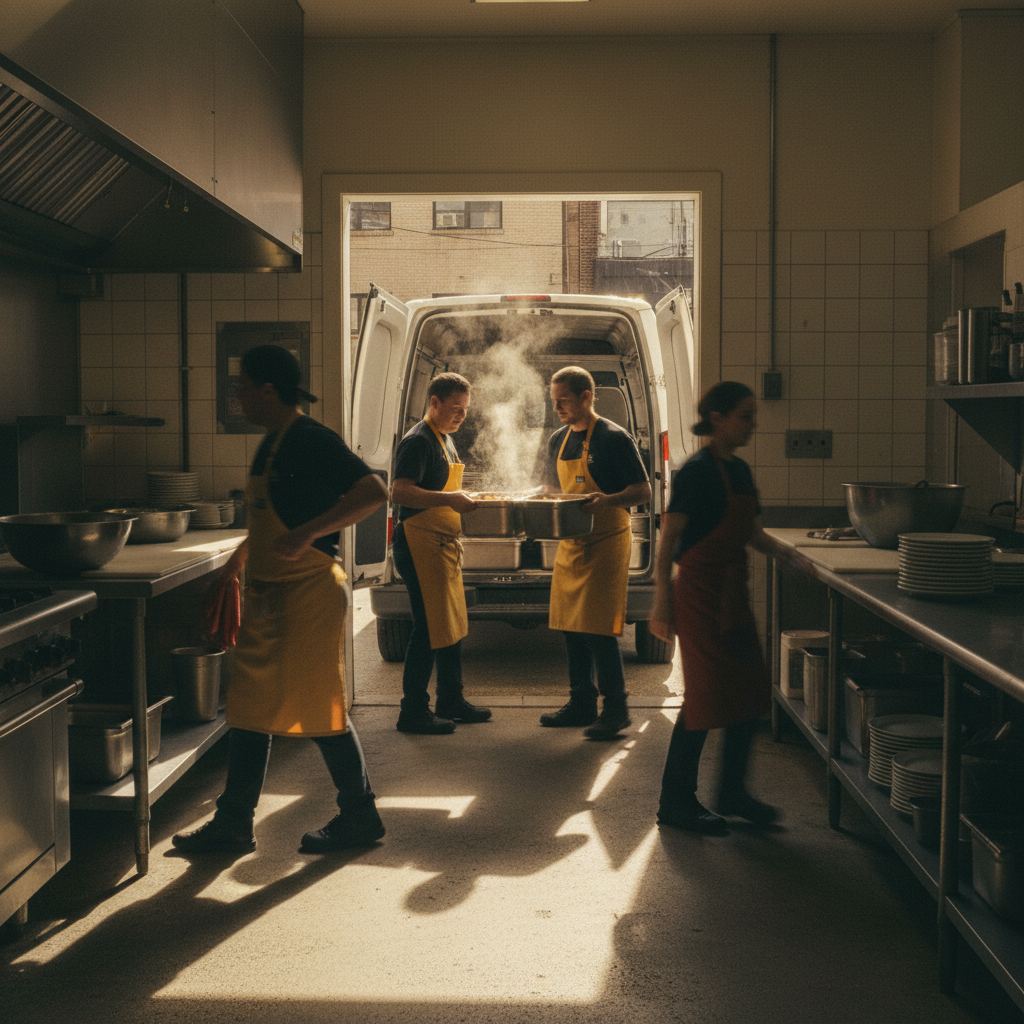
Cincinnati food service. Illustration generated with AI. Not a photograph of a Foody Finance client or location.
What drives financing conversations in Cincinnati
Capital here often funds kitchen equipment built for high-volume, fast-turn concepts like chili parlors alongside slower buildouts for full-service restaurants in neighborhoods like Over-the-Rhine. Game-day staffing and inventory needs near the riverfront also draw on working capital tied to the Reds' and Bengals' overlapping seasons.
Revenue and seasonality in Cincinnati
Over-the-Rhine and riverfront spots see surges tied to Reds and Bengals game days, while Hyde Park and Oakley carry steadier neighborhood dinner traffic year-round. Ohio River flooding in wetter months can disrupt riverfront business, and game-day-dependent concepts need reserves for weeks between home stands.
What this does to your numbers
Game days near downtown bring in a real spike in business, but the weeks without a home game go back to a much quieter normal.
Permitting in Cincinnati, and what it costs to wait
Hamilton County Public Health handles food facility inspection for most of Cincinnati while alcohol licensing runs through the Ohio Division of Liquor Control, a state agency with its own separate review queue. A riverfront concept aiming for an opening timed to baseball season should have financing that covers rent if the state liquor permit lands after Opening Day rather than before it.
What the wait actually costs
The state liquor permit can take longer than the buildout, which can push an opening past a target date like Reds Opening Day.
What raises the cost of capital here
01Ohio Division of Liquor Control review runs as a separate state-level step from Hamilton County's local health permitting
02Overlapping Reds and Bengals seasons concentrate riverfront and Over-the-Rhine revenue into specific weeks
03Periodic Ohio River flooding can disrupt riverfront-adjacent business access and deliveries in wetter months
Which program usually fits here
A working capital line sized around the actual home-game calendar fits better than a loan based on an average month.
Ohio outline. Boundary data: US Census Bureau cartographic boundary files, public domain. Simplified for display.
The number of guests served. Lenders pair it with check average to judge how reliable a month really is.
working capital
Cash for the everyday gaps: payroll, inventory, rent, and repairs. It is repaid out of daily or weekly sales rather than from one big event.
term
How long you have to repay. A longer term lowers the monthly payment and raises what the money costs in total.
equipment paper
A loan or lease tied to a specific machine. The machine itself is the security, so approval leans on the value of the hardware more than on your bank statements.
buildout capital
Money for the work that turns a space into a working kitchen: plumbing, electrical, hoods, walls, and permits. It pays for labor and materials you cannot resell, so it is priced differently than money for a fryer.
draw
Taking money out of an approved line or loan. Draws tied to construction milestones mean you only start paying interest on each piece as you use it.
hard credit pull
A formal credit check that shows on your report and can move your score a few points. It happens only after you pick a specific lender, not to get information.
underwriting
The lender reading your numbers to decide how much risk you are. Bank statements, time in business, and existing debt carry the most weight.
Why would a new Cincinnati bar near the riverfront need financing that covers a delayed liquor license?
Ohio's Division of Liquor Control reviews alcohol permits at the state level, separate from Hamilton County's food facility inspection, and the two rarely finish together. A concept aiming to open in time for Reds Opening Day or the start of Bengals season should have financing that covers rent and staff wages in case the state permit arrives later than the buildout does.
How does the Reds and Bengals schedule change cash flow for Over-the-Rhine restaurants?
Home game dates for both teams push heavy short-term traffic into Over-the-Rhine and riverfront-adjacent spots, while the weeks without a home game see volume drop back to a normal neighborhood level. A concept that budgets off game-day averages alone can underestimate how much cash it needs during the gaps between home stands.
Why do Cincinnati chili parlors post such consistent numbers compared to other restaurant categories in the city?
Cincinnati-style chili parlors, including regional chains like Skyline and Gold Star along with independents, sell a narrow low-price menu that has not changed format in decades, and that consistency shows up as flatter, more predictable weekly deposit patterns than sit-down restaurants tied to Reds or Bengals game schedules. These parlors draw local repeat customers rather than event traffic, so they see less swing around football's January to April gap. Lenders reviewing a chili parlor's financials should expect narrower month-to-month variance than a downtown restaurant near the Banks.
How do Cincinnati food businesses start a financing conversation?
Start with a free review by a specialist. You share the basics of the business, the use of funds, and recent bank statements, and you see every program that fits before any credit application exists. Short term options commonly fund in 1 to 3 business days once you choose an offer.
Do you serve areas outside Cincinnati in Ohio?
Yes. Every program is available statewide in Ohio and nationwide.
What is equipment financing, and when does it fit a Cincinnati operator?
You borrow against a specific machine, and the machine is what backs the loan. Use it when a fryer, a walk-in, an oven, or a vehicle has to be replaced and you would rather keep the cash in the account. Typical size is 5,000 to 500,000, funding runs 1 to 5 business days once you choose an offer, and you repay it as fixed monthly payment. You will be asked for: application, equipment quote, bank statements.
What is working capital, and when does it fit a Cincinnati operator?
Cash for the everyday gaps, repaid out of sales on a set schedule instead of at the end of a project. Use it for payroll, inventory, a slow stretch, or a job you have to fund before the client pays you. Typical size is 10,000 to 500,000, funding runs 1 to 3 business days once you choose an offer, and you repay it as fixed daily, weekly, or monthly payment. You will be asked for: application, 3 to 6 months of bank statements.
What is buildout and expansion, and when does it fit a Cincinnati operator?
Construction money for the work that turns a space into a working kitchen, usually released in stages as the job progresses. Use it for a second location, a remodel, a patio, or a kitchen conversion, and size it to cover the permit wait, not just the build. Typical size is 50,000 to 2,000,000, funding runs 1 to 4 weeks once you choose an offer, and you repay it as fixed payment, often with a draw schedule. You will be asked for: application, contractor bids, lease, financials.
Why does the Cincinnati calendar change what I should borrow?
Game days near downtown bring in a real spike in business, but the weeks without a home game go back to a much quieter normal.
What does waiting actually cost me in Cincinnati?
The state liquor permit can take longer than the buildout, which can push an opening past a target date like Reds Opening Day.
Which program do most Cincinnati operators end up using?
A working capital line sized around the actual home-game calendar fits better than a loan based on an average month. That is a starting point, not a decision. The specialist review looks at your deposits, your time in business, and what the money is for before anything is recommended.
Does asking about financing in Cincinnati affect my credit?
No. Getting information is a conversation, not an application. There is no credit application and no hard credit pull until you have picked a specific lender and want to move forward.
Start the conversation
Talk to a specialist before you fill out an application.
Start with a free, no-obligation review. We will send the right application only after we know what you actually qualify for.