A restaurant downtown near the Electric Works redevelopment can see a slow build in weekday traffic while surrounding construction continues for years. The rent still comes due every month regardless of how the block is progressing.
How do Fort Wayne food businesses get funded?
Fort Wayne operators start with a free review with a specialist, share recent business bank statements, and are matched to the programs that fit the use of funds. Working capital funds in 1 to 3 business days after you choose an offer, equipment in 1 to 5, and buildout capital in 1 to 4 weeks.
Estimates, not offers: Amounts, terms, and funding times are estimates based on programs commonly available in food service. Actual terms vary by program, lender underwriting, time in business, revenue, and credit profile. Nothing here is an offer of credit or a guarantee of approval. See source and method.
How Fort Wayne eats, and what that does to cash
01
Where Fort Wayne eats
The Landing, a downtown warehouse district along Columbia Street, has been revitalized into a brewery and restaurant corridor serving a mixed crowd of downtown workers and evening visitors. West Central, next to Parkview Field, carries restaurants and bars that depend heavily on TinCaps baseball crowds walking over on game nights from April through September. The Broadway and Bluffton Road corridor on the south side is chain-heavy casual dining serving surrounding neighborhoods. Georgetown, on the northeast side, mixes suburban chain restaurants with a handful of longtime family-owned diners. The Electric Works redevelopment, built on the former General Electric campus west of downtown, is adding new mixed-use restaurant space as that historic industrial site is converted. The downtown Grand Wayne Convention Center adds occasional multi-day event traffic distinct from the TinCaps' game-by-game draw. A West Central restaurant that depends on TinCaps game-night walk-ins sees a direct, visible drop in nightly receipts on any evening the team is on the road rather than playing at Parkview Field.
02
What Fort Wayne actually orders
Coney dogs, hot dogs topped with a meat-based chili sauce, are a regional Midwest staple found across Fort Wayne's diners and counter-service spots. The breaded pork tenderloin sandwich, a pounded and fried cutlet served oversized on a small bun, is the signature dish of Indiana more broadly and appears on nearly every casual menu in the city. Parkview Field's concession stands run a distinct ballpark food-service format from April through September that has no equivalent revenue stream the rest of the year. Brewery kitchens along The Landing serve a food-hall-adjacent format, pairing simple shareable menus with locally brewed beer rather than full sit-down dinners. Drive-thru format dominates the Coliseum Boulevard and Illinois Road commercial corridors on the north side. Foellinger-Freimann Botanical Conservatory and the nearby arts campus add a smaller steady weekday visitor base downtown. A pork tenderloin sandwich shop relying on a single specialty item sees demand hold steady year-round, but a ballpark concession operator at Parkview Field earns nearly all of its annual revenue in a single six-month stretch, leaving the October-through-March off-season with no comparable income to cover fixed lease costs.
03
The calendar that carries Fort Wayne
The Fort Wayne TinCaps, a minor league baseball team playing at Parkview Field downtown, run their season from April through September and are the single largest driver of West Central and downtown foot traffic during those months. General Electric's historic presence, now continued through the Electric Works redevelopment, and Sweetwater Sound's large campus on the southwest side both support steady weekday lunch demand tied to corporate payroll rather than seasonal events. The Three Rivers Festival each July draws a large citywide crowd downtown for a single week. Purdue University Fort Wayne's academic calendar shapes demand near its northeast side campus, with the usual summer and winter break slowdowns. Older Broadway corridor storefronts require similar, if smaller-scale, code upgrades before a full kitchen buildout can proceed. January and February are the quietest months citywide, with the TinCaps season months away and no major festival to draw crowds, and restaurants that maintain full staffing through that stretch see labor costs run ahead of the thin winter revenue.
04
Growth and cost pattern in Fort Wayne
New restaurant activity concentrates along The Landing downtown and in the Electric Works redevelopment on the former General Electric campus west of downtown. Electric Works' historic industrial buildings require extensive retrofit work to bring century-old electrical and structural systems up to code for restaurant use, adding cost and time beyond what a standard suburban shell would require. Downtown and West Central restaurants compete for staff with the suburban Dupont Road corridor's newer, higher-volume chain restaurants, which can offer more predictable hours. Commercial rent downtown runs below many comparably sized Midwest cities, giving new restaurants a lower fixed-cost entry point even as buildout costs in historic buildings run higher. Utility costs are moderate, though winter heating demand adds a predictable seasonal cost from December through February. A restaurant securing early space in the Electric Works redevelopment faces the same risk as any large historic retrofit project: unexpected structural or electrical findings during construction can push the opening date well past the originally budgeted timeline, straining pre-opening cash reserves.
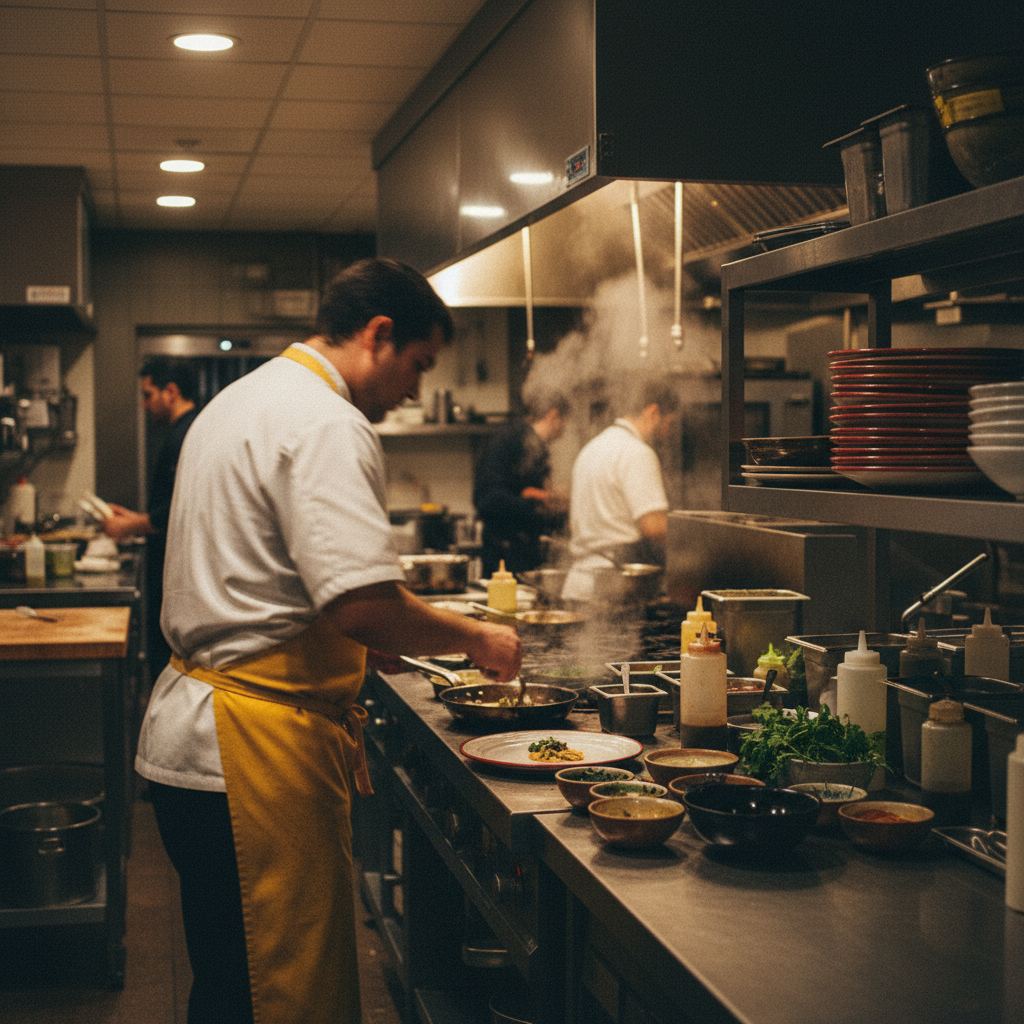
Fort Wayne food service. Illustration generated with AI. Not a photograph of a Foody Finance client or location.
What drives financing conversations in Fort Wayne
Money here often goes toward build-outs in redeveloping industrial space like Electric Works, where adapting a former factory building for food service carries higher costs than a standard retail shell. Fort Wayne's manufacturing and healthcare employer base supports steady weekday lunch demand that working capital plans build around through slower winter months. Financing needs to cover both the added cost of adaptive reuse construction and the gradual ramp-up while a redeveloping area builds its customer base.
Revenue and seasonality in Fort Wayne
Downtown Fort Wayne and The Landing district draw weekday lunch traffic from the city's manufacturing, healthcare, and insurance employers, while South Wayne and Georgetown rely more on steady neighborhood dining. Winter weather in northeast Indiana cuts into weekend covers, and because redeveloping areas like Electric Works are still building their resident and worker base, a new restaurant there may need more time than usual to reach the volume its lease was underwritten against.
What this does to your numbers
A restaurant in a redeveloping area like Electric Works may need more time to build up steady traffic than a spot in an established part of town.
Permitting in Fort Wayne, and what it costs to wait
The Allen County Department of Health issues food service permits for Fort Wayne restaurants, while the Indiana Alcohol and Tobacco Commission handles liquor licensing through a separate state process that includes a local board review. Adaptive reuse projects in older industrial buildings like Electric Works or in The Landing district often require additional structural and fire code work tied to their original non-restaurant use. Rent on these renovated spaces frequently starts before every inspection needed for both food and alcohol service is complete.
What the wait actually costs
If the local liquor board hearing gets scheduled well after the build-out finishes, you're paying rent on a space that can't serve alcohol yet.
What raises the cost of capital here
01Indiana Alcohol and Tobacco Commission licensing includes a local board review beyond the standard state application.
02Adaptive reuse of former industrial buildings like Electric Works often requires added structural and fire code work.
03Redeveloping districts take time to build a stable resident and worker base that can support projected sales volume.
Which program usually fits here
A buildout and expansion loan fits the extra cost of converting older industrial space, giving the business room to ramp up before the loan term catches up to full sales.
Indiana outline. Boundary data: US Census Bureau cartographic boundary files, public domain. Simplified for display.
Taking money out of an approved line or loan. Draws tied to construction milestones mean you only start paying interest on each piece as you use it.
covers
The number of guests served. Lenders pair it with check average to judge how reliable a month really is.
underwriting
The lender reading your numbers to decide how much risk you are. Bank statements, time in business, and existing debt carry the most weight.
buildout capital
Money for the work that turns a space into a working kitchen: plumbing, electrical, hoods, walls, and permits. It pays for labor and materials you cannot resell, so it is priced differently than money for a fryer.
term
How long you have to repay. A longer term lowers the monthly payment and raises what the money costs in total.
equipment paper
A loan or lease tied to a specific machine. The machine itself is the security, so approval leans on the value of the hardware more than on your bank statements.
working capital
Cash for the everyday gaps: payroll, inventory, rent, and repairs. It is repaid out of daily or weekly sales rather than from one big event.
hard credit pull
A formal credit check that shows on your report and can move your score a few points. It happens only after you pick a specific lender, not to get information.
Why does opening a restaurant in Electric Works involve different costs than a standalone building in Fort Wayne?
Electric Works is a converted former General Electric manufacturing campus, and adapting that kind of industrial space for food service typically requires structural, electrical, and fire code upgrades that a purpose-built retail shell wouldn't need, which adds to the build-out budget before the health and alcohol permits can even be finalized.
Does Fort Wayne's liquor license process involve more than the state application?
Yes. The Indiana Alcohol and Tobacco Commission requires a local board recommendation in addition to the state-level review, and scheduling that local hearing can add time beyond what the Allen County Department of Health's food permit process requires on its own.
Why does the TinCaps' April-through-September season matter more to a Fort Wayne restaurant than most Midwest minor league teams matter to their cities?
Parkview Field sits directly downtown next to West Central, close enough that fans routinely walk to nearby restaurants and bars before and after games rather than eating only at ballpark concessions. This makes the TinCaps schedule a more direct driver of downtown Fort Wayne's restaurant traffic than a stadium located farther from the commercial core would be. Lenders reviewing a West Central or downtown restaurant's monthly deposits should expect a visible lift on game nights and a corresponding flatness during October through March when the team is not playing, and that pattern reflects the stadium's location rather than any weakness in the business.
How do Fort Wayne food businesses start a financing conversation?
Start with a free review by a specialist. You share the basics of the business, the use of funds, and recent bank statements, and you see every program that fits before any credit application exists. Short term options commonly fund in 1 to 3 business days once you choose an offer.
Do you serve areas outside Fort Wayne in Indiana?
Yes. Every program is available statewide in Indiana and nationwide.
What is buildout and expansion, and when does it fit a Fort Wayne operator?
Construction money for the work that turns a space into a working kitchen, usually released in stages as the job progresses. Use it for a second location, a remodel, a patio, or a kitchen conversion, and size it to cover the permit wait, not just the build. Typical size is 50,000 to 2,000,000, funding runs 1 to 4 weeks once you choose an offer, and you repay it as fixed payment, often with a draw schedule. You will be asked for: application, contractor bids, lease, financials.
What is equipment financing, and when does it fit a Fort Wayne operator?
You borrow against a specific machine, and the machine is what backs the loan. Use it when a fryer, a walk-in, an oven, or a vehicle has to be replaced and you would rather keep the cash in the account. Typical size is 5,000 to 500,000, funding runs 1 to 5 business days once you choose an offer, and you repay it as fixed monthly payment. You will be asked for: application, equipment quote, bank statements.
What is working capital, and when does it fit a Fort Wayne operator?
Cash for the everyday gaps, repaid out of sales on a set schedule instead of at the end of a project. Use it for payroll, inventory, a slow stretch, or a job you have to fund before the client pays you. Typical size is 10,000 to 500,000, funding runs 1 to 3 business days once you choose an offer, and you repay it as fixed daily, weekly, or monthly payment. You will be asked for: application, 3 to 6 months of bank statements.
Why does the Fort Wayne calendar change what I should borrow?
A restaurant in a redeveloping area like Electric Works may need more time to build up steady traffic than a spot in an established part of town.
What does waiting actually cost me in Fort Wayne?
If the local liquor board hearing gets scheduled well after the build-out finishes, you're paying rent on a space that can't serve alcohol yet.
Which program do most Fort Wayne operators end up using?
A buildout and expansion loan fits the extra cost of converting older industrial space, giving the business room to ramp up before the loan term catches up to full sales. That is a starting point, not a decision. The specialist review looks at your deposits, your time in business, and what the money is for before anything is recommended.
Does asking about financing in Fort Wayne affect my credit?
No. Getting information is a conversation, not an application. There is no credit application and no hard credit pull until you have picked a specific lender and want to move forward.
Start the conversation
Talk to a specialist before you fill out an application.
Start with a free, no-obligation review. We will send the right application only after we know what you actually qualify for.