Indianapolis restaurants schedule around the Indy 500 and the Big Ten and NCAA event calendar downtown, then spend the rest of the year on steady but unremarkable local traffic.
How do Indianapolis food businesses get funded?
Indianapolis operators start with a free review with a specialist, share recent business bank statements, and are matched to the programs that fit the use of funds. Working capital funds in 1 to 3 business days after you choose an offer, equipment in 1 to 5, and buildout capital in 1 to 4 weeks.
Estimates, not offers: Amounts, terms, and funding times are estimates based on programs commonly available in food service. Actual terms vary by program, lender underwriting, time in business, revenue, and credit profile. Nothing here is an offer of credit or a guarantee of approval. See source and method.
How Indianapolis eats, and what that does to cash
01
Where Indianapolis eats
Massachusetts Avenue, known locally as Mass Ave, runs a dense strip of chef-driven restaurants and theaters downtown, drawing a 25 to 50 crowd paying 20 to 35 dollars per entree on weekend nights. Fountain Square, southeast of downtown, mixes dive bars, a bowling alley, and independent kitchens aimed at a younger, price-conscious base. Broad Ripple, north along the Monon Trail, runs bars and late-night counter service tied to a college-age and young-professional crowd, loud on weekends and quiet midweek. Fletcher Place, adjacent to Fountain Square, has filled in with breweries and coffee-forward cafes serving nearby apartment residents rather than visitors. The Wholesale District downtown, near Monument Circle and Lucas Oil Stadium, depends on Colts games, Pacers games, and convention traffic for its heaviest volume, going quiet on non-event weekdays. Irvington, on the east side, holds an older residential district with family-oriented restaurants serving longtime homeowners rather than nightlife seekers. These districts pull from different customer bases on different clocks, so a Broad Ripple late-night concept moved downtown would misjudge its weekday traffic entirely, and that misjudgment shows up as an underperforming lunch shift.
02
What Indianapolis actually orders
The breaded pork tenderloin sandwich, a cutlet pounded thin and fried larger than its bun, is the city's defining dish and a menu fixture from diners to gastropubs. Sugar cream pie, associated with the state more broadly, appears as a dessert staple at Indianapolis bakeries and diners. Sun King Brewing and other local breweries run taproom kitchens pairing beer with counter-order food across Fletcher Place and downtown. The City Market downtown houses a food hall format with multiple small vendors sharing overhead, a lower-barrier entry point for new operators. Coney dogs and tenderloin counters run a fast, low-ticket format, typically 6 to 10 dollars, common near factory and warehouse districts on the east and west sides. Speedway-adjacent food stands run a fairground format built for a single massive week of volume rather than year-round trade. Ethnic groceries and restaurants along 38th Street and Lafayette Road serve a growing immigrant population with lower average tickets than downtown. This mix of a signature low-cost sandwich and a single-event fairground format means kitchen volume can swing from a quiet Tuesday to a Race Day surge within the same calendar month.
03
The Indianapolis calendar
The Indianapolis 500, run over Memorial Day weekend at the Indianapolis Motor Speedway, brings a monthlong buildup through May that peaks with race weekend, generating the single largest tourism spike of the year for west-side and downtown restaurants. Gen Con, held each August at the Indiana Convention Center, fills downtown hotels and restaurants with tens of thousands of tabletop gaming attendees over a single four-day weekend. The Indianapolis Colts' fall home schedule, roughly eight or nine Sundays from September through January, drives Wholesale District bar and restaurant revenue on game days. The Indiana Pacers' NBA season, running October through April at Gainbridge Fieldhouse downtown, adds weeknight event traffic through the winter months that football alone does not cover. Butler University and IUPUI add smaller academic-calendar demand near their respective campuses. January and February, after the holidays and before May's race buildup, are the quietest stretch for west-side and Speedway-adjacent operators specifically. That combination of a single race weekend, a single convention weekend, and a long football and basketball season means revenue concentrates into a handful of predictable peak weeks rather than spreading evenly.
04
Growth and cost in Indianapolis
New restaurant openings have concentrated in Fountain Square and Fletcher Place, where older industrial buildings have converted to lower-cost restaurant space compared to a built-out Mass Ave. The Bottleworks District, a former Coca-Cola bottling plant redeveloped near Mass Ave, has added a food hall and hotel drawing new operators willing to pay premium rent for guaranteed foot traffic. Rent along Mass Ave has climbed over the past decade, pushing newer independent concepts toward Irvington and the near-east side for lower square-footage costs. Labor supply draws on Butler University and Ivy Tech students, but that pool tightens each May when the Indianapolis 500's month-long event schedule pulls hospitality workers toward higher-paying stadium and hospitality shifts. Winter construction delays are common for exterior buildout work given Indiana's cold, wet stretch from December through February. Eli Lilly's downtown expansion has added weekday lunch demand but also pushed competition for skilled trades needed for restaurant buildouts. Utility costs spike in both summer cooling and winter heating given Indiana's continental climate swings. Together, May's Indy 500 labor pull and Mass Ave's rising rent are pushing new restaurant investment toward Fountain Square and Irvington, and that shift is extending buildout timelines for anyone still targeting the central corridor.
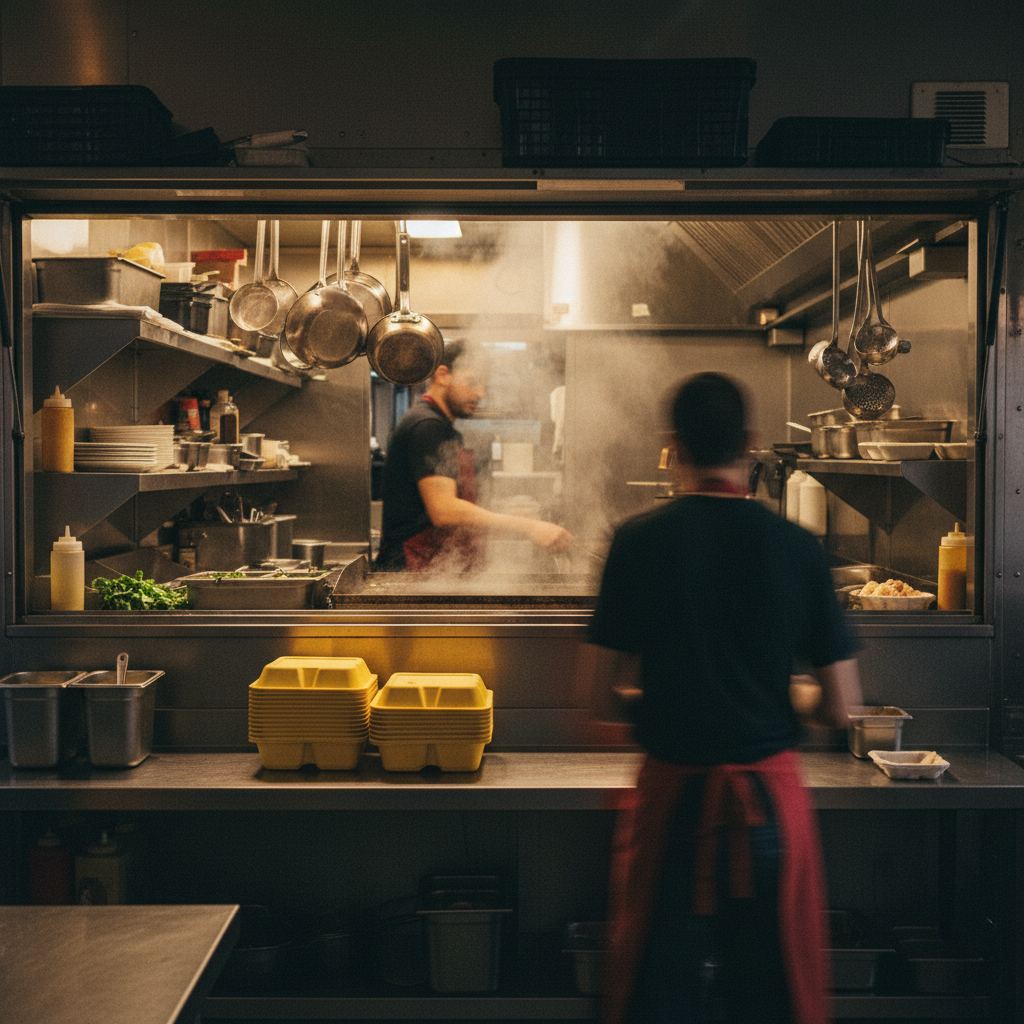
Indianapolis food service. Illustration generated with AI. Not a photograph of a Foody Finance client or location.
What drives financing conversations in Indianapolis
Capital typically funds catering equipment and banquet capacity tied to convention and sports tourism downtown, plus kitchen upgrades in Fountain Square and Broad Ripple aimed at a younger nightlife crowd. Mass Ave's dense restaurant row adds competitive pressure that pushes owners toward faster equipment turnover than a slower market would require.
Revenue and seasonality in Indianapolis
Memorial Day weekend and the Indy 500 draw a short, intense surge in downtown traffic, while major convention bookings at the Indiana Convention Center fill gaps through the rest of the year. Neighborhood spots in Broad Ripple and Fountain Square rely more on steady weekend nightlife than tourist spikes, so cash flow planning differs sharply by location.
What this does to your numbers
A few days in May around the 500 can matter more to your year than a slow month in February.
Permitting in Indianapolis, and what it costs to wait
The Marion County Public Health Department issues food service permits separately from the city's Department of Business and Neighborhood Services, which handles construction and occupancy, and downtown addresses near convention venues sometimes face added fire marshal review for banquet capacity. Indiana's alcohol permit process through the state excise office runs on its own clock, which can leave a finished dining room waiting to pour.
What the wait actually costs
If your building needs extra fire safety review for bigger crowds, you might be ready to open but not able to seat everyone yet.
What raises the cost of capital here
01Indy 500 weekend concentrates a large share of annual downtown tourism revenue into a few days each May.
02Convention Center bookings create uneven demand that shifts month to month rather than following a fixed season.
03Indiana's separate state alcohol permit process can delay bar revenue after a buildout is otherwise finished.
Which program usually fits here
Working capital smooths the gaps between convention bookings, while equipment financing keeps banquet capacity ready when the calendar fills.
Indiana outline. Boundary data: US Census Bureau cartographic boundary files, public domain. Simplified for display.
Taking money out of an approved line or loan. Draws tied to construction milestones mean you only start paying interest on each piece as you use it.
working capital
Cash for the everyday gaps: payroll, inventory, rent, and repairs. It is repaid out of daily or weekly sales rather than from one big event.
equipment paper
A loan or lease tied to a specific machine. The machine itself is the security, so approval leans on the value of the hardware more than on your bank statements.
SBA loan
A bank loan partly guaranteed by the Small Business Administration. Lowest cost of the options, longest paperwork, and the slowest to fund.
hard credit pull
A formal credit check that shows on your report and can move your score a few points. It happens only after you pick a specific lender, not to get information.
buildout capital
Money for the work that turns a space into a working kitchen: plumbing, electrical, hoods, walls, and permits. It pays for labor and materials you cannot resell, so it is priced differently than money for a fryer.
covers
The number of guests served. Lenders pair it with check average to judge how reliable a month really is.
underwriting
The lender reading your numbers to decide how much risk you are. Bank statements, time in business, and existing debt carry the most weight.
term
How long you have to repay. A longer term lowers the monthly payment and raises what the money costs in total.
How much does Indy 500 weekend matter for restaurant revenue downtown?
Memorial Day weekend and the days around the Indy 500 draw a concentrated surge of visitors downtown, and many restaurants near the Canal District and Mass Ave plan staffing and inventory around that week specifically. Because the spike is short, a loan structured around one flat monthly average misses how much of the year's tourism revenue lands in that single stretch.
Why does a downtown Indianapolis buildout sometimes need extra fire marshal review?
Restaurants and event spaces near the Indiana Convention Center or other banquet-capacity venues can trigger additional fire marshal review tied to occupancy limits, separate from the standard Marion County Public Health food service permit. That review adds time before a large-capacity dining room can open at full capacity, which matters most for spaces counting on convention traffic.
How does the Indianapolis 500 affect restaurant cash flow across the city?
West-side and Speedway-adjacent restaurants can see a large share of their annual revenue concentrated into the month of May, peaking with Memorial Day weekend, while January and February carry the least. Downtown and Mass Ave operators feel a separate spike each August from Gen Con and a longer, steadier lift from the Colts and Pacers seasons. A lender reviewing an Indianapolis restaurant's statements should identify which of these calendars a location actually depends on, since a west-side location keyed to race season will show a very different monthly pattern than a downtown convention-district address.
How do Indianapolis food businesses start a financing conversation?
Start with a free review by a specialist. You share the basics of the business, the use of funds, and recent bank statements, and you see every program that fits before any credit application exists. Short term options commonly fund in 1 to 3 business days once you choose an offer.
Do you serve areas outside Indianapolis in Indiana?
Yes. Every program is available statewide in Indiana and nationwide.
What is working capital, and when does it fit a Indianapolis operator?
Cash for the everyday gaps, repaid out of sales on a set schedule instead of at the end of a project. Use it for payroll, inventory, a slow stretch, or a job you have to fund before the client pays you. Typical size is 10,000 to 500,000, funding runs 1 to 3 business days once you choose an offer, and you repay it as fixed daily, weekly, or monthly payment. You will be asked for: application, 3 to 6 months of bank statements.
What is equipment financing, and when does it fit a Indianapolis operator?
You borrow against a specific machine, and the machine is what backs the loan. Use it when a fryer, a walk-in, an oven, or a vehicle has to be replaced and you would rather keep the cash in the account. Typical size is 5,000 to 500,000, funding runs 1 to 5 business days once you choose an offer, and you repay it as fixed monthly payment. You will be asked for: application, equipment quote, bank statements.
What is sba loans, and when does it fit a Indianapolis operator?
A bank loan partly guaranteed by the Small Business Administration, which is why the payment is the lowest available. Use it when you can plan months ahead. It is the cheapest money on this page and the slowest to arrive. Typical size is 50,000 to 5,000,000, funding runs 3 to 12 weeks once you choose an offer, and you repay it as amortized interest, lowest payment of any program. You will be asked for: tax returns, interim financials, debt schedule, plan.
Why does the Indianapolis calendar change what I should borrow?
A few days in May around the 500 can matter more to your year than a slow month in February.
What does waiting actually cost me in Indianapolis?
If your building needs extra fire safety review for bigger crowds, you might be ready to open but not able to seat everyone yet.
Which program do most Indianapolis operators end up using?
Working capital smooths the gaps between convention bookings, while equipment financing keeps banquet capacity ready when the calendar fills. That is a starting point, not a decision. The specialist review looks at your deposits, your time in business, and what the money is for before anything is recommended.
Does asking about financing in Indianapolis affect my credit?
No. Getting information is a conversation, not an application. There is no credit application and no hard credit pull until you have picked a specific lender and want to move forward.
Start the conversation
Talk to a specialist before you fill out an application.
Start with a free, no-obligation review. We will send the right application only after we know what you actually qualify for.