Jacksonville's footprint stretches across five county-sized council districts, so a single kitchen remodel can trigger three separate inspection calendars before a grand opening date holds.
How do Jacksonville food businesses get funded?
Jacksonville operators start with a free review with a specialist, share recent business bank statements, and are matched to the programs that fit the use of funds. Working capital funds in 1 to 3 business days after you choose an offer, equipment in 1 to 5, and buildout capital in 1 to 4 weeks.
Estimates, not offers: Amounts, terms, and funding times are estimates based on programs commonly available in food service. Actual terms vary by program, lender underwriting, time in business, revenue, and credit profile. Nothing here is an offer of credit or a guarantee of approval. See source and method.
How Jacksonville eats, and what that does to cash
01
Where Jacksonville eats
Riverside and Avondale carry the dinner and brunch trade along Park Street and King Street, drawing a 30 to 55 age band willing to pay 18 to 30 dollars per entree. San Marco holds a walkable square of bistros and wine bars near the fountain, favoring date-night and after-work spending from downtown professionals. Springfield, just north of downtown, has filled in with lower-cost taprooms and diners tied to its historic housing stock, pulling a younger, budget-conscious base. The Jacksonville Beaches, split among Jacksonville Beach, Neptune Beach, and Atlantic Beach, run on oceanfront bars, seafood shacks, and late-night counter service tied to tourist and surf traffic rather than office workers. Downtown, near Hemming Park and the stadium district, depends on Jaguars game days and weekday lunch crowds, with few kitchens staying open past 9pm on non-event nights. Five Points in Riverside adds a dense strip of counter-service spots aimed at students and service-industry regulars on their own schedules. These districts do not share customers or hours, so a concept built for beach tourist volume reads different foot traffic downtown, and that mismatch shows up first as slow weekday revenue.
02
What Jacksonville actually orders
Mayport shrimp, pulled straight off boats at the Mayport Village docks, anchors seafood counters and dockside shacks priced from 12 to 22 dollars a plate. Minorcan datil pepper shows up in chowders and hot sauces across local kitchens, a Northeast Florida signature drawn from St. Augustine's Minorcan settlers. Barbecue trailers and smokehouses run counter service with plates in the 10 to 18 dollar range, common near industrial corridors and beach parking lots alike. Cuban and Puerto Rican counter spots cluster near Arlington and the Southside, serving lunch-plate specials under 12 dollars to a working crowd on tight breaks. Beach bars along First Street run a drive-up and patio format built for tourists and surfers, with kitchens open late on weekends but closing early midweek in the off-season. Food halls have started appearing downtown and in Riverside, bundling several vendors under one roof to spread rent across smaller kitchens. Brewery kitchens in Riverside and Murray Hill pair small-batch beer with counter-order food for a 20-something crowd. This mix means equipment and staffing needs swing hard between a shrimp-boat plate and a brewery flatbread, and that swing drives uneven food cost location to location.
03
The Jacksonville calendar
The Florida-Georgia game, held at EverBank Stadium the last weekend of October or first weekend of November, floods downtown and Riverside with a single weekend of outsized volume that restaurants staff up for months ahead. Naval Station Mayport and Naval Air Station Jacksonville anchor payroll for thousands of sailors and civilian contractors, feeding steady lunch and weekend family traffic near the Southside and Mayport corridors. The Jaguars' fall home schedule, roughly eight Sundays from September through December, drives downtown bar revenue on game days and leaves it flat the rest of the week. CSX and the Port of Jacksonville support weekday office lunch demand downtown, though remote work has thinned that crowd since 2020. Beach season runs March through Labor Day, with spring break in March and July Fourth weekend as the two heaviest stretches for the Beaches district. Hurricane season, June through November, brings storm closures and evacuation orders that can shut coastal kitchens for days without notice. January and February are the quietest stretch citywide outside of game weekends. That mix of a single mega-weekend, a military payroll base, and hurricane shutdown risk means revenue can swing sharply between a record Saturday and a forced week of closure.
04
Growth and cost in Jacksonville
New restaurant openings concentrate in Riverside, San Marco, and the growing Southside corridor near St. Johns Town Center, where rooftops have expanded fastest. Downtown redevelopment around the Shipyards and Lot J has drawn planned dining space, though buildout there has moved slower than announced timelines suggested. Flood zone requirements near the St. Johns River add engineering and insurance costs for any space close to Riverside, San Marco, or the Southbank, raising buildout budgets before a kitchen opens. Labor competition from the Beaches' tourist economy pulls line cooks and servers from downtown and Southside operators each summer, tightening staffing just as inland demand should be steady. Utility costs run higher in summer with heavy air conditioning loads needed to keep dining rooms and walk-ins stable through Jacksonville's humid stretch from May through September. Commercial rent in San Marco and Avondale has climbed as those districts filled in, pushing new concepts toward Murray Hill and Springfield for lower square-footage costs. Hurricane-rated construction requirements for coastal-adjacent buildouts add permitting time beyond what inland projects face. Together, flood-zone insurance and hurricane-rated buildout requirements push opening costs and timelines higher than a comparable inland city, and that gap shows up as delayed openings and higher capital draws.
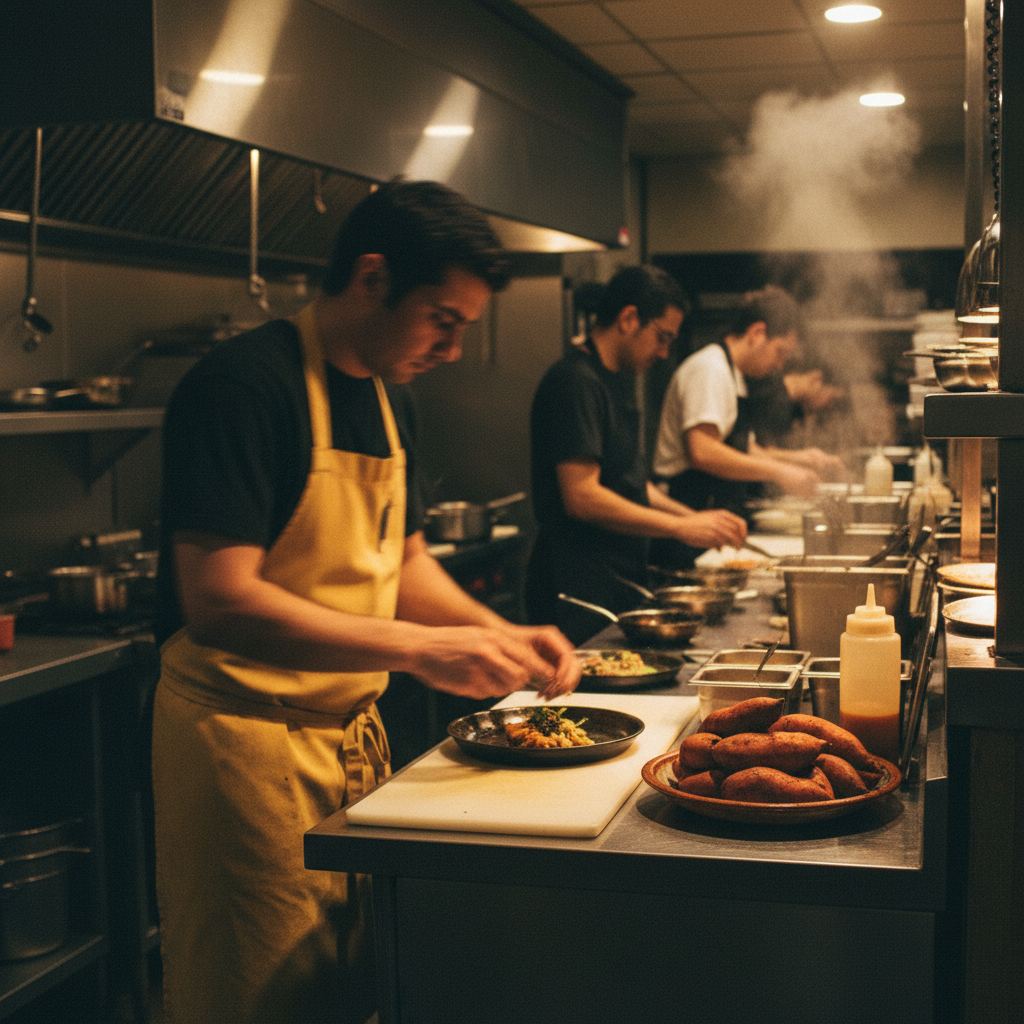
Jacksonville food service. Illustration generated with AI. Not a photograph of a Foody Finance client or location.
What drives financing conversations in Jacksonville
Operators here spend heavily on walk-in coolers and ventilation upgrades built for humid Gulf summers, plus flood-zone construction requirements near the St. Johns River. Riverside patio seating and Southbank tourist traffic both demand buildouts that survive storm season without shutting the kitchen down.
Revenue and seasonality in Jacksonville
Tourism traffic concentrates near the Southbank and Jacksonville Beach, while inland neighborhoods run on local lunch and weekend brunch crowds. Hurricane season from June through November forces some closures and insurance-driven downtime, so cash flow needs a cushion built for weeks without full seating.
What this does to your numbers
Storm season can shut the doors for stretches you can't predict, and the bills don't wait for the weather to clear.
Permitting in Jacksonville, and what it costs to wait
Duval County Health Department handles food service permits while the city's Building Inspection Division runs construction and occupancy separately, and any flood-zone address near the river adds elevation certificate review. A liquor license through the state ABT can clear before the health inspection even schedules, so a loan has to fund a kitchen sitting idle.
What the wait actually costs
A flood-zone address means extra paperwork before you can open, and every week of that is rent with no revenue.
What raises the cost of capital here
01Flood-zone construction rules near the St. Johns River add engineering review before occupancy sign-off.
02Hurricane season closures force revenue gaps that a fixed loan payment doesn't pause for.
03Humidity-rated HVAC and refrigeration specs cost more upfront than standard equipment quotes.
Which program usually fits here
A line of creditcovers the unpredictable storm-season gaps better than a fixed loan payment that doesn't flex.
Florida outline. Boundary data: US Census Bureau cartographic boundary files, public domain. Simplified for display.
A preapproved pool of money you pull from only when you need it, then pay back and reuse. You pay for what you draw, not for the full amount sitting there.
covers
The number of guests served. Lenders pair it with check average to judge how reliable a month really is.
underwriting
The lender reading your numbers to decide how much risk you are. Bank statements, time in business, and existing debt carry the most weight.
term
How long you have to repay. A longer term lowers the monthly payment and raises what the money costs in total.
equipment paper
A loan or lease tied to a specific machine. The machine itself is the security, so approval leans on the value of the hardware more than on your bank statements.
buildout capital
Money for the work that turns a space into a working kitchen: plumbing, electrical, hoods, walls, and permits. It pays for labor and materials you cannot resell, so it is priced differently than money for a fryer.
draw
Taking money out of an approved line or loan. Draws tied to construction milestones mean you only start paying interest on each piece as you use it.
working capital
Cash for the everyday gaps: payroll, inventory, rent, and repairs. It is repaid out of daily or weekly sales rather than from one big event.
hard credit pull
A formal credit check that shows on your report and can move your score a few points. It happens only after you pick a specific lender, not to get information.
How does hurricane season affect a restaurant loan in Jacksonville?
Lenders underwriting a Jacksonville restaurant expect at least a few closure days or reduced hours between June and November tied to storm warnings or actual landfall. A term loan payment doesn't shrink during those weeks, so the request should account for insurance deductibles and a stretch of lost covers rather than assuming a flat monthly revenue line.
Does a flood zone location slow down opening a restaurant in Jacksonville?
Addresses near the St. Johns River or Southbank often fall inside FEMA flood zones, which adds elevation certificate review to the city's building permit process on top of the standard Duval County health inspection. That extra track can push occupancy sign-off out by weeks, and financing needs to cover rent and staff pay during that stretch.
Why do Jacksonville restaurant sales look so different from month to month?
Jacksonville's calendar concentrates demand into a few sharp peaks rather than spreading it evenly. The Florida-Georgia game weekend, Jaguars home Sundays, and the March-to-Labor-Day beach season each pull outsized single-period revenue, while January, February, and hurricane-driven closures from June through November can erase weeks of trade with little warning. A lender or landlord reviewing bank statements for a Jacksonville restaurant should expect this lumpiness rather than a smooth month-over-month curve, and should check whether a location depends on Beaches tourist traffic, Jaguars game days, or steady Southside lunch business, since each carries a different risk profile.
How do Jacksonville food businesses start a financing conversation?
Start with a free review by a specialist. You share the basics of the business, the use of funds, and recent bank statements, and you see every program that fits before any credit application exists. Short term options commonly fund in 1 to 3 business days once you choose an offer.
Do you serve areas outside Jacksonville in Florida?
Yes. Every program is available statewide in Florida and nationwide.
What is equipment financing, and when does it fit a Jacksonville operator?
You borrow against a specific machine, and the machine is what backs the loan. Use it when a fryer, a walk-in, an oven, or a vehicle has to be replaced and you would rather keep the cash in the account. Typical size is 5,000 to 500,000, funding runs 1 to 5 business days once you choose an offer, and you repay it as fixed monthly payment. You will be asked for: application, equipment quote, bank statements.
What is buildout and expansion, and when does it fit a Jacksonville operator?
Construction money for the work that turns a space into a working kitchen, usually released in stages as the job progresses. Use it for a second location, a remodel, a patio, or a kitchen conversion, and size it to cover the permit wait, not just the build. Typical size is 50,000 to 2,000,000, funding runs 1 to 4 weeks once you choose an offer, and you repay it as fixed payment, often with a draw schedule. You will be asked for: application, contractor bids, lease, financials.
What is working capital, and when does it fit a Jacksonville operator?
Cash for the everyday gaps, repaid out of sales on a set schedule instead of at the end of a project. Use it for payroll, inventory, a slow stretch, or a job you have to fund before the client pays you. Typical size is 10,000 to 500,000, funding runs 1 to 3 business days once you choose an offer, and you repay it as fixed daily, weekly, or monthly payment. You will be asked for: application, 3 to 6 months of bank statements.
Why does the Jacksonville calendar change what I should borrow?
Storm season can shut the doors for stretches you can't predict, and the bills don't wait for the weather to clear.
What does waiting actually cost me in Jacksonville?
A flood-zone address means extra paperwork before you can open, and every week of that is rent with no revenue.
Which program do most Jacksonville operators end up using?
A line of credit covers the unpredictable storm-season gaps better than a fixed loan payment that doesn't flex. That is a starting point, not a decision. The specialist review looks at your deposits, your time in business, and what the money is for before anything is recommended.
Does asking about financing in Jacksonville affect my credit?
No. Getting information is a conversation, not an application. There is no credit application and no hard credit pull until you have picked a specific lender and want to move forward.
Start the conversation
Talk to a specialist before you fill out an application.
Start with a free, no-obligation review. We will send the right application only after we know what you actually qualify for.