Being fifteen minutes from Manhattan means Yonkers operators compete with city prices without city foot traffic, and margins get squeezed from both directions.
How do Yonkers food businesses get funded?
Yonkers operators start with a free review with a specialist, share recent business bank statements, and are matched to the programs that fit the use of funds. Working capital funds in 1 to 3 business days after you choose an offer, equipment in 1 to 5, and buildout capital in 1 to 4 weeks.
Estimates, not offers: Amounts, terms, and funding times are estimates based on programs commonly available in food service. Actual terms vary by program, lender underwriting, time in business, revenue, and credit profile. Nothing here is an offer of credit or a guarantee of approval. See source and method.
How Yonkers eats, and what that does to cash
01
Where Yonkers eats
Getty Square, the historic downtown around South Broadway, holds the city's Dominican and Puerto Rican restaurant core, with counter service comedores serving mofongo and pernil to working families at prices well under Manhattan norms. Nodine Hill and the streets around Ashburton Avenue carry a mix of Latin American and West African spots that turned over from the older Italian delis that once dominated the corridor. Ludlow, near the Metro-North station, still holds a cluster of old-line Italian bakeries and red sauce restaurants serving a longtime homeowner base that eats out on weekends rather than weeknights. The Cross County and Ridge Hill area in the city's east side is Yonkers's suburban retail corridor, anchored by chain casual dining that draws shoppers and Westchester commuters rather than Yonkers residents specifically. Empire City Casino near Yonkers Raceway pulls a distinct late-night crowd for its restaurants and food court, running hours that stretch well past midnight on weekends, a schedule most Getty Square restaurants do not attempt.
02
What Yonkers actually eats
Dominican comedores serving rice, beans, and stewed meats by the pound are the everyday lunch format in Getty Square and along South Broadway, typically priced 10 to 14 dollars a plate. Puerto Rican bakeries and pastelerias sell pastelillos and tres leches cake as counter items rather than sit-down desserts. Pizza by the slice remains a fixture from the city's Italian roots, with several decades-old shops still operating near Ludlow and along Nepperhan Avenue. Empanadas and Peruvian rotisserie chicken have grown as a format over the last several years, run largely as counter service or delivery-only kitchens rather than full dining rooms. The Ridge Hill development brought food hall style casual chains that Yonkers had not had before, aimed at a car-dependent suburban customer rather than the walkable downtown crowd. Waterfront restaurants along the Hudson River esplanade near downtown run a warm weather patio season from May through September, then cut outdoor seating and staff hours sharply once river winds make the space unusable in winter.
03
The Yonkers calendar
Consumer Reports, headquartered in Yonkers, and Con Edison's local operations provide steady weekday office lunch demand downtown year round. Empire City Casino draws a consistent flow of gaming customers to its restaurants regardless of season, giving that corridor less seasonal swing than the rest of the city. Yonkers's proximity to Manhattan means many residents commute out daily on Metro-North, which drains weekday evening dinner traffic from neighborhood restaurants that instead depend on weekend and Sunday family meals. The Hudson River waterfront hosts summer concerts and festivals from June through August that bring foot traffic to the downtown restaurant strip near the Yonkers riverfront library. Winter months from December through February see reduced outdoor dining and lower foot traffic in Getty Square, since much of the neighborhood's activity depends on street level walk-in traffic that drops off in cold weather. School calendars at Yonkers's large public system also shape lunch demand near the neighborhood delis that serve students during the academic year.
04
Growth and cost pattern
New restaurant space in Yonkers opens most often near Ridge Hill and along the Cross County corridor, where large retail parcels and structured parking make buildout easier than in the dense downtown. Getty Square storefronts are older and narrower, often requiring plumbing and electrical upgrades before a kitchen can be installed, which adds real delay to opening timelines for new operators taking over century-old buildings. Commercial rent in Yonkers runs below nearby Bronx and Manhattan rates, which is part of why operators priced out of New York City increasingly look here, but rent has climbed as that spillover demand has grown over the past several years. Labor costs track the broader New York metro area, since workers can commute easily to higher paying kitchen jobs in the Bronx or Manhattan, forcing Yonkers restaurants to compete on wage even with lower rent. Waterfront development near downtown has added new mixed-use buildings with ground floor retail, but permitting and inspection timelines in Yonkers can run longer than in surrounding Westchester towns, delaying opening dates and extending the period a new tenant pays rent without revenue.
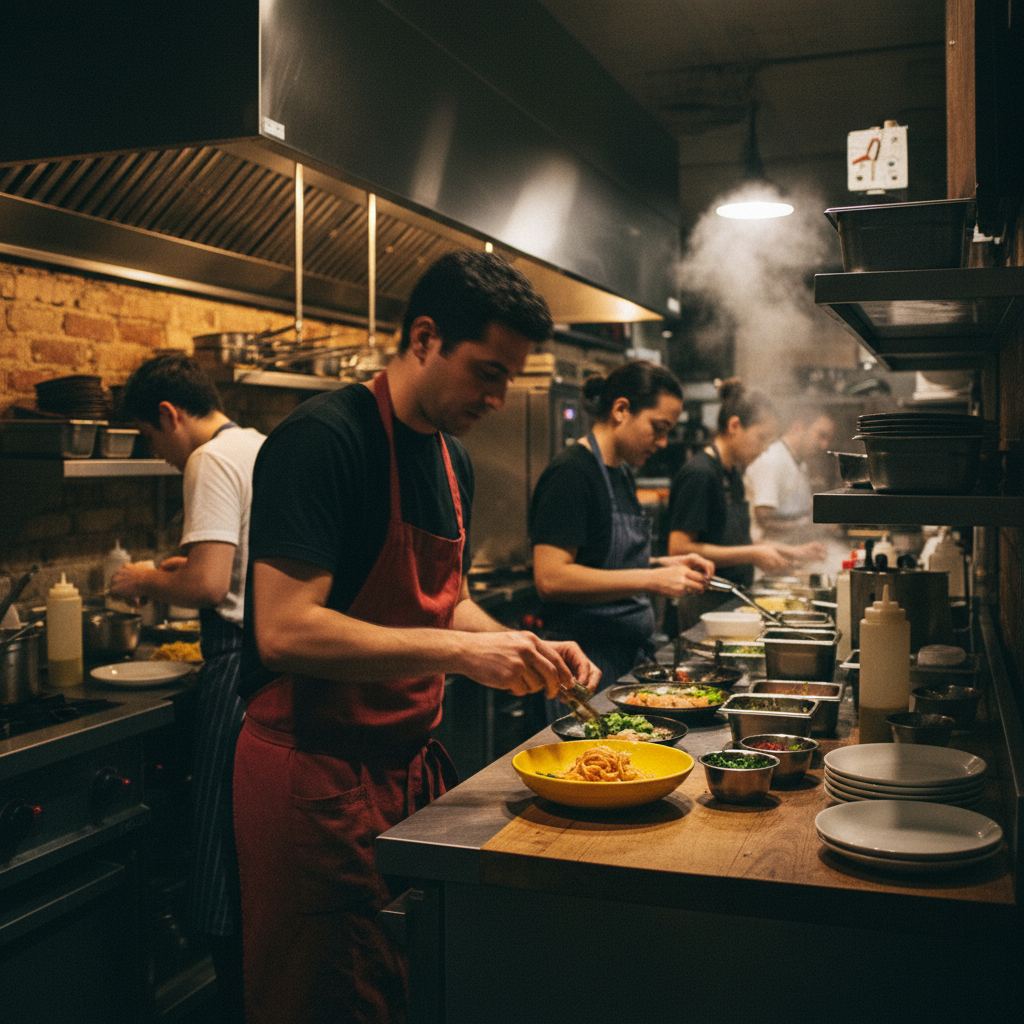
Yonkers food service. Illustration generated with AI. Not a photograph of a Foody Finance client or location.
What drives financing conversations in Yonkers
Getty Square and waterfront restaurants use capital to renovate spaces built decades ago into something that can compete with Westchester and Bronx alternatives nearby. Financing also covers payroll during the slow stretch after a buildout, since commuter customers don't show up until the space reopens fully staffed.
Revenue and seasonality in Yonkers
Commuter lunch traffic near the Metro-North stations contrasts with slower weekday dinners, and weekend volume depends heavily on whether customers stay local or head into Manhattan or the Bronx. Older building stock in Getty Square and Nodine Hill often needs electrical or plumbing upgrades that show up mid-renovation, adding cost after the buildout budget is already set.
What this does to your numbers
Rent is set at city-adjacent prices but customer counts are not, so the margin gets thin fast if a renovation runs long.
Permitting in Yonkers, and what it costs to wait
The Westchester County Department of Health inspects and permits food service operations across Yonkers, while the New York State Liquor Authority handles beer, wine, and liquor licensing through its own application queue that often runs behind. A restaurant converting an older Getty Square storefront should expect the liquor approval to lag well behind construction completion, which means covering rent on an unlicensed space for a stretch of weeks or longer.
What the wait actually costs
A slow liquor license means a finished space sits dark for weeks, still costing rent with no bar sales to offset it.
What raises the cost of capital here
01SLA liquor license approval routinely runs behind construction schedules in Westchester County
02Older commercial buildings near Getty Square often need electrical upgrades not visible until demolition
03Competition from Manhattan and Bronx price points limits how high menu prices can go
Which program usually fits here
An SBA loan suits a full buildout with a long payback horizon, while a line of creditcovers payroll during the licensing wait.
New York outline. Boundary data: US Census Bureau cartographic boundary files, public domain. Simplified for display.
A bank loan partly guaranteed by the Small Business Administration. Lowest cost of the options, longest paperwork, and the slowest to fund.
line of credit
A preapproved pool of money you pull from only when you need it, then pay back and reuse. You pay for what you draw, not for the full amount sitting there.
covers
The number of guests served. Lenders pair it with check average to judge how reliable a month really is.
buildout capital
Money for the work that turns a space into a working kitchen: plumbing, electrical, hoods, walls, and permits. It pays for labor and materials you cannot resell, so it is priced differently than money for a fryer.
draw
Taking money out of an approved line or loan. Draws tied to construction milestones mean you only start paying interest on each piece as you use it.
hard credit pull
A formal credit check that shows on your report and can move your score a few points. It happens only after you pick a specific lender, not to get information.
working capital
Cash for the everyday gaps: payroll, inventory, rent, and repairs. It is repaid out of daily or weekly sales rather than from one big event.
equipment paper
A loan or lease tied to a specific machine. The machine itself is the security, so approval leans on the value of the hardware more than on your bank statements.
term
How long you have to repay. A longer term lowers the monthly payment and raises what the money costs in total.
Why does opening a bar in Yonkers take longer than the buildout itself?
The New York State Liquor Authority processes license applications through a statewide queue that isn't tied to local construction timelines, so a Getty Square or waterfront space can finish renovation and still sit empty for weeks waiting on approval. Operators typically finance the gap so rent and initial staff hires don't stall out while the paperwork clears.
What hidden costs show up in Yonkers restaurant renovations?
Older commercial buildings around Nodine Hill and Getty Square frequently have outdated electrical panels or plumbing that only becomes visible once contractors open the walls. Buildout financing for Yonkers projects commonly needs room for this kind of mid-renovation discovery rather than a fixed number set before demolition starts.
Why do so many Yonkers restaurants depend on weekend traffic instead of weekday dinners?
A large share of Yonkers residents commute to jobs in Manhattan or the Bronx on Metro-North, leaving the city on weekday mornings and returning late, which limits weeknight dine-out demand in residential neighborhoods like Ludlow and Nodine Hill. Restaurants in these areas instead build their week around weekend family meals and Sunday gatherings, when commuters are home. This pattern shows up clearly in weekly sales data as a heavy Friday through Sunday concentration, and lenders reviewing a Yonkers restaurant's cash flow should expect that shape rather than the flatter weekly pattern seen in commuter-light cities.
How do Yonkers food businesses start a financing conversation?
Start with a free review by a specialist. You share the basics of the business, the use of funds, and recent bank statements, and you see every program that fits before any credit application exists. Short term options commonly fund in 1 to 3 business days once you choose an offer.
Do you serve areas outside Yonkers in New York?
Yes. Every program is available statewide in New York and nationwide.
What is buildout and expansion, and when does it fit a Yonkers operator?
Construction money for the work that turns a space into a working kitchen, usually released in stages as the job progresses. Use it for a second location, a remodel, a patio, or a kitchen conversion, and size it to cover the permit wait, not just the build. Typical size is 50,000 to 2,000,000, funding runs 1 to 4 weeks once you choose an offer, and you repay it as fixed payment, often with a draw schedule. You will be asked for: application, contractor bids, lease, financials.
What is sba loans, and when does it fit a Yonkers operator?
A bank loan partly guaranteed by the Small Business Administration, which is why the payment is the lowest available. Use it when you can plan months ahead. It is the cheapest money on this page and the slowest to arrive. Typical size is 50,000 to 5,000,000, funding runs 3 to 12 weeks once you choose an offer, and you repay it as amortized interest, lowest payment of any program. You will be asked for: tax returns, interim financials, debt schedule, plan.
What is business line of credit, and when does it fit a Yonkers operator?
An approved limit you pull from only when you need it, then repay and reuse. Use it for a season you can see coming, so you draw before the peak and pay it back out of the peak. Typical size is 10,000 to 250,000, funding runs 2 to 7 business days once you choose an offer, and you repay it as interest on the drawn balance only. You will be asked for: application, bank statements.
Why does the Yonkers calendar change what I should borrow?
Rent is set at city-adjacent prices but customer counts are not, so the margin gets thin fast if a renovation runs long.
What does waiting actually cost me in Yonkers?
A slow liquor license means a finished space sits dark for weeks, still costing rent with no bar sales to offset it.
Which program do most Yonkers operators end up using?
An SBA loan suits a full buildout with a long payback horizon, while a line of credit covers payroll during the licensing wait. That is a starting point, not a decision. The specialist review looks at your deposits, your time in business, and what the money is for before anything is recommended.
Does asking about financing in Yonkers affect my credit?
No. Getting information is a conversation, not an application. There is no credit application and no hard credit pull until you have picked a specific lender and want to move forward.
Start the conversation
Talk to a specialist before you fill out an application.
Start with a free, no-obligation review. We will send the right application only after we know what you actually qualify for.