Rochester's long winters compress the outdoor dining season into a few months, so a kitchen has to earn most of its patio revenue before the lake-effect snow arrives.
How do Rochester food businesses get funded?
Rochester operators start with a free review with a specialist, share recent business bank statements, and are matched to the programs that fit the use of funds. Working capital funds in 1 to 3 business days after you choose an offer, equipment in 1 to 5, and buildout capital in 1 to 4 weeks.
Estimates, not offers: Amounts, terms, and funding times are estimates based on programs commonly available in food service. Actual terms vary by program, lender underwriting, time in business, revenue, and credit profile. Nothing here is an offer of credit or a guarantee of approval. See source and method.
How Rochester eats, and what that does to cash
01
Where Rochester eats
Park Avenue carries the sit-down and brunch crowd, with small storefront restaurants and wine bars drawing university staff and young professionals who spend on weekend tabs. The South Wedge, around South Avenue, holds the later, cheaper, more industrial-casual scene, with dive bars and taco counters that stay open past midnight and skew toward a college and service-worker budget. Downtown, near East Avenue and the Sibley Building, daytime lunch counters serve office workers from the county and city government buildings, then go quiet by 7 PM. The Public Market on Union Street runs Tuesday, Thursday, and Saturday mornings and pulls a mixed crowd from across the metro for produce stalls and a handful of prepared food vendors, generating a burst of weekend cash that does not repeat midweek. Corn Hill anchors slower, higher-margin dinner service near the river with a reservation-driven clientele. Greece and Henrietta, the suburban corridors along West Ridge Road and Jefferson Road, carry chain volume and strip mall leases at lower rent than the city core. A restaurant in the Wedge and one on Park Avenue can post the same covers and still carry different rent per square foot, which changes the break-even math before a single ticket is rung.
02
What Rochester orders
The garbage plate, home fries or fries and mac salad piled under two cheeseburgers or hots with meat sauce, mustard, and onions, is the dish outsiders ask about and locals order at 2 AM after the bars close. Nick Tahou's on West Main Street remains the reference point, but plate-format counter service now runs across dozens of diners and drive-throughs on a 7 to 10 dollar ticket. White hots and red hots, Rochester's own hot dog styles from Zweigle's, show up at Frontier Field concession stands and corner stands alike. Chicken French, a pan-fried cutlet in lemon-butter-wine sauce, sits on nearly every Italian-American menu as a mid-tier entree. Sponge candy, a chocolate-covered honeycomb confection, moves through candy counters and holiday gift orders rather than restaurant menus. Garbage plates and hots both depend on a late-night counter format with minimal seating turnover economics, high fry-oil volume, and cheap proteins, which keeps food cost low but ties revenue to bar-closing hours, so a slow Tuesday night produces a real gap in the register that a daytime-only operator never sees.
03
The calendar that runs Rochester
The University of Rochester and its Medical Center, RIT, and Wegmans corporate headquarters in Gates anchor year-round weekday lunch and catering demand that does not depend on tourism. The Rochester International Jazz Festival in late June fills Gibbs Street and East End bars and restaurants for nine days with the single biggest tourism bump of the year. The Lilac Festival in Highland Park each May draws crowds but concentrates spending on festival food trucks rather than nearby sit-down rooms. Frontier Field's Red Wings season, April through Labor Day, keeps downtown bars busy on weeknight game dates. Winter is the drag: from January through March, lake-effect snow off Ontario cuts walk-in traffic sharply, and several Park Avenue restaurants shorten hours or close two days a week. RIT and U of R graduation weekends in May push a short catering and hotel-restaurant spike. A restaurant that banks on jazz-fest June revenue to cover a slow February has to carry six to eight weeks of thin cash flow on its own before the calendar turns back in its favor.
04
Growth and cost pattern
New restaurant openings concentrate in the South Wedge and on North Clinton Avenue, where older commercial buildings offer lower per-square-foot rent than Park Avenue or East End, but many require full mechanical and grease-trap work before a kitchen can open. Public Market vendors testing a storefront often move to Neighborhood of the Arts or Marketview Heights, where landlords are used to food tenants and buildout timelines run faster. Suburban growth along Jefferson Road in Henrietta favors drive-through and fast-casual formats with surface parking, cheaper labor pools, and lower utility costs than downtown high-rises. Winter construction delays are routine: contractors in Rochester lose weeks to snow and frozen ground between December and March, pushing buildout schedules past a planned spring opening. Labor draws from RIT and MCC student populations for part-time shifts, which keeps wage costs moderate but creates staffing gaps during winter and summer academic breaks. A build planned for a March opening that slips to May because of frozen-ground utility work means a full season of rent paid with no revenue against it.
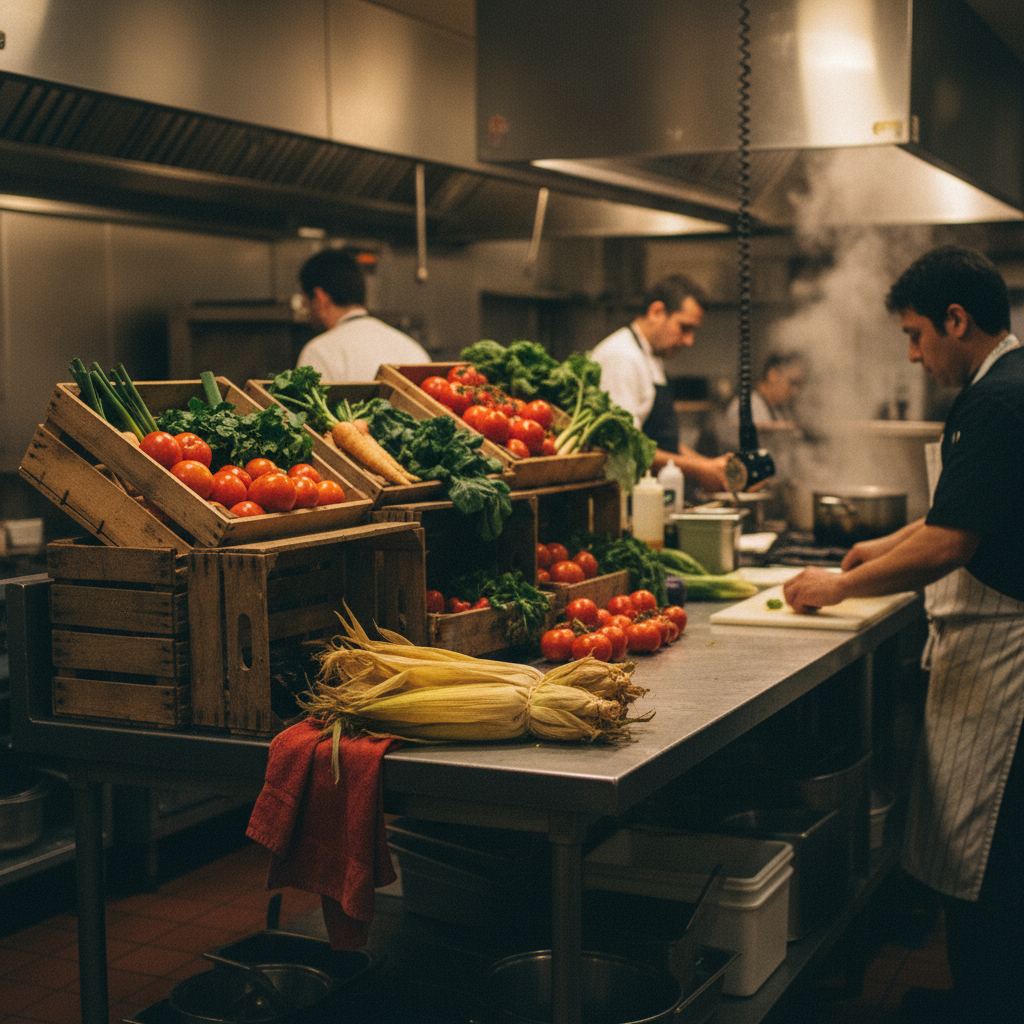
Rochester food service. Illustration generated with AI. Not a photograph of a Foody Finance client or location.
What drives financing conversations in Rochester
Capital here often funds indoor seating capacity and heating infrastructure that let a restaurant hold onto business through a Western New York winter, alongside patio buildout that only earns money from late spring through early fall. Restaurants near the University of Rochester and RIT also plan staffing around the academic calendar, since student spending drops sharply during summer break.
Revenue and seasonality in Rochester
Patio and outdoor dining revenue concentrates heavily between May and September, while indoor traffic has to carry the business through a winter that can bring frequent lake-effect snow. University of Rochester and RIT student populations add a reliable but seasonal customer base that thins out considerably each summer, requiring a different staffing and inventory plan than the academic year.
What this does to your numbers
You make most of your outdoor season money between May and September, then have to stretch it through a long, snowy winter.
Permitting in Rochester, and what it costs to wait
The Monroe County Department of Public Health handles food service permitting and inspection for Rochester, working separately from city building and fire review, and any restaurant serving alcohol needs a New York State Liquor Authority license processed on its own timeline. Because lake-effect winters can also slow contractor work between late fall and early spring, a buildout scheduled to finish before winter should build in a construction buffer.
What the wait actually costs
If your buildout runs into winter weather, the construction delay can cost you weeks of rent before you even open.
What raises the cost of capital here
01Lake-effect winter weather can slow contractor timelines for buildouts scheduled into late fall
02New York State Liquor Authority licensing runs independently of local health and building approval
03University of Rochester and RIT academic calendars create a summer dip in student-driven revenue
Which program usually fits here
A line of credit helps cover the slow summer when students are away, while equipment financing works for adding indoor seating to survive the winter.
New York outline. Boundary data: US Census Bureau cartographic boundary files, public domain. Simplified for display.
A preapproved pool of money you pull from only when you need it, then pay back and reuse. You pay for what you draw, not for the full amount sitting there.
equipment paper
A loan or lease tied to a specific machine. The machine itself is the security, so approval leans on the value of the hardware more than on your bank statements.
working capital
Cash for the everyday gaps: payroll, inventory, rent, and repairs. It is repaid out of daily or weekly sales rather than from one big event.
buildout capital
Money for the work that turns a space into a working kitchen: plumbing, electrical, hoods, walls, and permits. It pays for labor and materials you cannot resell, so it is priced differently than money for a fryer.
draw
Taking money out of an approved line or loan. Draws tied to construction milestones mean you only start paying interest on each piece as you use it.
hard credit pull
A formal credit check that shows on your report and can move your score a few points. It happens only after you pick a specific lender, not to get information.
covers
The number of guests served. Lenders pair it with check average to judge how reliable a month really is.
underwriting
The lender reading your numbers to decide how much risk you are. Bank statements, time in business, and existing debt carry the most weight.
term
How long you have to repay. A longer term lowers the monthly payment and raises what the money costs in total.
How does Rochester's winter affect the timeline for a restaurant buildout?
Lake-effect snow can slow exterior construction and delivery schedules between late fall and early spring, so a buildout planned to finish in October or November can run behind if a contractor hits a stretch of bad weather. Financing timed around a fall opening should carry extra weeks of holding costs in case winter conditions push completion into the new year.
Why do Rochester restaurants near the universities need different summer financing than the rest of the year?
With University of Rochester and RIT students gone for the summer, restaurants near those campuses see a real dip in weekday traffic that doesn't match the rest of the city's calendar. A line of credit sized to cover payroll during that lighter stretch keeps staffing steady heading into the fall semester rush.
Why do Rochester restaurant sales look so different between June and February?
Rochester's food economy runs on a short warm season. The Jazz Festival, Lilac Festival, and Red Wings games from May through September concentrate outdoor and tourism-driven spending into roughly five months, while lake-effect snow from Ontario suppresses walk-in traffic from January through March. Lenders reviewing a Rochester restaurant's bank statements should expect this swing as normal rather than a sign of instability, and should look at trailing twelve-month averages rather than any single winter month, since a February statement alone understates what the same business earns in June.
How do Rochester food businesses start a financing conversation?
Start with a free review by a specialist. You share the basics of the business, the use of funds, and recent bank statements, and you see every program that fits before any credit application exists. Short term options commonly fund in 1 to 3 business days once you choose an offer.
Do you serve areas outside Rochester in New York?
Yes. Every program is available statewide in New York and nationwide.
What is equipment financing, and when does it fit a Rochester operator?
You borrow against a specific machine, and the machine is what backs the loan. Use it when a fryer, a walk-in, an oven, or a vehicle has to be replaced and you would rather keep the cash in the account. Typical size is 5,000 to 500,000, funding runs 1 to 5 business days once you choose an offer, and you repay it as fixed monthly payment. You will be asked for: application, equipment quote, bank statements.
What is working capital, and when does it fit a Rochester operator?
Cash for the everyday gaps, repaid out of sales on a set schedule instead of at the end of a project. Use it for payroll, inventory, a slow stretch, or a job you have to fund before the client pays you. Typical size is 10,000 to 500,000, funding runs 1 to 3 business days once you choose an offer, and you repay it as fixed daily, weekly, or monthly payment. You will be asked for: application, 3 to 6 months of bank statements.
What is buildout and expansion, and when does it fit a Rochester operator?
Construction money for the work that turns a space into a working kitchen, usually released in stages as the job progresses. Use it for a second location, a remodel, a patio, or a kitchen conversion, and size it to cover the permit wait, not just the build. Typical size is 50,000 to 2,000,000, funding runs 1 to 4 weeks once you choose an offer, and you repay it as fixed payment, often with a draw schedule. You will be asked for: application, contractor bids, lease, financials.
Why does the Rochester calendar change what I should borrow?
You make most of your outdoor season money between May and September, then have to stretch it through a long, snowy winter.
What does waiting actually cost me in Rochester?
If your buildout runs into winter weather, the construction delay can cost you weeks of rent before you even open.
Which program do most Rochester operators end up using?
A line of credit helps cover the slow summer when students are away, while equipment financing works for adding indoor seating to survive the winter. That is a starting point, not a decision. The specialist review looks at your deposits, your time in business, and what the money is for before anything is recommended.
Does asking about financing in Rochester affect my credit?
No. Getting information is a conversation, not an application. There is no credit application and no hard credit pull until you have picked a specific lender and want to move forward.
Start the conversation
Talk to a specialist before you fill out an application.
Start with a free, no-obligation review. We will send the right application only after we know what you actually qualify for.