An Ironbound restaurant can run a packed weekend crowd driven by Portuguese and Brazilian steakhouse traffic and then face a quieter weekday tied to office worker patterns downtown. The rent bill doesn't know the difference.
How do Newark food businesses get funded?
Newark operators start with a free review with a specialist, share recent business bank statements, and are matched to the programs that fit the use of funds. Working capital funds in 1 to 3 business days after you choose an offer, equipment in 1 to 5, and buildout capital in 1 to 4 weeks.
Estimates, not offers: Amounts, terms, and funding times are estimates based on programs commonly available in food service. Actual terms vary by program, lender underwriting, time in business, revenue, and credit profile. Nothing here is an offer of credit or a guarantee of approval. See source and method.
How Newark eats, and what that does to cash
01
Where Newark eats
The Ironbound district, centered on Ferry Street, holds Newark's densest concentration of Portuguese and Brazilian restaurants, with churrasco steakhouses and seafood houses charging $25 to $45 a person and drawing diners from across northern New Jersey on weekends. Downtown Newark near Military Park and the Prudential Center serves office workers from Prudential Financial and PSEG headquarters on weekdays, with fast casual and sandwich counters at $10 to $15, then arena crowds on event nights spending $15 to $30 at nearby bars. University Heights, anchored by Rutgers-Newark and NJIT, supports cheap late-night pizza, halal carts, and student-priced Caribbean spots at $8 to $14. The North Ward's Broadway corridor carries a Puerto Rican and Dominican population with roast chicken and comida criolla spots at $10 to $16. Newark Liberty International Airport's cargo and hospitality workforce feeds a shift-driven diner and deli trade near Newark Airport Circle, running around the clock rather than standard meal hours.
02
What Newark orders
Portuguese and Brazilian food defines the Ironbound: bacalhau, grilled sardines, and rodizio-style churrasco at $25 to $45 a person, mostly full-service with some counter bakery formats for pastries and coffee. Dominican and Puerto Rican comida criolla, roast chicken, and mofongo along Broadway and in the North Ward run $9 to $15, largely counter service. Newark-style thin crust tomato pie, distinct from Trenton's version, holds loyal followings at a handful of longtime pizzerias charging $2 to $4 a slice. Downtown's Prudential Center brings arena food and nearby sports bars into play on game nights and concert dates, spending spikes tied directly to the arena schedule rather than steady weekly demand. Halal carts and Caribbean roti counters near Rutgers-Newark and NJIT serve students at $7 to $12. Shift work tied to Newark Airport and the Port Newark-Elizabeth Marine Terminal supports 24 hour diners, an unusual format that depends on steady overnight wages rather than discretionary dining spending.
03
Newark's calendar
Prudential Financial and PSEG's downtown headquarters drive weekday lunch traffic year-round, while the Prudential Center's NHL Devils season from October through April and its concert bookings create irregular evening spikes tied to a published schedule rather than season. Rutgers-Newark and NJIT's academic calendar drives University Heights traffic during fall and spring semesters, with a sharp drop each summer and around winter break in late December. The Portuguese Feast of Our Lady of Fatima each October brings large crowds to the Ironbound for a weekend of street food and church-affiliated vendors. Newark Liberty International Airport keeps nearby diners busy regardless of season since air travel and cargo shifts run continuously. Summer sees reduced downtown office lunch traffic as hybrid work schedules thin midweek attendance, and restaurants tied purely to arena nights face empty weeks whenever the Devils are on a long road trip or the arena has no concerts booked.
04
Growth and cost in Newark
New restaurant activity concentrates in the Ironbound, where Ferry Street storefronts turn over steadily but rents have climbed as the neighborhood draws visitors from Manhattan and suburban New Jersey, and in downtown Newark near the Prudential Center and NJPAC where redevelopment has added new mixed-use retail space at premium rents compared to older Broadway or South Ward corridors. Older buildings throughout Newark's commercial strips often require costly electrical and plumbing upgrades before a kitchen buildout can pass city inspection, adding unplanned capital costs. Labor costs sit below Manhattan and Jersey City rates, which pulls some operators to open in Newark specifically for that wage gap, though workers often commute in from Elizabeth and Irvington rather than living locally. Property and liability insurance costs run higher than in surrounding suburban Essex County towns given the city's claims history. Restaurants near the Prudential Center face buildout timing risk if construction runs past a scheduled arena season opener, losing access to the highest-traffic nights of the year before recovering the investment.
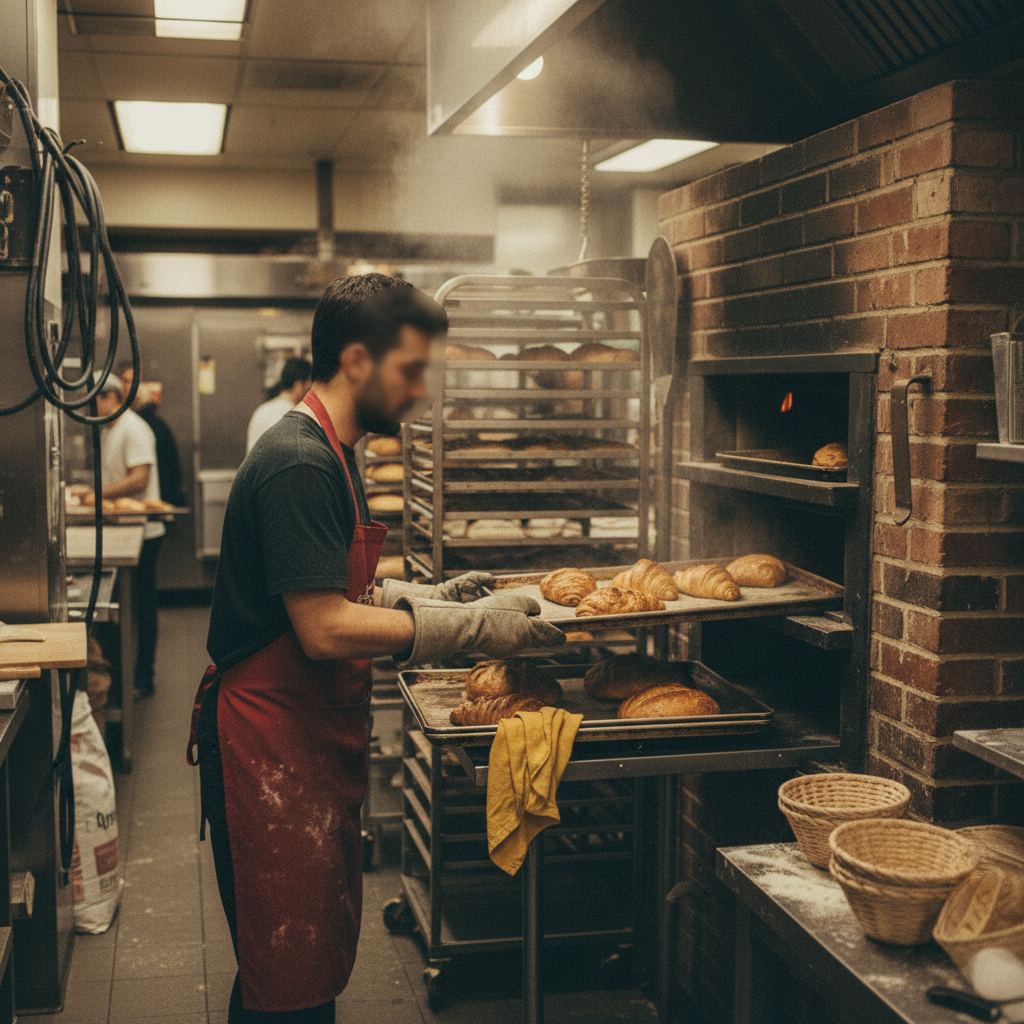
Newark food service. Illustration generated with AI. Not a photograph of a Foody Finance client or location.
What drives financing conversations in Newark
Money here often goes toward kitchen equipment suited to high-volume steakhouse and seafood service in the Ironbound, alongside build-out costs in older commercial buildings near Newark Penn Station that need electrical and plumbing upgrades before opening. Newark's proximity to Newark Liberty International Airport also supports catering and hospitality contracts that require upfront staffing investment. The financing needs to cover the period between signing a lease in an older building and passing every inspection required to open.
Revenue and seasonality in Newark
Ironbound's Portuguese and Brazilian restaurant corridor draws diners from across northern New Jersey on weekends, while downtown Newark leans on office worker lunch traffic tied to the city's insurance and financial services employers. Airport-adjacent catering and event business adds another revenue stream with its own invoicing cycle. Weekday downtown counts soften when office attendance dips, which puts more weight on weekend Ironbound volume to cover the month.
What this does to your numbers
Weekend Ironbound crowds can carry a lot of the month, while downtown weekday business depends on how many office workers are actually in the building.
Permitting in Newark, and what it costs to wait
The Newark Department of Health and Community Wellness issues food establishment permits, while liquor licensing runs through the New Jersey Division of Alcoholic Beverage Control alongside a municipal issuing authority process, and Newark's limited number of available liquor licenses can mean a long search for one to transfer. Older buildings near Penn Station and in the Ironbound frequently need fire code and electrical upgrades before final sign-off. That combination often means rent accrues for months before a full liquor license transfer is complete.
What the wait actually costs
If you have to wait to find a transferable liquor license, you could be paying rent on a finished restaurant for months before it can serve a drink.
What raises the cost of capital here
01New Jersey liquor license availability is capped by municipality, and Newark's supply can require locating a license to transfer rather than applying fresh.
02Older commercial buildings near Newark Penn Station often need electrical and fire code upgrades before certificate of occupancy.
03Office attendance patterns downtown directly affect weekday lunch volume for restaurants near the business district.
Which program usually fits here
Working capital financing fits the gap between paying for a catering event upfront and waiting on a client's invoice terms to actually get paid.
New Jersey outline. Boundary data: US Census Bureau cartographic boundary files, public domain. Simplified for display.
Taking money out of an approved line or loan. Draws tied to construction milestones mean you only start paying interest on each piece as you use it.
working capital
Cash for the everyday gaps: payroll, inventory, rent, and repairs. It is repaid out of daily or weekly sales rather than from one big event.
equipment paper
A loan or lease tied to a specific machine. The machine itself is the security, so approval leans on the value of the hardware more than on your bank statements.
buildout capital
Money for the work that turns a space into a working kitchen: plumbing, electrical, hoods, walls, and permits. It pays for labor and materials you cannot resell, so it is priced differently than money for a fryer.
hard credit pull
A formal credit check that shows on your report and can move your score a few points. It happens only after you pick a specific lender, not to get information.
covers
The number of guests served. Lenders pair it with check average to judge how reliable a month really is.
underwriting
The lender reading your numbers to decide how much risk you are. Bank statements, time in business, and existing debt carry the most weight.
term
How long you have to repay. A longer term lowers the monthly payment and raises what the money costs in total.
Why is getting a liquor license in Newark harder than in some other New Jersey cities?
New Jersey caps the number of consumption liquor licenses per municipality based on population, and in a densely built city like Newark, most available licenses are already in use, so a new restaurant often has to locate an existing license willing to transfer rather than applying for a new one, which can take considerably longer than the health permit process.
How does Newark Liberty International Airport affect catering business financing needs?
Airport-adjacent hospitality and catering contracts in Newark often involve larger events with upfront staffing and inventory costs paid out before the client invoice settles, since many of these contracts run on standard net payment terms. That gap between spending on an event and getting paid for it is a common reason operators use working capital financing tied to this segment.
Why do Ironbound restaurants post such different revenue patterns from downtown Newark restaurants just blocks away?
The Ironbound draws a regional weekend customer base coming specifically for Portuguese and Brazilian food, so its restaurants post strong Friday through Sunday revenue with a midweek lull. Downtown Newark restaurants depend on Prudential Financial, PSEG, and other office workers, so they post the opposite pattern, strong weekday lunch and thin weekends outside of Prudential Center event nights. A lender comparing two Newark restaurants by total monthly revenue alone would miss that they run on nearly inverted weekly cycles, which changes how each business should be expected to handle a slow month.
How do Newark food businesses start a financing conversation?
Start with a free review by a specialist. You share the basics of the business, the use of funds, and recent bank statements, and you see every program that fits before any credit application exists. Short term options commonly fund in 1 to 3 business days once you choose an offer.
Do you serve areas outside Newark in New Jersey?
Yes. Every program is available statewide in New Jersey and nationwide.
What is working capital, and when does it fit a Newark operator?
Cash for the everyday gaps, repaid out of sales on a set schedule instead of at the end of a project. Use it for payroll, inventory, a slow stretch, or a job you have to fund before the client pays you. Typical size is 10,000 to 500,000, funding runs 1 to 3 business days once you choose an offer, and you repay it as fixed daily, weekly, or monthly payment. You will be asked for: application, 3 to 6 months of bank statements.
What is equipment financing, and when does it fit a Newark operator?
You borrow against a specific machine, and the machine is what backs the loan. Use it when a fryer, a walk-in, an oven, or a vehicle has to be replaced and you would rather keep the cash in the account. Typical size is 5,000 to 500,000, funding runs 1 to 5 business days once you choose an offer, and you repay it as fixed monthly payment. You will be asked for: application, equipment quote, bank statements.
What is buildout and expansion, and when does it fit a Newark operator?
Construction money for the work that turns a space into a working kitchen, usually released in stages as the job progresses. Use it for a second location, a remodel, a patio, or a kitchen conversion, and size it to cover the permit wait, not just the build. Typical size is 50,000 to 2,000,000, funding runs 1 to 4 weeks once you choose an offer, and you repay it as fixed payment, often with a draw schedule. You will be asked for: application, contractor bids, lease, financials.
Why does the Newark calendar change what I should borrow?
Weekend Ironbound crowds can carry a lot of the month, while downtown weekday business depends on how many office workers are actually in the building.
What does waiting actually cost me in Newark?
If you have to wait to find a transferable liquor license, you could be paying rent on a finished restaurant for months before it can serve a drink.
Which program do most Newark operators end up using?
Working capital financing fits the gap between paying for a catering event upfront and waiting on a client's invoice terms to actually get paid. That is a starting point, not a decision. The specialist review looks at your deposits, your time in business, and what the money is for before anything is recommended.
Does asking about financing in Newark affect my credit?
No. Getting information is a conversation, not an application. There is no credit application and no hard credit pull until you have picked a specific lender and want to move forward.
Start the conversation
Talk to a specialist before you fill out an application.
Start with a free, no-obligation review. We will send the right application only after we know what you actually qualify for.