Aurora's food scene stretches across a huge footprint from Fitzsimons to Southlands, so a concept's delivery radius and staffing plan matter as much as its menu.
How do Aurora food businesses get funded?
Aurora operators start with a free review with a specialist, share recent business bank statements, and are matched to the programs that fit the use of funds. Working capital funds in 1 to 3 business days after you choose an offer, equipment in 1 to 5, and buildout capital in 1 to 4 weeks.
Estimates, not offers: Amounts, terms, and funding times are estimates based on programs commonly available in food service. Actual terms vary by program, lender underwriting, time in business, revenue, and credit profile. Nothing here is an offer of credit or a guarantee of approval. See source and method.
How Aurora eats, and what that does to cash
01
Where Aurora eats
Aurora spreads across three counties, and its dining map follows that sprawl. Havana Street through the Havana District carries Vietnamese and Korean kitchens serving pho, banh mi, and Korean fried chicken to shift workers and families, with tickets mostly under 15 dollars. Colfax Avenue, Aurora's stretch of the old cross-country highway, mixes dive bars, Ethiopian restaurants, and 24-hour diners at a similarly low price point. The Anschutz Medical Campus area near Fitzsimons draws hospital staff and students to fast-casual bowls and coffee counters running breakfast through late afternoon. Southlands, the outdoor lifestyle center near E-470, pulls suburban families to chain casual dining and a movie-and-dinner circuit on weekend nights. Stanley Marketplace, just over the Denver line but core to Aurora's food identity, packs a food hall format into a converted airplane hangar, with vendors sharing seating and a shared liquor license. Each district serves a different income band, and a menu built for Stanley's browsing crowd will not move at a Colfax counter, which means owners who guess wrong on format eat slow turns and marked-down inventory in the first quarter.
02
What Aurora actually orders
Aurora's plate reflects its immigrant population more than any Rocky Mountain cliche. Ethiopian restaurants serve doro wat and injera family-style, often BYOB, with tickets around 12 to 18 dollars per person. Vietnamese counters on Havana push pho and banh mi as fast lunch turns, rarely above 13 dollars a bowl. Korean barbecue and Korean fried chicken spots run later hours and heavier per-table spend, often 25 to 35 dollars a head with drinks. Mexican taquerias operate out of strip malls along Peoria Street, serving tacos and tortas at counter-service speed for under 10 dollars an item. Drive-through and quick-service chains dominate the E-470 corridor near Southlands, where car traffic outweighs foot traffic. Breweries near the old Aurora Fox Arts Center run kitchens as an add-on to beer sales rather than a primary draw. This range in format and check size means a single kitchen build cannot serve both the Colfax counter crowd and the Southlands dinner crowd, and misjudging which one you're building for shows up fast as uneven weekly cash intake.
03
The Aurora calendar
Anschutz Medical Campus and its associated hospitals, UCHealth and Children's Hospital Colorado among them, anchor steady weekday lunch traffic year-round, immune to tourist seasons. Buckley Space Force Base personnel and contractors support nearby fast-casual and family dining, with paydays on the 1st and 15th driving visible spikes. The Gaylord Rockies Resort and Convention Center near the airport brings convention groups through much of the year, with January and September as strong booking months for corporate events. Colorado Mills area retail slows in January and February after the holiday rush. Aurora's outdoor patio season at Stanley Marketplace and Southlands runs May through September, then drops off sharply once Denver's early snow arrives in October. The Aurora Municipal Center hosts civic events that draw modest lunch crowds midweek. Restaurants that lean on patio seating for half their capacity see that capacity vanish for five months, which forces owners to either close sections or absorb fixed rent on space nobody is using through the winter.
04
Growth and cost pattern
New restaurant activity in Aurora concentrates along the Southlands corridor near E-470, where big-box pad sites offer newer buildouts but higher triple-net rent than older Colfax storefronts. Havana Street and the surrounding Havana District still have lower rent per square foot, but many buildings are decades old, meaning grease trap, electrical, and HVAC upgrades often surface during permitting and add unplanned buildout weeks. Labor draws from a large immigrant workforce experienced in restaurant kitchens, which helps staffing but wages have climbed with Denver metro's overall labor market. Utilities run on Xcel Energy service, and older Colfax buildings with undersized electrical panels frequently need service upgrades to run modern kitchen equipment, a cost that surprises operators who budgeted only for interior finish. Aurora Water connection fees for new commercial space near Southlands add to upfront costs. Operators moving into older Colfax buildings should expect the electrical and grease trap findings to push their opening date back by several weeks and delay first revenue against fixed rent already accruing.
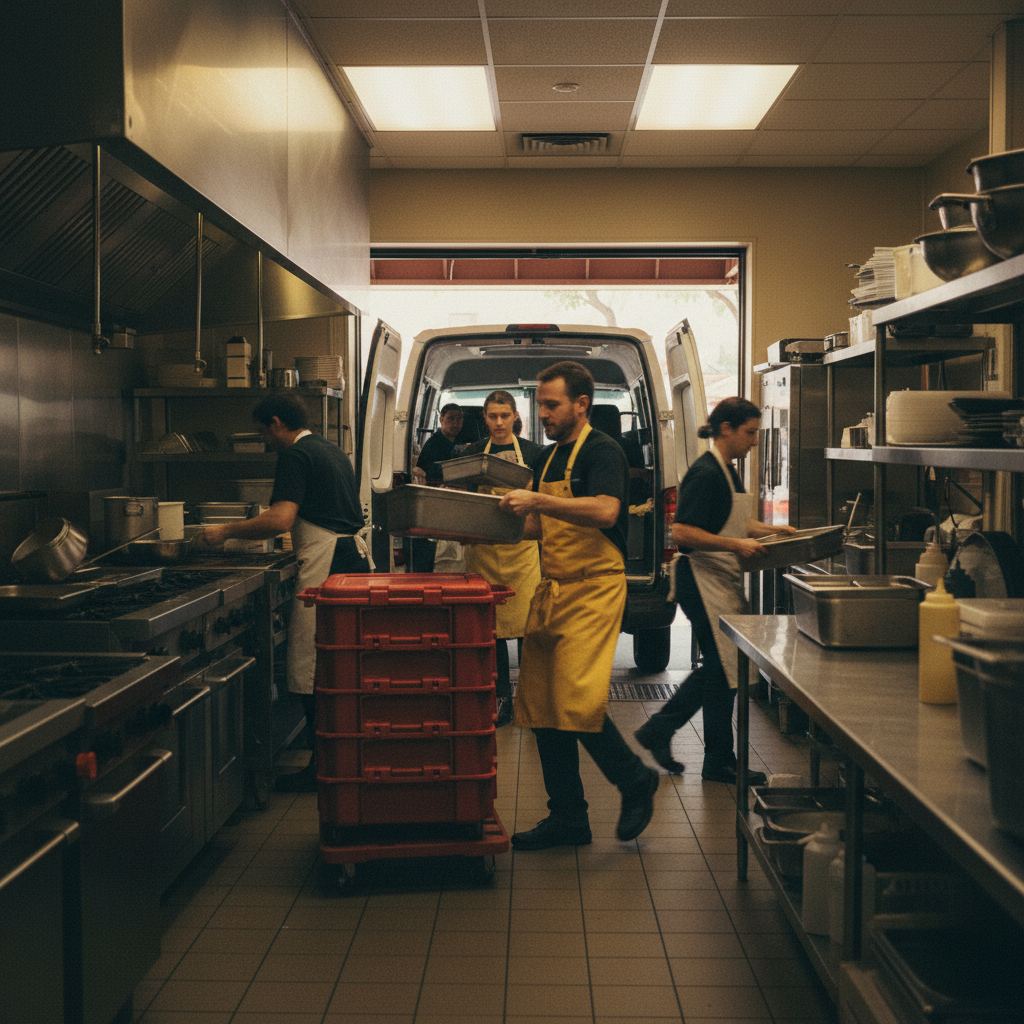
Aurora food service. Illustration generated with AI. Not a photograph of a Foody Finance client or location.
What drives financing conversations in Aurora
Capital tends to fund vehicles and commissary space for concepts serving the Anschutz Medical Campus and Buckley Space Force Base workforce across long commute distances. Winter weather adds a second draw, since heating and snow-related staffing gaps can eat into a slim early-year budget.
Revenue and seasonality in Aurora
Daytime traffic near Fitzsimons and the medical campus is steady year-round, while retail-anchored areas like Southlands see stronger weekend and holiday shopping season volume. Winter storms can cut a week's revenue sharply with little notice, and a concept without a cash buffer for a snowed-in weekend can miss a payroll cycle.
What this does to your numbers
Steady daytime business near the medical campus can carry a location through slow weeks, but retail-corridor spots swing harder with the shopping season.
Permitting in Aurora, and what it costs to wait
Tri-County Health oversight transitioned to Aurora's own public health authority, and food establishment permitting runs alongside Colorado's state and local liquor licensing, which requires separate city council or local authority approval before a state license issues. A concept planning both routes should budget financing that covers the wait between the two approvals.
What the wait actually costs
A snowstorm can wipe out a weekend of sales fast, and the local liquor approval step can push a bar's opening back by weeks.
What raises the cost of capital here
01Colorado's local-then-state liquor licensing sequence adds weeks a buildout schedule has to absorb
02Winter storm closures can erase a weekend's revenue with almost no notice
03Aurora's spread-out geography raises delivery and commissary logistics costs versus a compact urban core
Which program usually fits here
A flexible credit line covers both the weather gaps and the licensing wait without locking in a fixed repayment before revenue starts.
Colorado outline. Boundary data: US Census Bureau cartographic boundary files, public domain. Simplified for display.
The number of guests served. Lenders pair it with check average to judge how reliable a month really is.
commissary
A licensed production kitchen used to prep off site, most often by trucks and catering operations. It carries its own rent, equipment, and permits.
working capital
Cash for the everyday gaps: payroll, inventory, rent, and repairs. It is repaid out of daily or weekly sales rather than from one big event.
line of credit
A preapproved pool of money you pull from only when you need it, then pay back and reuse. You pay for what you draw, not for the full amount sitting there.
draw
Taking money out of an approved line or loan. Draws tied to construction milestones mean you only start paying interest on each piece as you use it.
buildout capital
Money for the work that turns a space into a working kitchen: plumbing, electrical, hoods, walls, and permits. It pays for labor and materials you cannot resell, so it is priced differently than money for a fryer.
hard credit pull
A formal credit check that shows on your report and can move your score a few points. It happens only after you pick a specific lender, not to get information.
equipment paper
A loan or lease tied to a specific machine. The machine itself is the security, so approval leans on the value of the hardware more than on your bank statements.
shoulder season
The in between weeks on either side of your busy season. Sales fall while rent, insurance, and salaried payroll do not.
term
How long you have to repay. A longer term lowers the monthly payment and raises what the money costs in total.
How does Colorado's liquor licensing sequence affect a new Aurora bar or restaurant?
Colorado requires local approval, often through the city, before the state liquor license can be issued, which means a concept cannot shortcut to a faster state-only process. That sequencing can add weeks beyond a standard buildout timeline, so financing structured to cover rent and payroll through both approval stages avoids a gap right before opening.
Does a restaurant near Fitzsimons need different financing than one in Southlands?
A Fitzsimons-area concept serving medical campus staff sees steadier weekday daytime traffic, while a Southlands retail-corridor concept leans on evening and weekend shopping crowds with sharper seasonal swings. The Southlands concept typically needs a larger working capital cushion to smooth holiday-season peaks and quieter months that follow.
Why do lenders treat Aurora, Colorado restaurant applications differently from a typical Denver metro suburb?
Aurora spans Adams, Arapahoe, and Douglas counties, so a single address can carry three different sales tax and licensing jurisdictions depending on exact location, and lenders reviewing financials check which jurisdiction actually applies before trusting projected tax lines. The city's population mix, with large Ethiopian, Vietnamese, and Korean communities, also means comparable sales data from generic American concepts understates what an ethnic-format restaurant can do on Havana Street or Colfax. Lenders who pull comps from citywide averages rather than the specific corridor often misjudge revenue potential in either direction, so location-specific data matters more here than in most single-jurisdiction suburbs.
How do Aurora food businesses start a financing conversation?
Start with a free review by a specialist. You share the basics of the business, the use of funds, and recent bank statements, and you see every program that fits before any credit application exists. Short term options commonly fund in 1 to 3 business days once you choose an offer.
Do you serve areas outside Aurora in Colorado?
Yes. Every program is available statewide in Colorado and nationwide.
What is business line of credit, and when does it fit a Aurora operator?
An approved limit you pull from only when you need it, then repay and reuse. Use it for a season you can see coming, so you draw before the peak and pay it back out of the peak. Typical size is 10,000 to 250,000, funding runs 2 to 7 business days once you choose an offer, and you repay it as interest on the drawn balance only. You will be asked for: application, bank statements.
What is working capital, and when does it fit a Aurora operator?
Cash for the everyday gaps, repaid out of sales on a set schedule instead of at the end of a project. Use it for payroll, inventory, a slow stretch, or a job you have to fund before the client pays you. Typical size is 10,000 to 500,000, funding runs 1 to 3 business days once you choose an offer, and you repay it as fixed daily, weekly, or monthly payment. You will be asked for: application, 3 to 6 months of bank statements.
What is buildout and expansion, and when does it fit a Aurora operator?
Construction money for the work that turns a space into a working kitchen, usually released in stages as the job progresses. Use it for a second location, a remodel, a patio, or a kitchen conversion, and size it to cover the permit wait, not just the build. Typical size is 50,000 to 2,000,000, funding runs 1 to 4 weeks once you choose an offer, and you repay it as fixed payment, often with a draw schedule. You will be asked for: application, contractor bids, lease, financials.
Why does the Aurora calendar change what I should borrow?
Steady daytime business near the medical campus can carry a location through slow weeks, but retail-corridor spots swing harder with the shopping season.
What does waiting actually cost me in Aurora?
A snowstorm can wipe out a weekend of sales fast, and the local liquor approval step can push a bar's opening back by weeks.
Which program do most Aurora operators end up using?
A flexible credit line covers both the weather gaps and the licensing wait without locking in a fixed repayment before revenue starts. That is a starting point, not a decision. The specialist review looks at your deposits, your time in business, and what the money is for before anything is recommended.
Does asking about financing in Aurora affect my credit?
No. Getting information is a conversation, not an application. There is no credit application and no hard credit pull until you have picked a specific lender and want to move forward.
Start the conversation
Talk to a specialist before you fill out an application.
Start with a free, no-obligation review. We will send the right application only after we know what you actually qualify for.