Chandler's tech campuses fill lunch counters on weekdays, but a triple-digit Arizona summer can empty outdoor dining areas for months straight.
How do Chandler food businesses get funded?
Chandler operators start with a free review with a specialist, share recent business bank statements, and are matched to the programs that fit the use of funds. Working capital funds in 1 to 3 business days after you choose an offer, equipment in 1 to 5, and buildout capital in 1 to 4 weeks.
Estimates, not offers: Amounts, terms, and funding times are estimates based on programs commonly available in food service. Actual terms vary by program, lender underwriting, time in business, revenue, and credit profile. Nothing here is an offer of credit or a guarantee of approval. See source and method.
How Chandler eats, and what that does to cash
01
Where Chandler eats
Downtown Chandler, centered on Boston Street and Arizona Avenue, is the city's walkable dining core, with patio restaurants and breweries drawing families and young professionals from nearby subdivisions on weekend evenings. San Tan Village, a large outdoor shopping center on the east side, functions as Chandler's second restaurant hub, mixing national chains with a few local concepts that lean on mall foot traffic. Ocotillo, an upscale residential area built around a lake, supports higher-end casual dining with families spending more per ticket than the downtown crowd. The area near the Intel Ocotillo campus draws a heavy weekday lunch crowd of tech and manufacturing employees on fixed shift breaks, favoring fast-casual formats that can turn a table in under 20 minutes. Chandler skews suburban and family-oriented compared to nearby Tempe, with fewer late-night bars and more restaurants closing by 9 or 10 p.m. Because so much of the dining traffic is tied to office and shift schedules rather than nightlife, a Chandler restaurant's slowest hours are late evening, unlike a downtown Phoenix spot that peaks after dark.
02
What Chandler orders
Sonoran hot dogs, bacon-wrapped and topped with beans and salsa, are a genuine regional staple sold from carts and small counters across the city, usually 5 to 7 dollars. Patio dining is the default format for much of the year given Arizona's mild winters, with restaurants investing heavily in misters and shade structures to keep outdoor seating usable into late spring. Mexican and Sonoran-style taco shops serve a fast, affordable lunch to the tech and manufacturing workforce near the Price Road corridor. Brewery kitchens have grown quickly downtown, pairing craft beer with elevated pub food for a crowd that treats a night out as a full evening rather than a quick meal. Family chain restaurants remain dominant in the San Tan Village and Chandler Fashion Center areas, reflecting the city's demographic lean toward households with children. Breakfast and brunch spots do strong weekend business citywide, tied to the area's early-rising, family-schedule culture. Because patio seating drives so much of Chandler's dining capacity, the arrival of summer heat physically removes usable seats from a restaurant's floor plan for months at a time.
03
The Chandler calendar
The Intel Ocotillo campus, one of Chandler's largest employers, runs shift schedules that create steady weekday lunch demand largely independent of tourist seasons, giving nearby restaurants a more stable base than those relying purely on leisure traffic. Winter, from November through April, is peak season for the broader Phoenix metro as snowbirds and spring training visitors arrive, and Chandler restaurants near Ocotillo and downtown see real overflow benefit from that regional surge. Cactus League spring training games, held nearby in the East Valley in March, add a modest visiting crowd to area restaurants. Summer, particularly June through August, is Chandler's genuine slow season, when daytime highs routinely exceed 105 degrees and outdoor patio seating becomes unusable during daylight hours, pushing all traffic toward evening. The Chandler Chuck Wagon Cookoff and other downtown festivals in the cooler months bring one-day traffic spikes to the downtown core. Back-to-school season in August briefly lifts family dining before the deep summer slump fully lifts in October. The loss of patio capacity every summer amounts to a real seasonal cut in usable seating that shows up as lower monthly revenue regardless of foot traffic elsewhere.
04
Growth and cost pattern
New restaurant development in Chandler concentrates along the Price Road tech corridor near Intel and other semiconductor and manufacturing employers, where new retail centers are being built specifically to serve daytime shift workers. San Tan Village continues to add restaurant space as the surrounding residential population grows further east toward Queen Creek. Downtown Chandler's Boston Street district has largely filled its available storefronts, pushing new concepts toward the edges of downtown or into strip centers on Arizona Avenue. Buildout costs run higher than in older Phoenix neighborhoods because of the near-universal requirement for heavy-duty HVAC systems capable of handling summer cooling loads, along with mandatory shade structures for any patio seating. Utility costs are a real ongoing burden given the near year-round need for air conditioning, with July and August bills climbing sharply. Labor costs track the broader Phoenix metro but face added competition from Intel and other large employers offering steady shift work. A restaurant that under-budgets its HVAC capacity for Chandler's summer heat can face equipment failures during the exact months when losing walk-in refrigeration is most costly.
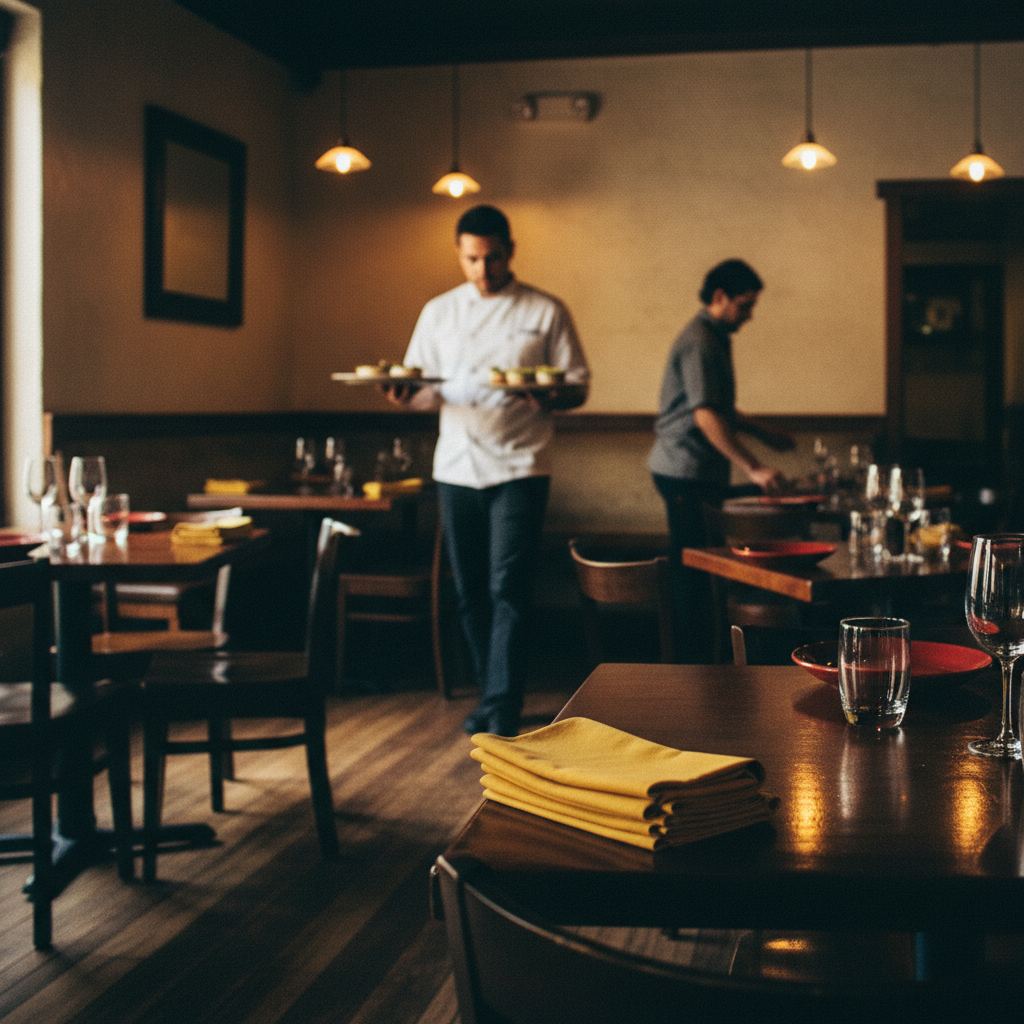
Chandler food service. Illustration generated with AI. Not a photograph of a Foody Finance client or location.
What drives financing conversations in Chandler
Funding here goes toward heavy-duty HVAC and misting systems needed to keep patios usable into late spring, along with staffing built around the tech-worker lunch rush near the Price Road corridor. New buildouts in fast-growing residential pockets also need capital to open ahead of rooftop demand rather than waiting for it to fully arrive.
Revenue and seasonality in Chandler
Weekday lunch business tied to the tech and semiconductor employers along the Price Road corridor carries much of the revenue, with evening and weekend traffic filling in around residential growth areas like Ocotillo. Summer heat pushes patio-dependent traffic down hard from June through September, which flattens cash flow right when utility costs climb.
What this does to your numbers
Weekday lunch crowds keep things steady most of the year, but summer heat can quiet the patio for months.
Permitting in Chandler, and what it costs to wait
Maricopa County Environmental Services handles food establishment permitting for Chandler, while liquor licensing runs through the Arizona Department of Liquor Licenses and Control on a separate state-level track. A concept can finish build-out and pass county inspection while still waiting on state alcohol approval, so financing has to keep the doors open on food revenue alone during that stretch.
What the wait actually costs
Waiting on a state liquor license means running on food sales alone for a while after opening.
What raises the cost of capital here
01Summer heat forces heavier HVAC use and shortens usable patio months to roughly eight a year
02State-level liquor licensing timelines run independently of county health permitting
03New residential development means some locations open before nearby rooftop density fully matures
Which program usually fits here
Equipment financingcovers the HVAC upgrades summer demands, and buildout financing supports opening in fast-growing areas ahead of full rooftop demand.
Arizona outline. Boundary data: US Census Bureau cartographic boundary files, public domain. Simplified for display.
A loan or lease tied to a specific machine. The machine itself is the security, so approval leans on the value of the hardware more than on your bank statements.
covers
The number of guests served. Lenders pair it with check average to judge how reliable a month really is.
buildout capital
Money for the work that turns a space into a working kitchen: plumbing, electrical, hoods, walls, and permits. It pays for labor and materials you cannot resell, so it is priced differently than money for a fryer.
underwriting
The lender reading your numbers to decide how much risk you are. Bank statements, time in business, and existing debt carry the most weight.
draw
Taking money out of an approved line or loan. Draws tied to construction milestones mean you only start paying interest on each piece as you use it.
working capital
Cash for the everyday gaps: payroll, inventory, rent, and repairs. It is repaid out of daily or weekly sales rather than from one big event.
hard credit pull
A formal credit check that shows on your report and can move your score a few points. It happens only after you pick a specific lender, not to get information.
commissary
A licensed production kitchen used to prep off site, most often by trucks and catering operations. It carries its own rent, equipment, and permits.
term
How long you have to repay. A longer term lowers the monthly payment and raises what the money costs in total.
Why does Chandler's summer heat matter more for financing than in a milder climate city?
Once temperatures regularly pass 100 degrees, patio seating along corridors like Ocotillo and downtown Chandler goes largely unused from June through September, cutting total seating capacity for a third of the year. Equipment financing for stronger HVAC or shade and misting systems is often what keeps a location viable through that stretch rather than losing the summer entirely.
How does opening near Chandler's tech corridor affect underwriting?
A location built around the Price Road tech and semiconductor employment corridor depends heavily on weekday lunch volume, which makes revenue more sensitive to layoffs or hybrid work shifts among a handful of large employers. Lenders weighing a buildout request in that area tend to look closely at how diversified the customer base is beyond that one lunch crowd.
How does being a suburb of Phoenix rather than a standalone city change how a Chandler restaurant's numbers should be read?
A Chandler restaurant's revenue pattern often looks steadier month to month than a downtown Phoenix or Scottsdale restaurant's, because a large share of its weekday traffic comes from stable employers like Intel rather than from tourism or nightlife that swings hard with the winter snowbird season. Lenders looking at a Chandler location's numbers should expect a real but smaller summer dip, driven mainly by lost patio seating rather than lost customers outright, and a modest winter bump as regional tourism spills over from Phoenix and Scottsdale. A restaurant showing a summer collapse as steep as a downtown Scottsdale bar's is unusual for this market and worth a closer look.
How do Chandler food businesses start a financing conversation?
Start with a free review by a specialist. You share the basics of the business, the use of funds, and recent bank statements, and you see every program that fits before any credit application exists. Short term options commonly fund in 1 to 3 business days once you choose an offer.
Do you serve areas outside Chandler in Arizona?
Yes. Every program is available statewide in Arizona and nationwide.
What is equipment financing, and when does it fit a Chandler operator?
You borrow against a specific machine, and the machine is what backs the loan. Use it when a fryer, a walk-in, an oven, or a vehicle has to be replaced and you would rather keep the cash in the account. Typical size is 5,000 to 500,000, funding runs 1 to 5 business days once you choose an offer, and you repay it as fixed monthly payment. You will be asked for: application, equipment quote, bank statements.
What is buildout and expansion, and when does it fit a Chandler operator?
Construction money for the work that turns a space into a working kitchen, usually released in stages as the job progresses. Use it for a second location, a remodel, a patio, or a kitchen conversion, and size it to cover the permit wait, not just the build. Typical size is 50,000 to 2,000,000, funding runs 1 to 4 weeks once you choose an offer, and you repay it as fixed payment, often with a draw schedule. You will be asked for: application, contractor bids, lease, financials.
What is working capital, and when does it fit a Chandler operator?
Cash for the everyday gaps, repaid out of sales on a set schedule instead of at the end of a project. Use it for payroll, inventory, a slow stretch, or a job you have to fund before the client pays you. Typical size is 10,000 to 500,000, funding runs 1 to 3 business days once you choose an offer, and you repay it as fixed daily, weekly, or monthly payment. You will be asked for: application, 3 to 6 months of bank statements.
Why does the Chandler calendar change what I should borrow?
Weekday lunch crowds keep things steady most of the year, but summer heat can quiet the patio for months.
What does waiting actually cost me in Chandler?
Waiting on a state liquor license means running on food sales alone for a while after opening.
Which program do most Chandler operators end up using?
Equipment financing covers the HVAC upgrades summer demands, and buildout financing supports opening in fast-growing areas ahead of full rooftop demand. That is a starting point, not a decision. The specialist review looks at your deposits, your time in business, and what the money is for before anything is recommended.
Does asking about financing in Chandler affect my credit?
No. Getting information is a conversation, not an application. There is no credit application and no hard credit pull until you have picked a specific lender and want to move forward.
Start the conversation
Talk to a specialist before you fill out an application.
Start with a free, no-obligation review. We will send the right application only after we know what you actually qualify for.