Straddling both Dallas and Tarrant counties, a Grand Prairie restaurant owner can end up navigating two different sets of local rules depending on which side of the property line the kitchen sits on.
How do Grand Prairie food businesses get funded?
Grand Prairie operators start with a free review with a specialist, share recent business bank statements, and are matched to the programs that fit the use of funds. Working capital funds in 1 to 3 business days after you choose an offer, equipment in 1 to 5, and buildout capital in 1 to 4 weeks.
Estimates, not offers: Amounts, terms, and funding times are estimates based on programs commonly available in food service. Actual terms vary by program, lender underwriting, time in business, revenue, and credit profile. Nothing here is an offer of credit or a guarantee of approval. See source and method.
How Grand Prairie eats, and what that does to cash
01
Where Grand Prairie eats
Epic Central, the city's newer downtown development around the Epic Waters indoor water park and convention center, has become the main draw for family dining and event catering, pricing mid-range at 15 to 25 dollars a plate. Lone Star Park, the horse racing track on the city's north side, drives seasonal restaurant and bar traffic tied directly to its live racing calendar rather than a year-round crowd. The Texas Trust CU Theatre and Uptown Theater, both concert venues, pull pre-show dinner traffic to nearby chain and independent restaurants on show nights, creating demand spikes that do not repeat on off nights. The Great Southwest Industrial District, one of the largest industrial parks in Texas, supports blue collar lunch spots and taco trucks serving warehouse and logistics workers on tight lunch windows rather than sit-down service. Older Grand Prairie neighborhoods along Main Street hold a smaller cluster of long-running Tex-Mex restaurants that serve a stable local customer base distinct from the entertainment district crowds drawn to Epic Central and the concert venues.
02
What Grand Prairie actually eats
Tex-Mex is the steadiest everyday format citywide, with family-run restaurants along Main Street and Camp Wisdom Road serving combination plates priced 10 to 15 dollars for a weekday lunch crowd. Barbecue trailers and smaller barbecue restaurants have grown near the industrial district, serving brisket and sausage plates to warehouse workers on lunch breaks, typically counter service with minimal seating. Concert venue nights at Texas Trust CU Theatre create a distinct fast, high-volume dinner rush at nearby restaurants, with tables turning quickly before showtime and then going empty once doors open. Lone Star Park's live racing season brings a sit-down dining room and simulcast bar crowd that eats and drinks through race cards on weekend afternoons and evenings during the meet. Epic Waters and the surrounding Epic Central development have brought food hall style counter service options aimed at families visiting the water park, running longest hours on weekends and school breaks. Drive-through chains dominate the retail corridors along State Highway 161, built for commuter traffic passing between Dallas and Fort Worth rather than destination dining.
03
The Grand Prairie calendar
Lone Star Park's live thoroughbred racing meet runs primarily in spring, and restaurants and bars on the property see their heaviest weeks then, followed by a long stretch of lighter simulcast-only business the rest of the year. Lockheed Martin's Grand Prairie plant and the Great Southwest Industrial District provide steady weekday lunch demand year round that does not follow a seasonal pattern the way the entertainment venues do. Concert schedules at Texas Trust CU Theatre and Uptown Theater run heaviest in the spring and fall touring seasons, with fewer shows booked during the hottest summer weeks and around the December holidays. Epic Waters draws its largest crowds during Dallas-area school breaks, especially spring break in March and the full summer months from June through August, with a corresponding drop each September when schools resume. Cold snaps in January and February, including occasional winter storms that affect the whole Dallas-Fort Worth region, can shut down outdoor event schedules and cut foot traffic across all four of these districts at once.
04
Growth and cost pattern
New restaurant development concentrates around Epic Central, where the city has actively courted new construction near the water park and convention center, offering newer buildout shells compared to older strip centers elsewhere in the city. State Highway 161 and the interchange with I-30 have also drawn new retail construction, aimed at capturing commuter traffic moving between Dallas and Fort Worth rather than serving Grand Prairie residents specifically. Commercial rent in Grand Prairie runs below neighboring Arlington and Irving, which has made it a landing spot for restaurant groups priced out of those markets, though rents near Epic Central have risen as that development has filled in. Labor competes with the Great Southwest Industrial District's warehouse and logistics jobs, which often pay comparable hourly wages to entry-level kitchen work, making staffing harder for restaurants that cannot match those rates. Event-driven revenue at Lone Star Park and the concert venues creates uneven weekly cash flow for restaurants near those properties, since a slow week without a race card or a booked show can leave those same dining rooms largely empty.
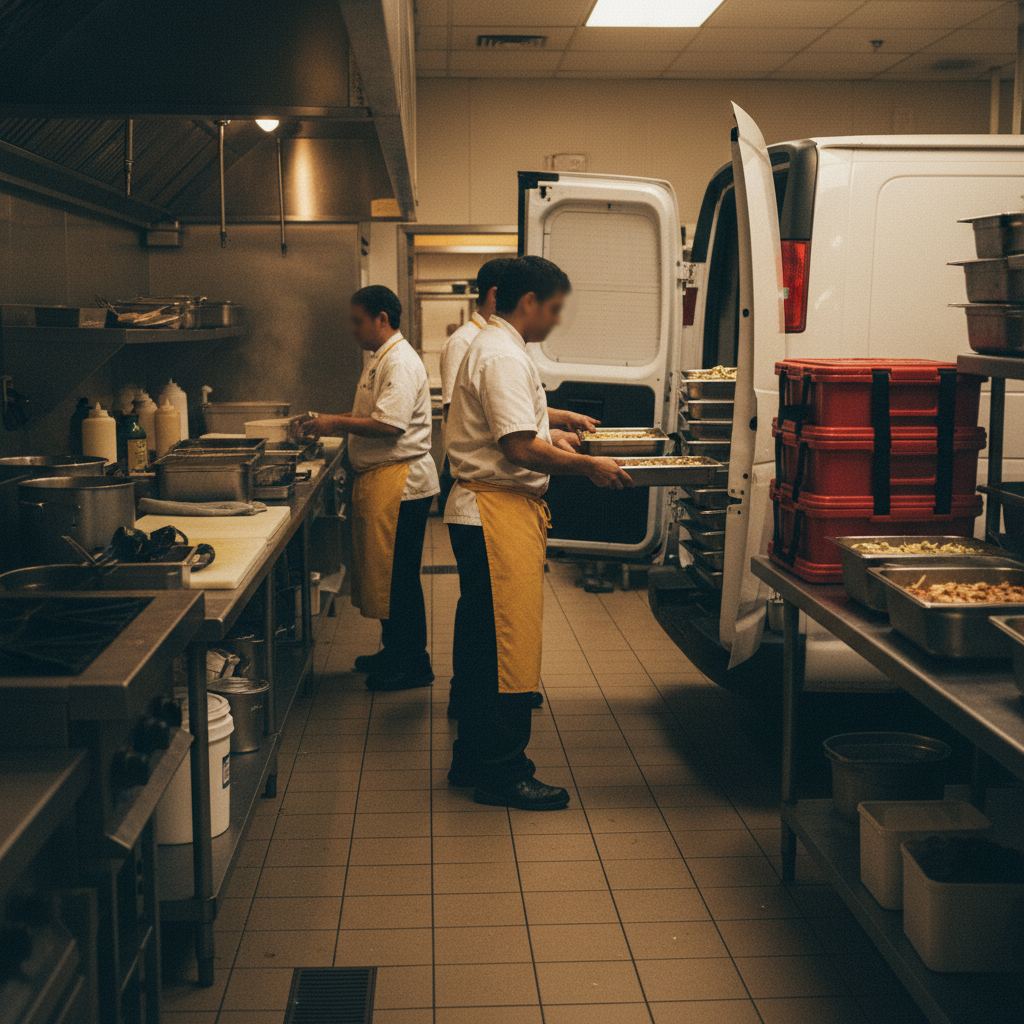
Grand Prairie food service. Illustration generated with AI. Not a photograph of a Foody Finance client or location.
What drives financing conversations in Grand Prairie
Restaurants near Epic Waters and the Lone Star Park entertainment district use capital to staff up for event-driven weekend surges tied to racing and water park seasons. Downtown Grand Prairie operators lean on buildout financing to convert older commercial space as the area redevelops around new residential growth nearby.
Revenue and seasonality in Grand Prairie
Lone Star Park racing season and Epic Waters water park draw concentrated weekend crowds for months at a time, while weekday traffic depends more on the area's growing residential base and nearby DFW-area employers. Summer heat drives water park and event traffic up sharply, so revenue is noticeably front-loaded toward the warmer months.
What this does to your numbers
Warm months near the water park and racetrack bring strong weekends, but the calendar the rest of the year is a lot quieter.
Permitting in Grand Prairie, and what it costs to wait
Depending on the exact address, food service inspection in Grand Prairie falls under either the Tarrant County or Dallas County health department, which surprises operators expecting a single city process. Texas Alcoholic Beverage Commission licensing runs statewide and separately from either county's inspection, so a bar buildout near Epic Waters or Lone Star Park should budget for both approvals landing at different times.
What the wait actually costs
Not knowing which county issues your permit can add confusion and lost weeks before an inspection even gets scheduled.
What raises the cost of capital here
01Which county's health department has jurisdiction depends on the exact Grand Prairie address
02TABC licensing timelines run independently of either county's food inspection process
03Racing and water park seasons front-load weekend revenue into warmer months
Which program usually fits here
A working capital line suits scaling staffing up and down with the event seasons, while buildout financing fits converting an older downtown space.
Texas outline. Boundary data: US Census Bureau cartographic boundary files, public domain. Simplified for display.
Taking money out of an approved line or loan. Draws tied to construction milestones mean you only start paying interest on each piece as you use it.
working capital
Cash for the everyday gaps: payroll, inventory, rent, and repairs. It is repaid out of daily or weekly sales rather than from one big event.
buildout capital
Money for the work that turns a space into a working kitchen: plumbing, electrical, hoods, walls, and permits. It pays for labor and materials you cannot resell, so it is priced differently than money for a fryer.
equipment paper
A loan or lease tied to a specific machine. The machine itself is the security, so approval leans on the value of the hardware more than on your bank statements.
hard credit pull
A formal credit check that shows on your report and can move your score a few points. It happens only after you pick a specific lender, not to get information.
covers
The number of guests served. Lenders pair it with check average to judge how reliable a month really is.
underwriting
The lender reading your numbers to decide how much risk you are. Bank statements, time in business, and existing debt carry the most weight.
term
How long you have to repay. A longer term lowers the monthly payment and raises what the money costs in total.
Why might two Grand Prairie restaurants have different health department contacts?
Grand Prairie sits across both Dallas and Tarrant counties, and which health department inspects a given kitchen depends on the property's exact location rather than the city as a whole. Restaurants near Epic Waters may fall under a different county than ones closer to downtown, which affects who to call for a permit renewal or inspection scheduling question.
How should a restaurant near Lone Star Park plan for seasonal revenue swings?
Racing season and Epic Waters' operating months bring in concentrated weekend crowds that don't carry through the full year, so restaurants nearby often see a front-loaded revenue pattern tied to warmer months. Working capital is commonly used to keep staffing and inventory flexible enough to scale down once the seasonal traffic tapers off.
Why does restaurant traffic near Lone Star Park depend so heavily on the racing calendar?
Lone Star Park runs live thoroughbred racing on a seasonal meet, concentrated mainly in the spring, and the restaurants and bars built into the property depend on race days for their sit-down and bar traffic. Outside the live meet, the venue still operates simulcast wagering, but foot traffic and dining demand drop substantially compared to a live race day. Restaurants near the track that rely on race-day crowds see a clear split between the live meet months and the rest of the year. Lenders reviewing financials for a restaurant near Lone Star Park should separate live meet weeks from the surrounding months rather than averaging them together.
How do Grand Prairie food businesses start a financing conversation?
Start with a free review by a specialist. You share the basics of the business, the use of funds, and recent bank statements, and you see every program that fits before any credit application exists. Short term options commonly fund in 1 to 3 business days once you choose an offer.
Do you serve areas outside Grand Prairie in Texas?
Yes. Every program is available statewide in Texas and nationwide.
What is working capital, and when does it fit a Grand Prairie operator?
Cash for the everyday gaps, repaid out of sales on a set schedule instead of at the end of a project. Use it for payroll, inventory, a slow stretch, or a job you have to fund before the client pays you. Typical size is 10,000 to 500,000, funding runs 1 to 3 business days once you choose an offer, and you repay it as fixed daily, weekly, or monthly payment. You will be asked for: application, 3 to 6 months of bank statements.
What is buildout and expansion, and when does it fit a Grand Prairie operator?
Construction money for the work that turns a space into a working kitchen, usually released in stages as the job progresses. Use it for a second location, a remodel, a patio, or a kitchen conversion, and size it to cover the permit wait, not just the build. Typical size is 50,000 to 2,000,000, funding runs 1 to 4 weeks once you choose an offer, and you repay it as fixed payment, often with a draw schedule. You will be asked for: application, contractor bids, lease, financials.
What is equipment financing, and when does it fit a Grand Prairie operator?
You borrow against a specific machine, and the machine is what backs the loan. Use it when a fryer, a walk-in, an oven, or a vehicle has to be replaced and you would rather keep the cash in the account. Typical size is 5,000 to 500,000, funding runs 1 to 5 business days once you choose an offer, and you repay it as fixed monthly payment. You will be asked for: application, equipment quote, bank statements.
Why does the Grand Prairie calendar change what I should borrow?
Warm months near the water park and racetrack bring strong weekends, but the calendar the rest of the year is a lot quieter.
What does waiting actually cost me in Grand Prairie?
Not knowing which county issues your permit can add confusion and lost weeks before an inspection even gets scheduled.
Which program do most Grand Prairie operators end up using?
A working capital line suits scaling staffing up and down with the event seasons, while buildout financing fits converting an older downtown space. That is a starting point, not a decision. The specialist review looks at your deposits, your time in business, and what the money is for before anything is recommended.
Does asking about financing in Grand Prairie affect my credit?
No. Getting information is a conversation, not an application. There is no credit application and no hard credit pull until you have picked a specific lender and want to move forward.
Start the conversation
Talk to a specialist before you fill out an application.
Start with a free, no-obligation review. We will send the right application only after we know what you actually qualify for.