OK metro

Restaurant financing in Oklahoma City.

Oklahoma City's growth around the Bricktown and Midtown entertainment districts has outpaced older commercial kitchen infrastructure in some of those same buildings.

How do Oklahoma City food businesses get funded?

Oklahoma City operators start with a free review with a specialist, share recent business bank statements, and are matched to the programs that fit the use of funds. Working capital funds in 1 to 3 business days after you choose an offer, equipment in 1 to 5, and buildout capital in 1 to 4 weeks.

Estimates, not offers: Amounts, terms, and funding times are estimates based on programs commonly available in food service. Actual terms vary by program, lender underwriting, time in business, revenue, and credit profile. Nothing here is an offer of credit or a guarantee of approval. See source and method.

How Oklahoma City eats, and what that does to cash

01

Where Oklahoma City eats

Bricktown carries the tourist and convention crowd with canal-front chain restaurants and sports bars feeding Thunder game visitors and out of town conference attendees at $20 to $35 dinner checks. The Plaza District along NW 16th Street holds independent restaurants and craft cocktail bars serving a younger, higher-spending local crowd. Midtown around NW 10th Street mixes converted historic buildings into upscale casual dining feeding downtown office workers and residents. The Paseo Arts District carries a smaller cluster of restaurants tied to gallery walks and weekend foot traffic. Asian District along NW 23rd and 24th Streets holds Vietnamese and Asian grocery-anchored restaurants serving both immigrant families and broader city diners at $10 to $18 tickets. Automobile Alley near downtown mixes lunch-focused cafes with office workers from nearby employers. The suburban corridors of Edmond and Norman pull family dining and chain casual restaurants tied to university and school district populations rather than downtown nightlife. This split between a tourist-facing Bricktown core and resident-facing neighborhood strips means restaurants depend heavily on which side of downtown they sit for steady versus event-driven traffic.
02

What the city actually eats

Oklahoma City is known for chicken fried steak, onion burgers pressed thin on the griddle in the style popularized at Sid's and Tucker's, and fried onion burger stands that trace back to Depression-era El Reno kitchens nearby. Barbecue smokehouses serving brisket and ribs run counter service formats with $12 to $18 plates. Steakhouses tied to the city's cattle and stockyard history, including Cattlemen's Steakhouse near the historic Stockyards City district, serve $25 to $45 dinner checks to both locals and tourists. Drive through and drive-in formats remain common along suburban corridors in Edmond, Moore, and Norman, reflecting the region's car-dependent layout. Food truck clusters gather near downtown office towers on weekday lunches. Craft brewery kitchens have grown in the Plaza District and Automobile Alley, pairing simple pub food with local beer. Late night options concentrate narrowly in Bricktown around bar close rather than spreading citywide. This mix of low-ticket drive through concepts and higher-ticket steakhouse dining means labor scheduling swings sharply between fast lunch rushes and slower, service-heavy dinner shifts.

03

The calendar that runs the year

The Oklahoma City Thunder's NBA season from October through April drives consistent Bricktown and downtown restaurant traffic on game nights at Paycom Center. The state fair each September at the fairgrounds pulls citywide visitors for a two week run, spiking demand at nearby restaurants. Tinker Air Force Base and the Federal Aviation Administration's Mike Monroney Aeronautical Center employ large workforces that anchor steady weekday lunch demand year round regardless of tourism cycles. The University of Oklahoma in nearby Norman drives football Saturdays each fall that spill into Oklahoma City dining for pre- and post-game crowds. Devon Energy and Chesapeake Energy corporate campuses downtown and in the Village anchor office lunch traffic tied to energy sector employment cycles. Summer months bring slower downtown lunch traffic as office workers take vacation and OU is out of session, while conventions at the Oklahoma City Convention Center create scattered multi-day spikes through the year. This combination of energy sector employment, a single NBA season, and one concentrated fair week means restaurant revenue depends on stacking several distinct calendars rather than one steady season.

04

Growth and cost pattern

New restaurant construction concentrates along the Plaza District, Midtown's NW 10th corridor, and suburban growth areas in Edmond and Moore, where commercial land remains inexpensive compared to coastal metros. Downtown buildout in older Midtown warehouse buildings often requires asbestos abatement and structural upgrades before a kitchen can open, adding delays uncommon in newer suburban strip centers. Labor costs run below national averages given Oklahoma's lower minimum wage and cost of living, giving operators more room in payroll budgets than coastal cities. Tornado season each spring, typically April through June, adds insurance and construction timing risk for any buildout scheduled during those months, since contractors and materials can be delayed by storm damage elsewhere in the region. Utility costs stay moderate, though summer cooling loads for kitchen HVAC systems run high given consistent 90-plus degree stretches. Suburban strip center leases in Edmond and Moore typically move faster through permitting than downtown historic district reviews. These combined seasonal storm risk and downtown historic permitting delays mean buildout timelines can slip by months depending on which part of the metro a new restaurant chooses.

Food service operation in Oklahoma City
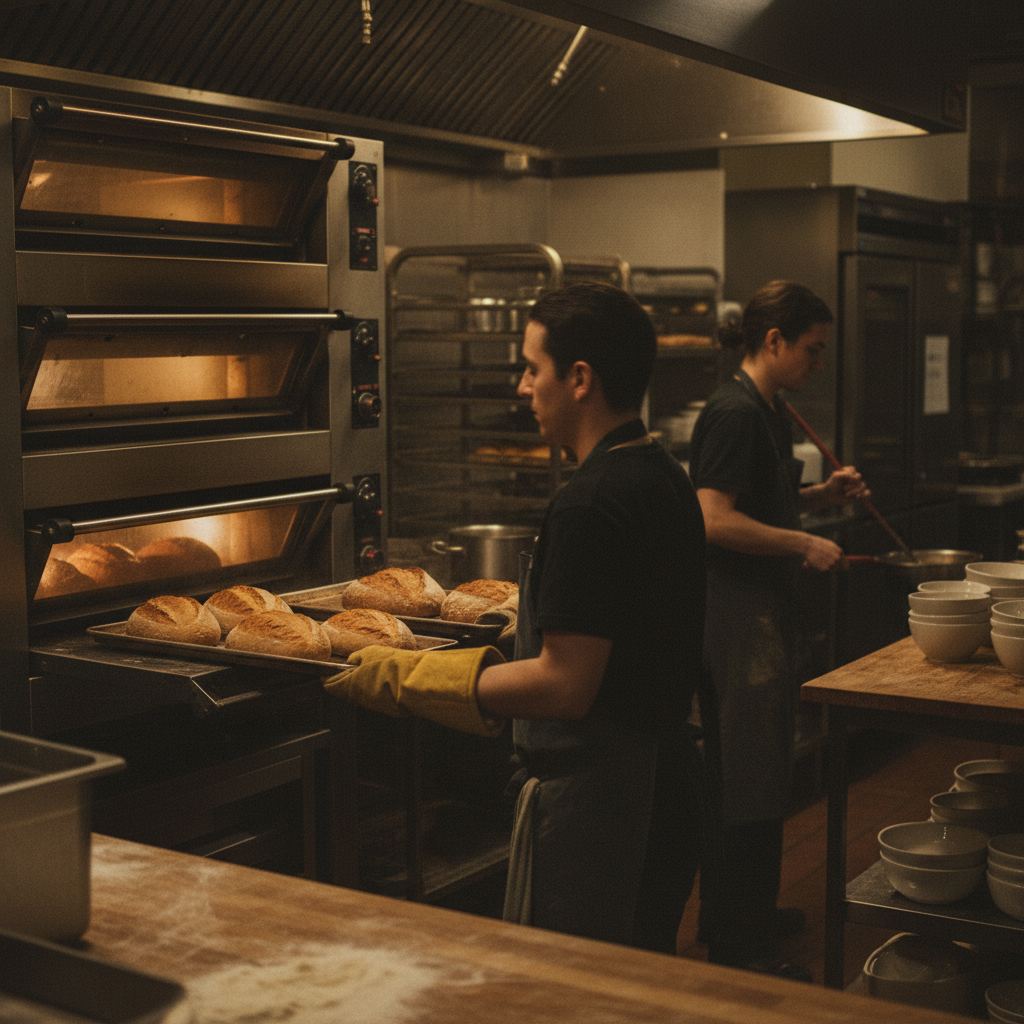
Oklahoma City food service. Illustration generated with AI. Not a photograph of a Foody Finance client or location.

What drives financing conversations in Oklahoma City

Financing here frequently covers converting warehouse and older commercial spaces in Automobile Alley and Bricktown into working kitchens, which means grease trap, hood, and electrical upgrades on top of standard buildout costs. Severe weather season also pushes some owners toward backup power and storm-rated construction investments that a calmer climate wouldn't require.

Revenue and seasonality in Oklahoma City

Bricktown draws steady tourist and event traffic tied to Thunder home games and nearby ballpark events, while Plaza District and Midtown lean on local weekend dining crowds. Severe weather season in spring can force sudden short-term closures, so cash flow planning needs a buffer for unplanned days off that a calmer climate elsewhere wouldn't require.

What this does to your numbers

Game nights and ballpark events bring in a lot of business at once, but the calendar between them can be slow.

Permitting in Oklahoma City, and what it costs to wait

The Oklahoma City-County Health Department handles food service permitting while the city's Development Services Department manages building permits and inspections separately, and older warehouse conversions in Automobile Alley often require electrical and structural upgrades uncovered during that process. Oklahoma's ABLE Commission issues liquor licenses on its own state-level timeline, which can leave a finished bar space waiting weeks for its pour license.

What the wait actually costs

Older warehouse buildings often need surprise electrical work before you can open, which adds cost after the plan is already set.

What raises the cost of capital here

  • 01Warehouse conversions in Automobile Alley often require electrical and structural upgrades beyond standard buildout costs.
  • 02Thunder home games and ballpark events concentrate Bricktown foot traffic into specific nights rather than spreading evenly.
  • 03Spring severe weather season can force sudden closures that a fixed loan payment doesn't accommodate.

Which program usually fits here

Equipment financing covers the surprise repair costs, while a credit line handles the sudden closures storm season sometimes forces.

Oklahoma City
Oklahoma outline. Boundary data: US Census Bureau cartographic boundary files, public domain. Simplified for display.

Free review, no hard credit pull

Get funds now and review your options

Step 01 of 03 · Your operation

A specialist reviews every request and reaches out the same business day

Areas we serve

  • Bricktown
  • Midtown
  • Automobile Alley
  • Plaza District
  • Western Avenue

Financing terms on this page

Definitions for the terms used above.

draw
Taking money out of an approved line or loan. Draws tied to construction milestones mean you only start paying interest on each piece as you use it.
term
How long you have to repay. A longer term lowers the monthly payment and raises what the money costs in total.
equipment paper
A loan or lease tied to a specific machine. The machine itself is the security, so approval leans on the value of the hardware more than on your bank statements.
covers
The number of guests served. Lenders pair it with check average to judge how reliable a month really is.
buildout capital
Money for the work that turns a space into a working kitchen: plumbing, electrical, hoods, walls, and permits. It pays for labor and materials you cannot resell, so it is priced differently than money for a fryer.
working capital
Cash for the everyday gaps: payroll, inventory, rent, and repairs. It is repaid out of daily or weekly sales rather than from one big event.
hard credit pull
A formal credit check that shows on your report and can move your score a few points. It happens only after you pick a specific lender, not to get information.
underwriting
The lender reading your numbers to decide how much risk you are. Bank statements, time in business, and existing debt carry the most weight.

Oklahoma City financing questions

How do Thunder games affect restaurant revenue in Bricktown?

OKC Thunder home games and events at the nearby ballpark draw concentrated foot traffic into Bricktown on specific nights, and many restaurants in the district plan staffing and inventory around the game schedule rather than a flat weekly pattern. Financing sized around that uneven demand fits better than one built on a simple monthly average.

Why do older buildings in Automobile Alley cost more to convert into restaurants?

Many buildings in Automobile Alley started as warehouse or light industrial space, and converting them into working kitchens often uncovers electrical and structural issues that the city's Development Services Department requires fixing before occupancy sign-off. That discovery typically happens after demolition starts, past the point of the original budget estimate.

How does Oklahoma City's tornado season affect restaurant operations?

Spring storm season, typically April through June, brings warning sirens and sudden closures that can empty a dining room mid-service with little notice, and severe outbreaks sometimes force full-day shutdowns for staff and customer safety. Restaurants near Moore and south Oklahoma City, areas hit by major tornadoes in past decades, often carry higher property insurance premiums as a result. Lenders reviewing an Oklahoma City restaurant's monthly numbers should expect occasional unexplained single-day revenue drops each spring tied to storm activity rather than to the business itself, and should factor insurance costs above the national average for food service properties in storm-prone corridors.

How do Oklahoma City food businesses start a financing conversation?

Start with a free review by a specialist. You share the basics of the business, the use of funds, and recent bank statements, and you see every program that fits before any credit application exists. Short term options commonly fund in 1 to 3 business days once you choose an offer.

Do you serve areas outside Oklahoma City in Oklahoma?

Yes. Every program is available statewide in Oklahoma and nationwide.

What is equipment financing, and when does it fit a Oklahoma City operator?

You borrow against a specific machine, and the machine is what backs the loan. Use it when a fryer, a walk-in, an oven, or a vehicle has to be replaced and you would rather keep the cash in the account. Typical size is 5,000 to 500,000, funding runs 1 to 5 business days once you choose an offer, and you repay it as fixed monthly payment. You will be asked for: application, equipment quote, bank statements.

What is buildout and expansion, and when does it fit a Oklahoma City operator?

Construction money for the work that turns a space into a working kitchen, usually released in stages as the job progresses. Use it for a second location, a remodel, a patio, or a kitchen conversion, and size it to cover the permit wait, not just the build. Typical size is 50,000 to 2,000,000, funding runs 1 to 4 weeks once you choose an offer, and you repay it as fixed payment, often with a draw schedule. You will be asked for: application, contractor bids, lease, financials.

What is working capital, and when does it fit a Oklahoma City operator?

Cash for the everyday gaps, repaid out of sales on a set schedule instead of at the end of a project. Use it for payroll, inventory, a slow stretch, or a job you have to fund before the client pays you. Typical size is 10,000 to 500,000, funding runs 1 to 3 business days once you choose an offer, and you repay it as fixed daily, weekly, or monthly payment. You will be asked for: application, 3 to 6 months of bank statements.

Why does the Oklahoma City calendar change what I should borrow?

Game nights and ballpark events bring in a lot of business at once, but the calendar between them can be slow.

What does waiting actually cost me in Oklahoma City?

Older warehouse buildings often need surprise electrical work before you can open, which adds cost after the plan is already set.

Which program do most Oklahoma City operators end up using?

Equipment financing covers the surprise repair costs, while a credit line handles the sudden closures storm season sometimes forces. That is a starting point, not a decision. The specialist review looks at your deposits, your time in business, and what the money is for before anything is recommended.

Does asking about financing in Oklahoma City affect my credit?

No. Getting information is a conversation, not an application. There is no credit application and no hard credit pull until you have picked a specific lender and want to move forward.

Start the conversation

Talk to a specialist before you fill out an application.

Start with a free, no-obligation review. We will send the right application only after we know what you actually qualify for.

Start a free review

Prefer to call

(833) 505-1900