Fort Worth's stockyards tourism and downtown business lunch crowd pull in opposite directions, and a menu built for one doesn't automatically work for the other.
How do Fort Worth food businesses get funded?
Fort Worth operators start with a free review with a specialist, share recent business bank statements, and are matched to the programs that fit the use of funds. Working capital funds in 1 to 3 business days after you choose an offer, equipment in 1 to 5, and buildout capital in 1 to 4 weeks.
Estimates, not offers: Amounts, terms, and funding times are estimates based on programs commonly available in food service. Actual terms vary by program, lender underwriting, time in business, revenue, and credit profile. Nothing here is an offer of credit or a guarantee of approval. See source and method.
How Fort Worth eats, and what that does to cash
01
Where Fort Worth eats
The Stockyards National Historic District runs steakhouses, saloons, and tourist-facing barbecue joints priced from 20 to 40 dollars a plate, drawing convention visitors and out-of-town families more than locals. Near Southside, along Magnolia Avenue, holds a walkable strip of chef-driven restaurants and bars aimed at a 25 to 45 age band spending 15 to 30 dollars per entree. West 7th mixes apartment towers with patio bars and chain-adjacent concepts that lean on TCU students and young professionals for weeknight volume. Sundance Square downtown carries the business-lunch and pre-theater dinner trade tied to the Bass Performance Hall and nearby office towers, quiet on weekends once office workers leave. Camp Bowie Boulevard runs a longer stretch of steakhouses and Tex-Mex spots serving a wealthier, car-dependent West Side crowd rather than pedestrian traffic. Fairmount and the Near Eastside have added lower-cost taco trucks and family-run kitchens serving working residents rather than visitors. These districts pull from separate customer bases on separate schedules, so a Stockyards-style tourist concept transplanted into Near Southside will not draw the same walk-in volume, and that gap surfaces first as a slow opening quarter.
02
What Fort Worth actually orders
Tex-Mex dominates counter-service and sit-down menus alike, with combination plates typically running 10 to 18 dollars across the city's west and south sides. Chicken fried steak remains a standard plate-lunch item at diners and cafeterias, particularly along Camp Bowie and in older Southside neighborhoods. Brisket-forward barbecue, smoked low and slow, anchors both Stockyards tourist stops and neighborhood trailers, with a full plate running 14 to 24 dollars depending on the cut. Chili parlors and Frito pie stands persist as a specifically Fort Worth format, distinct from Dallas menus across the river. Rodeo-season food stands at the Stockyards and Will Rogers Memorial Center run a fairground format built for high volume and short dwell time. Craft breweries in the Near Southside and Race Street corridor pair small-batch beer with counter-order barbecue or wood-fired pizza. Patio dining is standard citywide given the mild fall and spring, but summer heat above 95 degrees pushes outdoor seating capacity down for months at a time, and that seasonal patio loss cuts directly into peak-hour seating revenue.
03
The Fort Worth calendar
The Fort Worth Stock Show and Rodeo, running from mid-January through early February, is the single largest annual driver of Stockyards and West Side restaurant volume, pulling in visitors from across North Texas for three weeks. Texas Christian University's fall semester and home football Saturdays feed West 7th and the Near Southside with student and alumni traffic from September through November. Lockheed Martin's nearby manufacturing plant and Bell's helicopter operations support steady weekday lunch demand in the western suburbs and along Camp Bowie. Downtown's convention calendar, tied to the Fort Worth Convention Center and Bass Performance Hall events, drives weekday dinner traffic independent of the Stock Show cycle. Dallas Fort Worth International Airport's cargo and travel volume supports a base of business travel dining that holds steadier than tourist-driven demand. Summer months, June through August, see reduced patio capacity and slower weekend tourism as heat pushes visitors indoors or out of the region entirely. The Stock Show's three-week concentration means a Stockyards restaurant can generate a disproportionate share of annual revenue in January and February alone, leaving the rest of the year to carry fixed costs on thinner volume.
04
Growth and cost in Fort Worth
New restaurant openings cluster in the Near Southside along Magnolia Avenue and in West 7th, where multifamily construction has added rooftops within walking distance of new kitchens. The Stockyards has seen recent redevelopment adding hotel rooms and event space, drawing operators willing to pay premium rent for guaranteed tourist foot traffic. Rent along Magnolia Avenue has climbed as the corridor filled in over the past decade, pushing newer concepts toward Fairmount and the Near Eastside for lower square-footage costs. Labor competition with Dallas, a short commute east, pulls experienced kitchen staff toward higher-paying Dallas kitchens, tightening the hiring pool for Fort Worth operators. Buildout costs for Stockyards-area spaces run higher due to historic-district design requirements that limit exterior changes and add permitting time. Summer utility costs spike as air conditioning runs continuously from June through September to keep dining rooms comfortable against consistent 95-plus degree heat. Water and grease-trap requirements for barbecue-heavy concepts add equipment costs uncommon in lighter-menu cities. Together, historic-district permitting delays and Dallas-driven labor competition push both opening timelines and payroll costs higher than a comparable Texas city without those pressures, and that combination shows up as slower breakeven timelines.
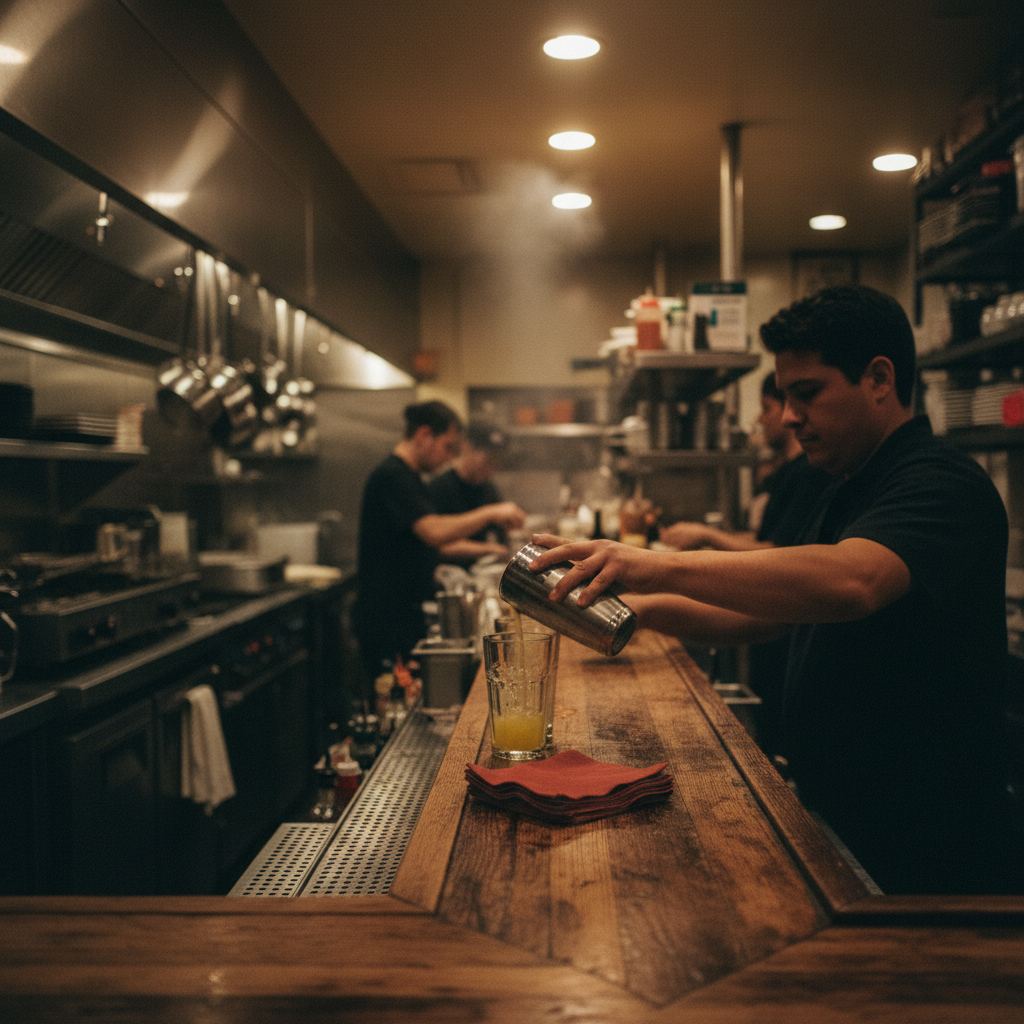
Fort Worth food service. Illustration generated with AI. Not a photograph of a Foody Finance client or location.
What drives financing conversations in Fort Worth
Capital here often goes toward smoker and grill equipment built for high-volume barbecue service, plus buildouts near the Stockyards District that meet historic preservation standards. Sundance Square and West 7th nightlife draws late crowds that require bar licensing and extended kitchen hours, both of which raise staffing and equipment costs before the doors open.
Revenue and seasonality in Fort Worth
Stock show season in late January and February drives a surge in Stockyards traffic that many operators plan staffing around months ahead. Downtown weekday lunch depends on office worker volume, while West 7th and Sundance Square carry weekend and event-night revenue, so cash flow swings hard between weekday and weekend patterns.
What this does to your numbers
Weekday lunch money and weekend bar money come from different crowds, so your slow days and busy days don't line up evenly.
Permitting in Fort Worth, and what it costs to wait
Tarrant County Public Health issues the food establishment permit while the City of Fort Worth handles building and fire code separately, and any Stockyards District address adds historic district design review before construction starts. Texas alcohol licensing through the TABC runs on its own timeline, so a bar buildout can sit finished but unable to pour.
What the wait actually costs
A historic district address or a liquor license application can leave you paying rent on a space you can't fully use yet.
What raises the cost of capital here
01Historic district design review in the Stockyards adds construction sign-off time beyond standard permitting.
02TABC alcohol licensing runs separately from city building permits and can outlast the buildout timeline.
03Stock show season staffing ramps up costs weeks before the seasonal revenue actually arrives.
Which program usually fits here
An SBA loan fits a full buildout timeline, while a credit line covers the stock show ramp-up before the crowds arrive.
Texas outline. Boundary data: US Census Bureau cartographic boundary files, public domain. Simplified for display.
A bank loan partly guaranteed by the Small Business Administration. Lowest cost of the options, longest paperwork, and the slowest to fund.
covers
The number of guests served. Lenders pair it with check average to judge how reliable a month really is.
working capital
Cash for the everyday gaps: payroll, inventory, rent, and repairs. It is repaid out of daily or weekly sales rather than from one big event.
equipment paper
A loan or lease tied to a specific machine. The machine itself is the security, so approval leans on the value of the hardware more than on your bank statements.
hard credit pull
A formal credit check that shows on your report and can move your score a few points. It happens only after you pick a specific lender, not to get information.
buildout capital
Money for the work that turns a space into a working kitchen: plumbing, electrical, hoods, walls, and permits. It pays for labor and materials you cannot resell, so it is priced differently than money for a fryer.
draw
Taking money out of an approved line or loan. Draws tied to construction milestones mean you only start paying interest on each piece as you use it.
underwriting
The lender reading your numbers to decide how much risk you are. Bank statements, time in business, and existing debt carry the most weight.
term
How long you have to repay. A longer term lowers the monthly payment and raises what the money costs in total.
Why does opening a bar in the Stockyards take longer than expected?
A Stockyards District address triggers historic preservation design review through the city on top of the standard Tarrant County Public Health permit and separate TABC alcohol license application. Each track runs on its own schedule, and a buildout can be physically complete while still waiting on a pour license, which means financing needs to cover rent and payroll during that gap.
How does Fort Worth's Stock Show affect restaurant cash flow?
The Fort Worth Stock Show and Rodeo in January and February pulls heavy foot traffic into the Stockyards and surrounding areas, and many operators staff up and stock inventory in the weeks before it starts. That upfront spend happens before the revenue lands, so working capital timed to that calendar matters more than a loan sized only for average monthly sales.
How does the Fort Worth Stock Show affect a restaurant's yearly numbers?
For Stockyards-area and West Side restaurants, mid-January through early February can represent a disproportionate share of annual revenue, since the Stock Show and Rodeo pulls regional visitors who do not return in similar volume the rest of the year. A lender reviewing statements for a Fort Worth restaurant should ask whether a location sits inside the Stock Show's pull radius or depends on TCU's academic calendar and Near Southside foot traffic instead, since those two revenue patterns peak in different months and carry different risk if either season underperforms.
How do Fort Worth food businesses start a financing conversation?
Start with a free review by a specialist. You share the basics of the business, the use of funds, and recent bank statements, and you see every program that fits before any credit application exists. Short term options commonly fund in 1 to 3 business days once you choose an offer.
Do you serve areas outside Fort Worth in Texas?
Yes. Every program is available statewide in Texas and nationwide.
What is equipment financing, and when does it fit a Fort Worth operator?
You borrow against a specific machine, and the machine is what backs the loan. Use it when a fryer, a walk-in, an oven, or a vehicle has to be replaced and you would rather keep the cash in the account. Typical size is 5,000 to 500,000, funding runs 1 to 5 business days once you choose an offer, and you repay it as fixed monthly payment. You will be asked for: application, equipment quote, bank statements.
What is sba loans, and when does it fit a Fort Worth operator?
A bank loan partly guaranteed by the Small Business Administration, which is why the payment is the lowest available. Use it when you can plan months ahead. It is the cheapest money on this page and the slowest to arrive. Typical size is 50,000 to 5,000,000, funding runs 3 to 12 weeks once you choose an offer, and you repay it as amortized interest, lowest payment of any program. You will be asked for: tax returns, interim financials, debt schedule, plan.
What is working capital, and when does it fit a Fort Worth operator?
Cash for the everyday gaps, repaid out of sales on a set schedule instead of at the end of a project. Use it for payroll, inventory, a slow stretch, or a job you have to fund before the client pays you. Typical size is 10,000 to 500,000, funding runs 1 to 3 business days once you choose an offer, and you repay it as fixed daily, weekly, or monthly payment. You will be asked for: application, 3 to 6 months of bank statements.
Why does the Fort Worth calendar change what I should borrow?
Weekday lunch money and weekend bar money come from different crowds, so your slow days and busy days don't line up evenly.
What does waiting actually cost me in Fort Worth?
A historic district address or a liquor license application can leave you paying rent on a space you can't fully use yet.
Which program do most Fort Worth operators end up using?
An SBA loan fits a full buildout timeline, while a credit line covers the stock show ramp-up before the crowds arrive. That is a starting point, not a decision. The specialist review looks at your deposits, your time in business, and what the money is for before anything is recommended.
Does asking about financing in Fort Worth affect my credit?
No. Getting information is a conversation, not an application. There is no credit application and no hard credit pull until you have picked a specific lender and want to move forward.
Start the conversation
Talk to a specialist before you fill out an application.
Start with a free, no-obligation review. We will send the right application only after we know what you actually qualify for.