Arlington's calendar runs on Cowboys home games, Rangers homestands, and Six Flags crowds, so kitchens staff up and down in the same month more than most Texas cities.
How do Arlington food businesses get funded?
Arlington operators start with a free review with a specialist, share recent business bank statements, and are matched to the programs that fit the use of funds. Working capital funds in 1 to 3 business days after you choose an offer, equipment in 1 to 5, and buildout capital in 1 to 4 weeks.
Estimates, not offers: Amounts, terms, and funding times are estimates based on programs commonly available in food service. Actual terms vary by program, lender underwriting, time in business, revenue, and credit profile. Nothing here is an offer of credit or a guarantee of approval. See source and method.
How Arlington eats, and what that does to cash
01
Where Arlington eats
Arlington's Entertainment District, built around AT&T Stadium and Globe Life Field, holds sports bars, brewery kitchens, and large format restaurants sized for pre game and post game crowds, with prices set to absorb high volume on event days and near empty rooms on non event days. Downtown Arlington, smaller and quieter than the Entertainment District, mixes city hall foot traffic with a handful of chef driven restaurants and coffee shops serving a daytime office crowd. The University of Texas at Arlington campus area, west of downtown, runs cheaper counter service and taco spots aimed at student budgets, busy during fall and spring semesters and quiet in summer. Cooper Street and Interstate 20's retail corridors carry the city's chain restaurant density, drawing suburban families at moderate prices on a steady weekly schedule rather than event driven spikes. Six Flags Over Texas runs its own concession food service tied to park hours, not the surrounding neighborhood. Because the Entertainment District depends on scheduled events rather than daily traffic, a single game day there can outsell an entire week at a Cooper Street location, concentrating revenue into specific dates.
02
What Arlington orders
Tex-Mex, from breakfast tacos to fajita platters, runs as a steady sit down and counter service staple across the city at moderate prices, independent of the sports calendar. Barbecue and brewery kitchen combinations cluster in the Entertainment District, pairing smoked brisket plates with craft beer taps in large format rooms built to seat crowds before kickoff or first pitch. Stadium concessions inside AT&T Stadium and Globe Life Field run a separate, higher margin food service system tied strictly to event dates rather than daily walk in traffic. Front Street and the blocks immediately around the ballpark run a patio heavy format, outdoor seating meant to catch foot traffic in the hours before and after games. Chain fast casual and drive through formats dominate Cooper Street and Interstate 20, built for car traffic. Food trucks park near UTA and near the Entertainment District on event days, running a mobile format that can relocate to wherever that week's crowd is largest. Because the Entertainment District's format depends on the Rangers and Cowboys schedules landing on specific dates, a kitchen staffed for a Saturday game sits idle on a Tuesday with no game, creating payroll costs that do not track daily revenue.
03
Arlington's calendar
The Dallas Cowboys season, roughly September through January with games concentrated on Sundays and occasional Monday or Thursday nights, drives the single largest recurring revenue events for Entertainment District restaurants, with each home game functioning as its own mini peak. The Texas Rangers season, April through September with a heavier home schedule in summer, adds a second, more frequent driver of Entertainment District traffic that overlaps briefly with the start of football season each September. Six Flags Over Texas runs full daily hours from roughly March through October and scales back to weekends only in the off season, shifting food service staffing needs sharply between seasons. The University of Texas at Arlington's fall and spring semesters support restaurants near campus, with a summer enrollment drop cutting that area's lunch traffic. The Arlington Convention Center and nearby hotels book meetings year round, concentrated more heavily in spring and fall shoulder seasons. A run of consecutive home games in October, when football and baseball overlap, can produce a cash surplus that must then carry the business through the quieter months of January and February when neither team plays at home.
04
Growth and cost in Arlington
New restaurant development concentrates along Collins Street and inside the Entertainment District itself, where land near the stadiums commands the highest lease rates in the city due to guaranteed event day foot traffic. Cooper Street and the Interstate 20 corridor offer lower rent retail pad sites suited to chain and fast casual buildouts with drive through lanes, a cheaper and faster path to opening than an Entertainment District storefront. Buildouts near the stadiums often require larger kitchen equipment and bar capacity to handle event day volume spikes, raising upfront equipment costs compared to a standard neighborhood restaurant sized for steady daily traffic. Labor costs rise sharply around home games, since operators need enough staff on hand for event day surges but cannot justify that same staffing level on non event weekdays, creating scheduling strain. Utility costs peak in the July through September stretch when both cooling loads and Rangers home games overlap. A restaurant that overbuilds its kitchen and bar capacity to match Cowboys game day demand carries that equipment cost and loan payment through every non game weekday of the year, regardless of whether a game is scheduled.
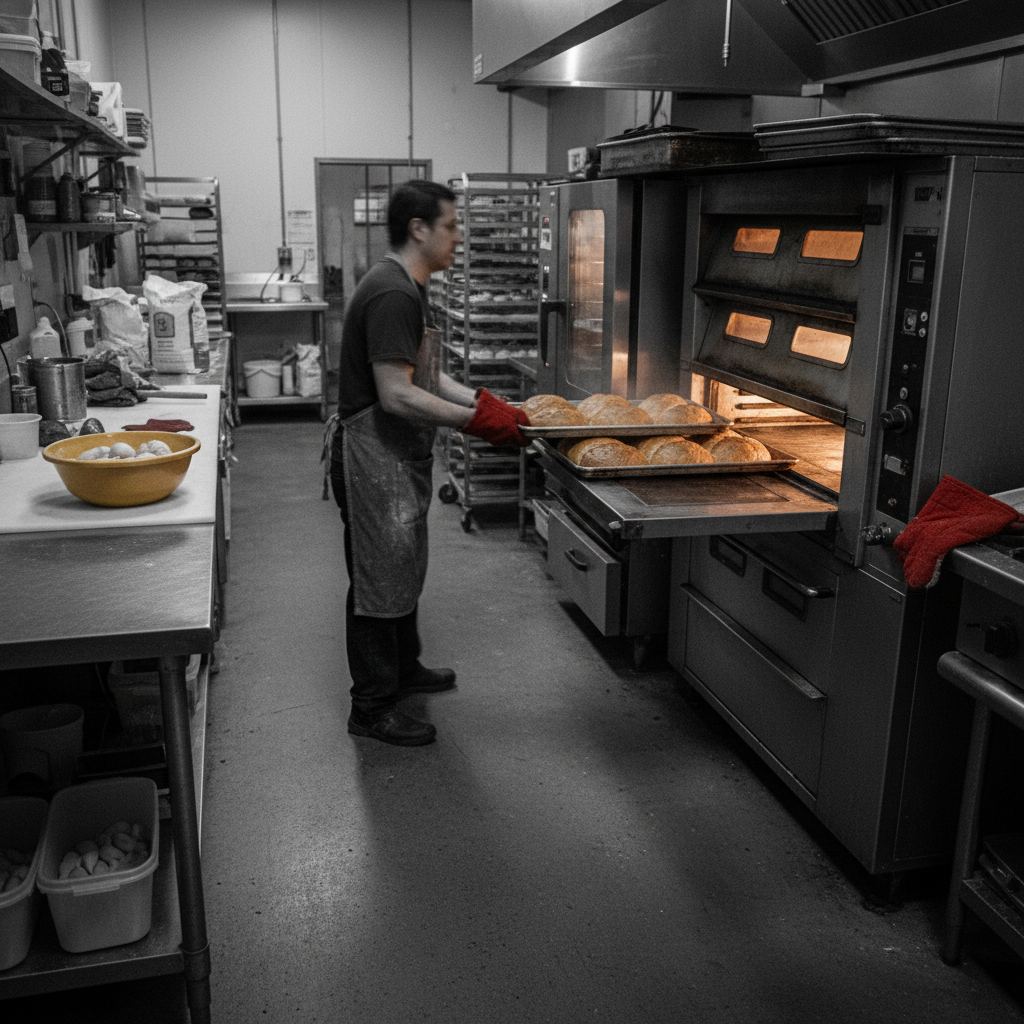
Arlington food service. Illustration generated with AI. Not a photograph of a Foody Finance client or location.
What drives financing conversations in Arlington
Money here tends to go toward walk-in coolers and line equipment sized for game-day surges near the Entertainment District, plus staffing float for the weeks between events. A second wave covers buildouts in growing corridors like Viridian where rooftops are still filling in.
Revenue and seasonality in Arlington
Ticket-holder traffic on event nights drives disproportionate volume against otherwise steady suburban lunch and family dinner business. Checks skew toward groups and pre-game packages, and slow weeks between Cowboys and Rangers dates can leave payroll exposed if a concept built its budget around game-day averages.
What this does to your numbers
Money comes in fast around Cowboys, Rangers, and Six Flags dates, then slows down in between, so the bank balance moves in bursts instead of a steady climb.
Permitting in Arlington, and what it costs to wait
Texas has no state sales tax on food service permits but alcohol sales route through the Texas Alcoholic Beverage Commission on a separate timeline from the City of Arlington's health and building sign-off, and TABC review can run behind a lease start. A bar or full-service concept near the stadiums needs financing that covers rent before the TABC permit clears.
What the wait actually costs
If the alcohol license takes longer than the buildout, rent and staff wages still come due before the bar can pour a drink.
What raises the cost of capital here
01Game-day staffing swings between Cowboys, Rangers, and Six Flags calendars strain labor budgets
02TABC licensing runs on a track separate from city health approval and can outlast a lease's free-rent period
03Suburban buildout costs in newer corridors like Viridian run higher than older strip retail
Which program usually fits here
A line of credit that flexes with event weeks fits better than a lump sum sized off a flat monthly average.
Texas outline. Boundary data: US Census Bureau cartographic boundary files, public domain. Simplified for display.
The number of guests served. Lenders pair it with check average to judge how reliable a month really is.
line of credit
A preapproved pool of money you pull from only when you need it, then pay back and reuse. You pay for what you draw, not for the full amount sitting there.
working capital
Cash for the everyday gaps: payroll, inventory, rent, and repairs. It is repaid out of daily or weekly sales rather than from one big event.
equipment paper
A loan or lease tied to a specific machine. The machine itself is the security, so approval leans on the value of the hardware more than on your bank statements.
buildout capital
Money for the work that turns a space into a working kitchen: plumbing, electrical, hoods, walls, and permits. It pays for labor and materials you cannot resell, so it is priced differently than money for a fryer.
draw
Taking money out of an approved line or loan. Draws tied to construction milestones mean you only start paying interest on each piece as you use it.
hard credit pull
A formal credit check that shows on your report and can move your score a few points. It happens only after you pick a specific lender, not to get information.
underwriting
The lender reading your numbers to decide how much risk you are. Bank statements, time in business, and existing debt carry the most weight.
term
How long you have to repay. A longer term lowers the monthly payment and raises what the money costs in total.
How does the Cowboys and Rangers schedule affect financing timing for a new restaurant near the stadiums?
A concept opening close to AT&T Stadium or Globe Life Field sees revenue concentrated on a limited number of event dates each month, with quieter stretches in between. Financing that assumes even monthly income can undercount payroll needs during non-event weeks, so working capital sized around the actual event calendar, not a flat average, holds up better through the first season.
Does a full bar concept in Arlington need financing that covers a TABC delay?
Yes. TABC issues alcohol permits on a separate review track from the City of Arlington's building and health sign-off, and the two rarely finish at the same time. A buildout loan or credit line that assumes on-time TABC approval can leave a gap where rent and staff wages are due before the bar can legally sell its first drink.
Why does an Entertainment District restaurant's monthly revenue look so uneven compared to one on Cooper Street?
An Entertainment District restaurant near AT&T Stadium or Globe Life Field draws most of its revenue from a fixed number of home game dates published months in advance, so its monthly totals rise and fall with how many games fall inside that specific month. A Cooper Street restaurant serving surrounding neighborhoods sees steadier week to week sales tied to regular car traffic rather than a sports schedule. A lender comparing the two should check the Cowboys and Rangers schedules against the bank statement dates before treating an Entertainment District dip as a sign of trouble, since a month with only one or two home games will look weaker by design.
How do Arlington food businesses start a financing conversation?
Start with a free review by a specialist. You share the basics of the business, the use of funds, and recent bank statements, and you see every program that fits before any credit application exists. Short term options commonly fund in 1 to 3 business days once you choose an offer.
Do you serve areas outside Arlington in Texas?
Yes. Every program is available statewide in Texas and nationwide.
What is equipment financing, and when does it fit a Arlington operator?
You borrow against a specific machine, and the machine is what backs the loan. Use it when a fryer, a walk-in, an oven, or a vehicle has to be replaced and you would rather keep the cash in the account. Typical size is 5,000 to 500,000, funding runs 1 to 5 business days once you choose an offer, and you repay it as fixed monthly payment. You will be asked for: application, equipment quote, bank statements.
What is working capital, and when does it fit a Arlington operator?
Cash for the everyday gaps, repaid out of sales on a set schedule instead of at the end of a project. Use it for payroll, inventory, a slow stretch, or a job you have to fund before the client pays you. Typical size is 10,000 to 500,000, funding runs 1 to 3 business days once you choose an offer, and you repay it as fixed daily, weekly, or monthly payment. You will be asked for: application, 3 to 6 months of bank statements.
What is buildout and expansion, and when does it fit a Arlington operator?
Construction money for the work that turns a space into a working kitchen, usually released in stages as the job progresses. Use it for a second location, a remodel, a patio, or a kitchen conversion, and size it to cover the permit wait, not just the build. Typical size is 50,000 to 2,000,000, funding runs 1 to 4 weeks once you choose an offer, and you repay it as fixed payment, often with a draw schedule. You will be asked for: application, contractor bids, lease, financials.
Why does the Arlington calendar change what I should borrow?
Money comes in fast around Cowboys, Rangers, and Six Flags dates, then slows down in between, so the bank balance moves in bursts instead of a steady climb.
What does waiting actually cost me in Arlington?
If the alcohol license takes longer than the buildout, rent and staff wages still come due before the bar can pour a drink.
Which program do most Arlington operators end up using?
A line of credit that flexes with event weeks fits better than a lump sum sized off a flat monthly average. That is a starting point, not a decision. The specialist review looks at your deposits, your time in business, and what the money is for before anything is recommended.
Does asking about financing in Arlington affect my credit?
No. Getting information is a conversation, not an application. There is no credit application and no hard credit pull until you have picked a specific lender and want to move forward.
Start the conversation
Talk to a specialist before you fill out an application.
Start with a free, no-obligation review. We will send the right application only after we know what you actually qualify for.