TX metro

Restaurant financing in Austin.

Austin is a trailer and brick and mortar market at once, and plenty of operators run both while a permanent location is under construction.

How do Austin food businesses get funded?

Austin operators start with a free review with a specialist, share recent business bank statements, and are matched to the programs that fit the use of funds. Working capital funds in 1 to 3 business days after you choose an offer, equipment in 1 to 5, and buildout capital in 1 to 4 weeks.

Estimates, not offers: Amounts, terms, and funding times are estimates based on programs commonly available in food service. Actual terms vary by program, lender underwriting, time in business, revenue, and credit profile. Nothing here is an offer of credit or a guarantee of approval. See source and method.

How Austin eats, and what that does to cash

01

Where Austin eats

Rainey Street, once a residential block of small bungalows, is now a dense strip of bars and food trailers serving a young, nightlife heavy crowd near downtown high rises. South Congress Avenue mixes boutique shopping with food trailers and mid to high price restaurants serving both tourists and locals within view of the Texas State Capitol. East Austin, historically a working class Latino and Black neighborhood, now holds a dense cluster of chef driven restaurants and breweries that has pushed rents up sharply over the past decade. The Domain, a mixed use development in north Austin, serves the tech worker population employed nearby with chain and upscale casual restaurants. Barton Springs and Zilker Park support a cluster of restaurants serving outdoor recreation crowds on weekends. South Austin along South Lamar holds barbecue trailers and casual restaurants at prices below downtown. Rent near downtown and Rainey Street reflects tourist and convention proximity, while East Austin's rents have risen fastest of any district as new development has concentrated there.
02

What Austin orders

Barbecue is Austin's defining dish, with brisket sold by the pound from trailers and brick and mortar smokehouses that routinely sell out by early afternoon on weekends, a scarcity that shapes local dining habits. Breakfast tacos are a daily staple sold from trailers and counter service shops citywide for a few dollars each. Food trailers, clustered in trailer parks across South Congress, East Austin, and elsewhere, function as a distinct low overhead restaurant format that lets operators test concepts before committing to a full lease. Queso and Tex Mex combination plates remain common at sit down restaurants. Live music venues across downtown and the East Side pair food service with nightly shows, extending kitchen hours later than typical restaurant service. Craft brewery kitchens have expanded across South Austin and East Austin. A barbecue plate by the pound runs fifteen to twenty five dollars, a breakfast taco costs three to five dollars, and a sit down East Austin dinner runs thirty to fifty dollars a person. The food trailer format's lower buildout cost has let new operators enter the market with far less startup capital than a full brick and mortar lease requires.

03

The Austin calendar

South by Southwest each March brings a citywide surge of visitors for music, film, and tech conferences, filling restaurants and bars downtown and on Rainey Street for over a week. Austin City Limits Festival each October draws large crowds to Zilker Park across two consecutive weekends, spiking nearby restaurant and bar traffic. The University of Texas at Austin sets an academic calendar that drives dining near campus and downtown, with a marked slowdown each summer once students leave for break. The state legislature meets in Austin every two years starting in January, bringing a temporary influx of staff and lobbyists that lifts downtown lunch and dinner business during session months. Formula 1's United States Grand Prix each October at Circuit of the Americas draws an international crowd for a single weekend. Summer heat above 100 degrees cuts outdoor dining traffic from June through August even with patios open. A restaurant built around South by Southwest and Austin City Limits can see two single events carry a disproportionate share of annual revenue, leaving the rest of the calendar reliant on steadier local and university traffic.

04

Growth and cost in Austin

New restaurant growth has pushed toward the suburbs of Round Rock, Cedar Park, and Georgetown as Austin's population growth, driven partly by tech company relocations, has outpaced central city housing supply. East Austin still draws independent openings, though rising land values there have pushed buildout costs and ground leases higher than a decade ago. Labor costs have climbed quickly as Austin's cost of living has risen faster than many other Texas metros, narrowing the gap with coastal markets. Food trailers remain a lower cost entry point, since they avoid the tenant improvement costs of a full commercial kitchen buildout, though they require dedicated trailer park space and shared utility hookups. Buildout in older East Austin buildings can require updated electrical and plumbing systems before passing health inspection. Summer utility costs rise sharply as cooling demand peaks against extended heat. A trailer park based concept can open in a matter of weeks, while a full brick and mortar buildout on South Congress or in East Austin can stretch past four months, a gap that changes how quickly each format reaches its first dollar of revenue.

Food service operation in Austin
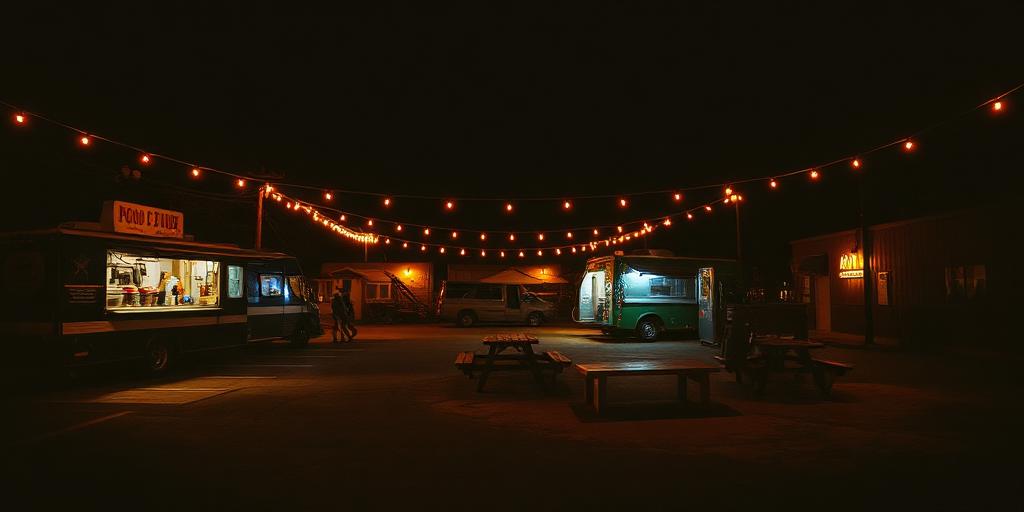
Austin food service. Illustration generated with AI. Not a photograph of a Foody Finance client or location.

What drives financing conversations in Austin

Food truck and trailer financing is unusually common here, often followed within 2 years by a buildout request for the first fixed location.

Revenue and seasonality in Austin

Festival weeks concentrate a large share of annual revenue, tech payrolls support weekday and catering volume, and the truck and trailer scene competes directly with brick and mortar for the same dollars.

What this does to your numbers

Festival weeks, tech payrolls, and a strong patio culture drive volume, and the summer heat shifts traffic to evenings.

Permitting in Austin, and what it costs to wait

City of Austin permitting and Travis County health review are known bottlenecks, and mobile and trailer operations carry their own separate track. A commissary requirement discovered late turns a truck launch into a two location project, and the capital request has to cover both.

What the wait actually costs

Rising downtown rents mean a delay costs more per week here than it did 5 years ago, and trailer and food park operations follow their own siting rules.

What raises the cost of capital here

  • 01Event weeks compress a meaningful share of annual revenue into a handful of days
  • 02Food truck to brick and mortar conversions are more common here than in most metros
  • 03Rising commercial rent shortens the payback window lenders will underwrite

Which program usually fits here

Trailers finance closer to vehicles than to buildings, and permanent buildouts should be sized against the permit calendar rather than the contractor schedule.

Austin
Texas outline. Boundary data: US Census Bureau cartographic boundary files, public domain. Simplified for display.

Free review, no hard credit pull

Get funds now and review your options

Step 01 of 03 · Your operation

A specialist reviews every request and reaches out the same business day

Areas we serve

  • East Austin
  • South Congress
  • Domain
  • Rainey Street
  • Round Rock

Financing terms on this page

Definitions for the terms used above.

commissary
A licensed production kitchen used to prep off site, most often by trucks and catering operations. It carries its own rent, equipment, and permits.
underwriting
The lender reading your numbers to decide how much risk you are. Bank statements, time in business, and existing debt carry the most weight.
equipment paper
A loan or lease tied to a specific machine. The machine itself is the security, so approval leans on the value of the hardware more than on your bank statements.
buildout capital
Money for the work that turns a space into a working kitchen: plumbing, electrical, hoods, walls, and permits. It pays for labor and materials you cannot resell, so it is priced differently than money for a fryer.
draw
Taking money out of an approved line or loan. Draws tied to construction milestones mean you only start paying interest on each piece as you use it.
working capital
Cash for the everyday gaps: payroll, inventory, rent, and repairs. It is repaid out of daily or weekly sales rather than from one big event.
hard credit pull
A formal credit check that shows on your report and can move your score a few points. It happens only after you pick a specific lender, not to get information.
covers
The number of guests served. Lenders pair it with check average to judge how reliable a month really is.
term
How long you have to repay. A longer term lowers the monthly payment and raises what the money costs in total.

Austin financing questions

Can an Austin food truck operator finance a move into a brick and mortar space?

Yes, and the truck's deposit history is the asset. Documented revenue from the mobile operation supports a buildout request that a pure startup could not get, so keep the statements clean before you apply.

How do event weeks affect an Austin financing request?

They create spikes that underwriting reads as volatility unless they are explained. A specialist presents the calendar alongside the statements so the peaks read as recurring events rather than one time anomalies.

Why do so many Austin restaurants start as food trailers before opening a full location?

A food trailer requires far less upfront capital than a full lease and commercial kitchen buildout, letting an operator prove out a menu and build a customer base in trailer parks across South Congress, East Austin, and elsewhere before committing to a brick and mortar space. That path lowers the initial cash needed but also caps daily capacity and seating, so revenue growth depends on eventually moving indoors. Lenders evaluating an Austin restaurant should understand whether an applicant's track record comes from trailer volume, which does not always translate directly into full restaurant seating and staffing economics.

How do Austin food businesses start a financing conversation?

Start with a free review by a specialist. You share the basics of the business, the use of funds, and recent bank statements, and you see every program that fits before any credit application exists. Short term options commonly fund in 1 to 3 business days once you choose an offer.

Do you serve areas outside Austin in Texas?

Yes. Every program is available statewide in Texas and nationwide.

What is equipment financing, and when does it fit a Austin operator?

You borrow against a specific machine, and the machine is what backs the loan. Use it when a fryer, a walk-in, an oven, or a vehicle has to be replaced and you would rather keep the cash in the account. Typical size is 5,000 to 500,000, funding runs 1 to 5 business days once you choose an offer, and you repay it as fixed monthly payment. You will be asked for: application, equipment quote, bank statements.

What is buildout and expansion, and when does it fit a Austin operator?

Construction money for the work that turns a space into a working kitchen, usually released in stages as the job progresses. Use it for a second location, a remodel, a patio, or a kitchen conversion, and size it to cover the permit wait, not just the build. Typical size is 50,000 to 2,000,000, funding runs 1 to 4 weeks once you choose an offer, and you repay it as fixed payment, often with a draw schedule. You will be asked for: application, contractor bids, lease, financials.

What is working capital, and when does it fit a Austin operator?

Cash for the everyday gaps, repaid out of sales on a set schedule instead of at the end of a project. Use it for payroll, inventory, a slow stretch, or a job you have to fund before the client pays you. Typical size is 10,000 to 500,000, funding runs 1 to 3 business days once you choose an offer, and you repay it as fixed daily, weekly, or monthly payment. You will be asked for: application, 3 to 6 months of bank statements.

Why does the Austin calendar change what I should borrow?

Festival weeks, tech payrolls, and a strong patio culture drive volume, and the summer heat shifts traffic to evenings.

What does waiting actually cost me in Austin?

Rising downtown rents mean a delay costs more per week here than it did 5 years ago, and trailer and food park operations follow their own siting rules.

Which program do most Austin operators end up using?

Trailers finance closer to vehicles than to buildings, and permanent buildouts should be sized against the permit calendar rather than the contractor schedule. That is a starting point, not a decision. The specialist review looks at your deposits, your time in business, and what the money is for before anything is recommended.

Does asking about financing in Austin affect my credit?

No. Getting information is a conversation, not an application. There is no credit application and no hard credit pull until you have picked a specific lender and want to move forward.

Start the conversation

Talk to a specialist before you fill out an application.

Start with a free, no-obligation review. We will send the right application only after we know what you actually qualify for.

Start a free review

Prefer to call

(833) 505-1900