Raleigh restaurant demand rises and falls with the NC State academic calendar and Research Triangle hiring cycles, leaving owners near campus and downtown planning around two different clocks.
How do Raleigh food businesses get funded?
Raleigh operators start with a free review with a specialist, share recent business bank statements, and are matched to the programs that fit the use of funds. Working capital funds in 1 to 3 business days after you choose an offer, equipment in 1 to 5, and buildout capital in 1 to 4 weeks.
Estimates, not offers: Amounts, terms, and funding times are estimates based on programs commonly available in food service. Actual terms vary by program, lender underwriting, time in business, revenue, and credit profile. Nothing here is an offer of credit or a guarantee of approval. See source and method.
How Raleigh eats, and what that does to cash
01
Where Raleigh eats
Downtown Raleigh's Glenwood South district carries the city's densest late night and cocktail bar scene, drawing a young professional crowd at 20 to 35 dollars per person. The Warehouse District and Moore Square area mix converted tobacco and industrial buildings into brewery taprooms and counter service restaurants at 12 to 20 dollars. Cameron Village, an older shopping district near North Carolina State University, holds a mix of casual dining serving students and nearby residents. North Hills, a large mixed use development off Six Forks Road, carries upscale chain and independent dining aimed at suburban professionals at 25 to 40 dollars. The North Carolina State Fairgrounds and nearby Hillsborough Street serve the North Carolina State student population with lower priced counter service. Downtown near the North Carolina Museum of Natural Sciences and the legislative building draws government worker lunch traffic on weekdays. Because Raleigh sits within the Research Triangle alongside Durham and Chapel Hill, restaurant owners often watch talent and customer migration across all three cities, since a single employer relocation between them can shift lunch demand from one downtown to another.
02
Dishes and formats Raleigh is known for
Eastern North Carolina barbecue, built on whole hog cooking and a vinegar based sauce distinct from Kansas City or Texas styles, anchors counter service smokehouses across Raleigh at 10 to 18 dollars a plate. Farm to table dining, drawing on North Carolina's agricultural regions, is strong in Glenwood South and North Hills at 30 dollars and up per person. Craft breweries have expanded through the Warehouse District's former tobacco and industrial buildings, pairing taprooms with food trucks or pub kitchens. Biscuit focused breakfast counters are a strong weekday morning format tied to the region's Southern food identity, at 6 to 10 dollars. Food halls have opened in redeveloped downtown buildings, offering multiple vendor stalls under one roof. Patio dining runs from March through November given the mild Piedmont climate. Because so many Raleigh restaurants source pork and produce from nearby North Carolina farms as part of their identity, adverse weather affecting the state's hog or produce regions can raise ingredient costs for Raleigh kitchens more directly than for cities sourcing from national distribution networks.
03
Raleigh's calendar
North Carolina State University, with more than 35,000 students, drives demand near Hillsborough Street and Cameron Village during the fall and spring semesters, with a sharp drop during winter break and summer months. The North Carolina General Assembly's session, typically running January through July in odd numbered years and a shorter session in even years, supports downtown weekday lunch demand tied to legislative staff and lobbyists. The North Carolina State Fair each October at the fairgrounds draws large crowds for an eleven day run, a strong seasonal boost for nearby restaurants. Research Triangle Park's technology and pharmaceutical employers support steady weekday demand year round in nearby corridors. College basketball season, running November through March and including Atlantic Coast Conference tournament excitement, drives bar and restaurant traffic on game nights near campus and downtown sports bars. Because the legislative session's length varies by year under North Carolina's biennial schedule, downtown restaurant owners see a stronger lunch season in odd numbered years than in even numbered ones, a swing tied directly to the state's political calendar.
04
Growth and cost pattern in Raleigh
New restaurant growth concentrates in North Hills' continued mixed use expansion, the Warehouse District's ongoing warehouse conversions, and fast growing suburbs like Wake Forest and Cary at the metro's edges. Rent has climbed steadily as Research Triangle Park's technology and pharmaceutical growth draws new residents, pushing North Hills and Glenwood South lease rates above older downtown blocks. Older Warehouse District buildings, some dating to the early tobacco industry era, require structural and fire code upgrades that add cost to an otherwise attractive historic buildout. Labor costs have risen alongside Research Triangle Park's tech sector wages, which compete with restaurant kitchens for workers even at entry level positions. Utility costs rise in summer, June through August, as Piedmont humidity drives air conditioning loads, and again modestly in winter for heating. Because the North Carolina General Assembly's biennial session length affects downtown lunch demand differently year to year, restaurant owners near the Capitol build financial projections that account for a stronger year in odd numbered legislative session years compared to shorter session years.
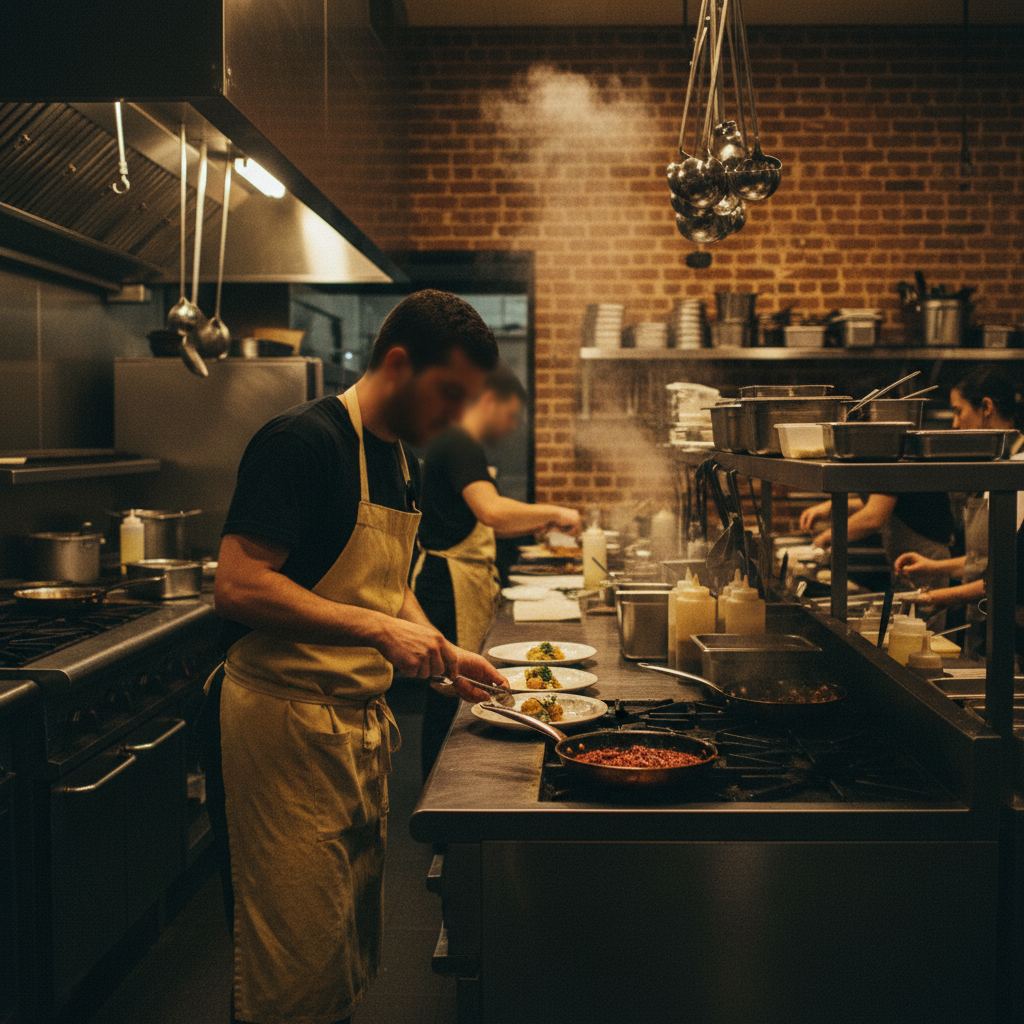
Raleigh food service. Illustration generated with AI. Not a photograph of a Foody Finance client or location.
What drives financing conversations in Raleigh
Capital here often funds buildouts in Glenwood South and downtown spaces converted from older commercial buildings, plus staffing increases timed to fall semester move-in and Research Triangle corporate growth. Restaurants near North Carolina State University also use working capital to manage the summer enrollment dip.
Revenue and seasonality in Raleigh
Fall and spring semesters bring steady traffic near NC State and downtown, while summer break thins that base even as Research Triangle corporate spending holds flat. North Hills and Five Points see consistent local dining, and Triangle-area corporate catering adds invoice revenue on standard net terms.
What this does to your numbers
Business near campus slows down every summer when students leave, even though the rest of the city keeps a steadier pace from corporate workers.
Permitting in Raleigh, and what it costs to wait
Wake County Environmental Health Services permits and inspects food establishments, while alcohol sales require approval from the North Carolina ABC Commission along with a local ABC board process that runs on its own timeline. A Glenwood South concept planning a full bar should expect the ABC approval to take longer than the health inspection, with lease payments starting before either finishes.
What the wait actually costs
A slow ABC approval can leave a finished bar unable to serve alcohol for weeks after the kitchen is ready.
What raises the cost of capital here
01NC State's academic calendar creates a predictable summer dip in demand near campus and downtown.
02Growth in the Research Triangle tech and biotech sector supports steadier corporate catering and private dining demand.
03Older Warehouse District and Glenwood South buildings often need mechanical and fire suppression upgrades before opening.
Which program usually fits here
An SBA loan fits for a larger buildout backed by steady corporate demand, and working capital fits for covering the summer semester gap.
North Carolina outline. Boundary data: US Census Bureau cartographic boundary files, public domain. Simplified for display.
A bank loan partly guaranteed by the Small Business Administration. Lowest cost of the options, longest paperwork, and the slowest to fund.
working capital
Cash for the everyday gaps: payroll, inventory, rent, and repairs. It is repaid out of daily or weekly sales rather than from one big event.
buildout capital
Money for the work that turns a space into a working kitchen: plumbing, electrical, hoods, walls, and permits. It pays for labor and materials you cannot resell, so it is priced differently than money for a fryer.
term
How long you have to repay. A longer term lowers the monthly payment and raises what the money costs in total.
draw
Taking money out of an approved line or loan. Draws tied to construction milestones mean you only start paying interest on each piece as you use it.
hard credit pull
A formal credit check that shows on your report and can move your score a few points. It happens only after you pick a specific lender, not to get information.
covers
The number of guests served. Lenders pair it with check average to judge how reliable a month really is.
How does the NC ABC system affect restaurant financing timelines in Raleigh?
North Carolina runs alcohol sales through a state ABC Commission alongside local ABC boards, which means a Raleigh restaurant applying for a mixed beverage permit works through both a state and local review process rather than a single county office. That structure often adds weeks to the alcohol approval relative to the county health inspection, so lease and buildout financing needs to cover the gap between a finished kitchen and a bar that can legally pour.
Why does Research Triangle growth matter for Raleigh restaurant lending?
The steady influx of tech and biotech workers into the Triangle supports corporate catering, private dining, and happy hour demand that holds up better through the year than a purely seasonal college town would see. Owners near North Hills and downtown often point to that corporate base when structuring longer-term financing like an SBA loan for a larger buildout, since the underlying demand is less tied to the academic calendar.
How does the Research Triangle's shared labor market between Raleigh, Durham, and Chapel Hill affect Raleigh restaurant staffing?
Because Raleigh sits within commuting distance of Durham and Chapel Hill, restaurant workers frequently choose jobs based on which of the three cities offers better pay, tips, or hours at a given time, rather than staying loyal to one city's restaurant scene. A wage increase or major opening in Durham can pull kitchen staff away from Raleigh restaurants within the same week, and the reverse happens just as easily. Owners in Glenwood South and North Hills often report needing to match Triangle wide pay trends rather than just local competitors. Lenders reviewing a Raleigh restaurant's labor costs should compare them against the broader Triangle market rather than Raleigh alone, since staffing costs move with the whole region's job market.
How do Raleigh food businesses start a financing conversation?
Start with a free review by a specialist. You share the basics of the business, the use of funds, and recent bank statements, and you see every program that fits before any credit application exists. Short term options commonly fund in 1 to 3 business days once you choose an offer.
Do you serve areas outside Raleigh in North Carolina?
Yes. Every program is available statewide in North Carolina and nationwide.
What is buildout and expansion, and when does it fit a Raleigh operator?
Construction money for the work that turns a space into a working kitchen, usually released in stages as the job progresses. Use it for a second location, a remodel, a patio, or a kitchen conversion, and size it to cover the permit wait, not just the build. Typical size is 50,000 to 2,000,000, funding runs 1 to 4 weeks once you choose an offer, and you repay it as fixed payment, often with a draw schedule. You will be asked for: application, contractor bids, lease, financials.
What is working capital, and when does it fit a Raleigh operator?
Cash for the everyday gaps, repaid out of sales on a set schedule instead of at the end of a project. Use it for payroll, inventory, a slow stretch, or a job you have to fund before the client pays you. Typical size is 10,000 to 500,000, funding runs 1 to 3 business days once you choose an offer, and you repay it as fixed daily, weekly, or monthly payment. You will be asked for: application, 3 to 6 months of bank statements.
What is sba loans, and when does it fit a Raleigh operator?
A bank loan partly guaranteed by the Small Business Administration, which is why the payment is the lowest available. Use it when you can plan months ahead. It is the cheapest money on this page and the slowest to arrive. Typical size is 50,000 to 5,000,000, funding runs 3 to 12 weeks once you choose an offer, and you repay it as amortized interest, lowest payment of any program. You will be asked for: tax returns, interim financials, debt schedule, plan.
Why does the Raleigh calendar change what I should borrow?
Business near campus slows down every summer when students leave, even though the rest of the city keeps a steadier pace from corporate workers.
What does waiting actually cost me in Raleigh?
A slow ABC approval can leave a finished bar unable to serve alcohol for weeks after the kitchen is ready.
Which program do most Raleigh operators end up using?
An SBA loan fits for a larger buildout backed by steady corporate demand, and working capital fits for covering the summer semester gap. That is a starting point, not a decision. The specialist review looks at your deposits, your time in business, and what the money is for before anything is recommended.
Does asking about financing in Raleigh affect my credit?
No. Getting information is a conversation, not an application. There is no credit application and no hard credit pull until you have picked a specific lender and want to move forward.
Start the conversation
Talk to a specialist before you fill out an application.
Start with a free, no-obligation review. We will send the right application only after we know what you actually qualify for.