Baltimore's rowhouse commercial corridors were never built for modern kitchen loads, and retrofitting one for a restaurant often costs more than the lease itself suggests.
How do Baltimore food businesses get funded?
Baltimore operators start with a free review with a specialist, share recent business bank statements, and are matched to the programs that fit the use of funds. Working capital funds in 1 to 3 business days after you choose an offer, equipment in 1 to 5, and buildout capital in 1 to 4 weeks.
Estimates, not offers: Amounts, terms, and funding times are estimates based on programs commonly available in food service. Actual terms vary by program, lender underwriting, time in business, revenue, and credit profile. Nothing here is an offer of credit or a guarantee of approval. See source and method.
How Baltimore eats, and what that does to cash
01
Where Baltimore eats
Fells Point and Federal Hill carry the city's bar-heavy nightlife economy, with cobblestone blocks of rowhouse taverns and late-night crab houses serving a mixed local and tourist crowd at 20 to 35 dollars a head. Harbor East, newer and more upscale, holds steakhouses and hotel restaurants tied to business travelers and convention traffic near the Baltimore Convention Center. Hampden, along The Avenue, runs a quirkier, lower-price scene of diners and coffee shops serving a younger local crowd at 12 to 20 dollars. Mount Vernon pairs the Peabody Institute and cultural institutions with wine bars and a slower dinner trade. Highlandtown and Greektown hold the city's older ethnic dining base, particularly Greek and Latin American kitchens serving working-class neighborhoods at lower price points. Locust Point, near Fort McHenry, has grown around the Under Armour campus with lunch-driven fast-casual traffic. A crab house in Fells Point depending on summer tourist walk-in traffic carries a fundamentally different cash rhythm than a Highlandtown diner built on repeat neighborhood customers, and the tourist location's winter slowdown creates a cash gap the neighborhood spot does not face.
02
What Baltimore serves
Blue crabs, steamed with Old Bay and served by the dozen on paper-covered tables, define the city's summer dining identity, with a dozen jumbo crabs running 60 to 90 dollars depending on the season's harvest. Crab cakes, broiler-style and lightly breaded, appear on menus from counter windows to white-tablecloth rooms at 15 to 35 dollars. Pit beef, a charcoal-grilled roast beef sandwich sold from roadside stands and parking-lot smokers, is a distinct Baltimore format found mainly along Pulaski Highway and outer-county roads. Berger cookies, a fudge-topped local cookie, show up as a bakery-counter staple rather than a restaurant dish. Snowballs, shaved ice with syrup, run as a seasonal walk-up format across rowhouse neighborhoods each summer. Harbor East's hotel dining supports a steady weekday steakhouse trade independent of crab pricing. A Fells Point crab house that prices its dozen against wholesale bushel costs sees that menu price swing with the Chesapeake Bay harvest, and a poor crab season directly compresses margins on the restaurant's highest-visibility dish during its peak summer months.
03
The Baltimore calendar
Johns Hopkins University and Johns Hopkins Hospital, the city's largest employer, anchor steady weekday lunch demand around East Baltimore and Charles Village year-round. Under Armour's headquarters in Locust Point and T. Rowe Price Downtown add office-driven lunch traffic on weekdays. Baltimore Orioles games at Camden Yards from April through September drive Downtown and Federal Hill bar traffic, while Ravens games at M&T Bank Stadium concentrate Sunday crowds from September through January. The Preakness Stakes in mid-May brings a concentrated one-week tourist and betting crowd to Pimlico and nearby neighborhoods. Summer tourist season, driven by the Inner Harbor and blue crab availability, peaks from June through August and pulls disproportionate revenue into that stretch for Fells Point and Federal Hill. Convention traffic through the Baltimore Convention Center fills Harbor East hotels unevenly across the year. Winter months, particularly January and February, see a sharp drop in Inner Harbor tourist traffic that leaves crab-focused restaurants managing a slow season with a smaller, colder-weather menu.
04
Growth and cost pattern
New restaurant activity concentrates in Harbor East, where new construction offers move-in-ready shells at high per-square-foot rent, and in older Highlandtown and Remington rowhouse commercial strips, where lower rent comes with rowhouse-scale kitchens that limit equipment capacity and require costly structural work to expand. Hampden's Avenue corridor has drawn smaller independent openings due to moderate rent and strong foot traffic, though narrow storefronts constrain seating counts. Labor competes with Johns Hopkins' large hourly healthcare workforce, which can pull kitchen staff toward hospital food service jobs with more predictable schedules. Rowhouse buildings common across Baltimore's dining corridors often require asbestos abatement or structural reinforcement before a commercial kitchen buildout can proceed, adding cost and delay not typical of suburban strip-center construction. A Highlandtown buildout that uncovers required abatement mid-renovation can add months to a project timeline, pushing a planned spring opening into the slower late-summer season and missing the year's strongest tourist-adjacent revenue window.
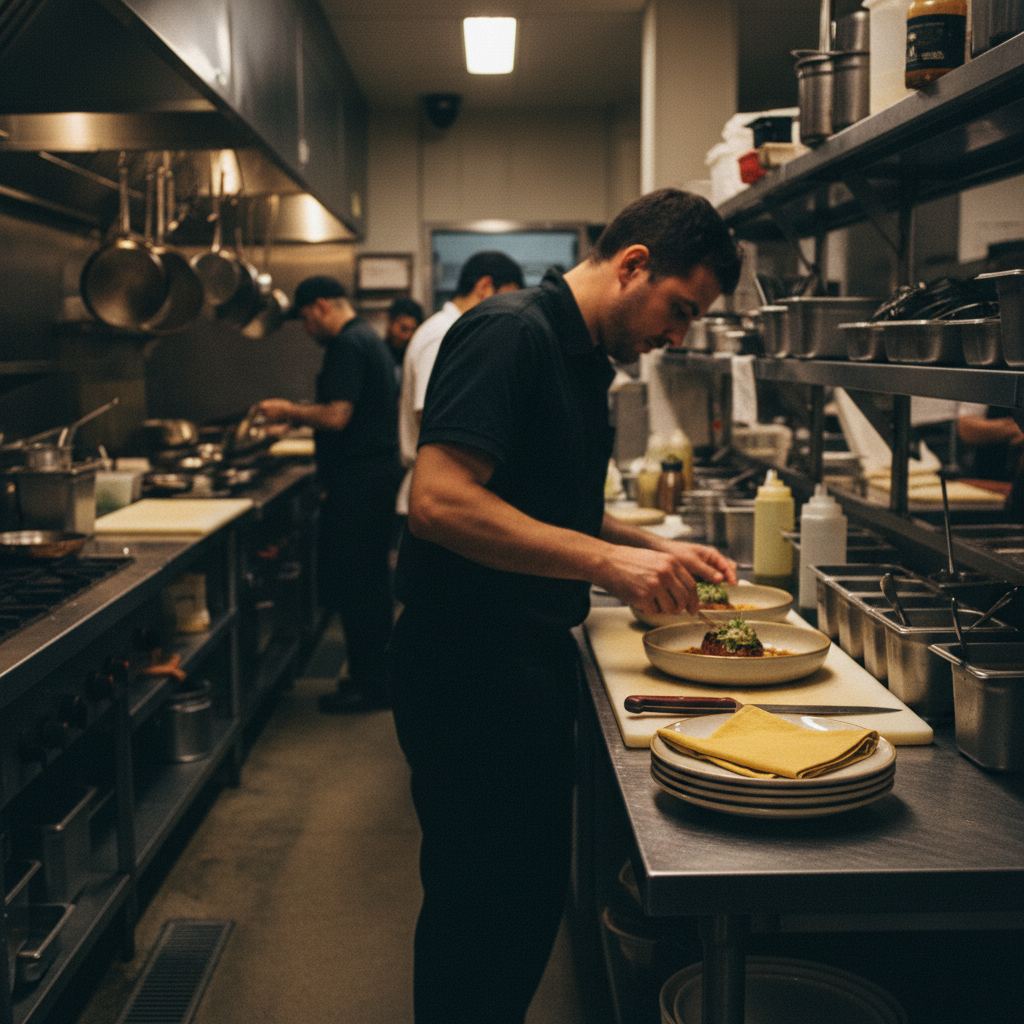
Baltimore food service. Illustration generated with AI. Not a photograph of a Foody Finance client or location.
What drives financing conversations in Baltimore
Capital here frequently covers electrical and structural upgrades in converted rowhouse storefronts across Fells Point and Hampden, since these buildings predate current commercial kitchen demand. Seafood-focused menus near the harbor also require refrigeration and storage capacity built for a perishable-heavy supply chain that runs on tighter timing than a dry goods kitchen.
Revenue and seasonality in Baltimore
Fells Point and Federal Hill draw steady tourist and nightlife traffic tied to the Inner Harbor, while Hampden and Canton lean more on local weekend dining. Seafood supply costs shift seasonally, and harbor-area tourism slows in the coldest winter months, so cash flow planning has to absorb both a perishable-heavy cost base and a seasonal tourist dip.
What this does to your numbers
Winter near the harbor is a lot quieter than summer, so your slow months need their own plan.
Permitting in Baltimore, and what it costs to wait
The Baltimore City Health Department issues food service permits separately from the city's Department of Housing and Community Development, which handles construction and rowhouse-related code compliance, and older commercial rowhouses often require electrical service upgrades before a kitchen can pass inspection. Maryland's alcohol licensing runs through a local board that operates on its own schedule, adding a track that doesn't move with the construction timeline.
What the wait actually costs
Old rowhouse buildings often need electrical upgrades that cost more than the lease made it sound like.
What raises the cost of capital here
01Converted rowhouse storefronts often need electrical service upgrades before passing a kitchen inspection.
02Perishable seafood supply chains near the harbor require tighter refrigeration capacity than a dry goods kitchen.
03Winter tourism slowdowns near the Inner Harbor reduce foot traffic for stretches that summer revenue has to offset.
Which program usually fits here
Equipment financingcovers the electrical and refrigeration upgrades, while a credit line handles the winter tourism dip.
Maryland outline. Boundary data: US Census Bureau cartographic boundary files, public domain. Simplified for display.
Taking money out of an approved line or loan. Draws tied to construction milestones mean you only start paying interest on each piece as you use it.
equipment paper
A loan or lease tied to a specific machine. The machine itself is the security, so approval leans on the value of the hardware more than on your bank statements.
covers
The number of guests served. Lenders pair it with check average to judge how reliable a month really is.
buildout capital
Money for the work that turns a space into a working kitchen: plumbing, electrical, hoods, walls, and permits. It pays for labor and materials you cannot resell, so it is priced differently than money for a fryer.
working capital
Cash for the everyday gaps: payroll, inventory, rent, and repairs. It is repaid out of daily or weekly sales rather than from one big event.
hard credit pull
A formal credit check that shows on your report and can move your score a few points. It happens only after you pick a specific lender, not to get information.
underwriting
The lender reading your numbers to decide how much risk you are. Bank statements, time in business, and existing debt carry the most weight.
term
How long you have to repay. A longer term lowers the monthly payment and raises what the money costs in total.
Why do rowhouse restaurant buildouts in Baltimore cost more than expected?
Many commercial spaces in Fells Point and Hampden are converted rowhouses built long before modern kitchen electrical and ventilation demand, and bringing them up to code for a commercial kitchen often means a full electrical service upgrade the city's housing and construction review requires before final inspection. That work typically gets discovered after a lease is signed, not before.
How does winter affect restaurant revenue near Baltimore's Inner Harbor?
Tourist traffic around Fells Point and the Inner Harbor drops noticeably in the coldest winter months compared to the warmer season, which creates a real revenue dip for restaurants leaning on that visitor base. Financing that assumes flat year-round revenue underestimates how much winter months differ from peak tourist season.
Why do crab prices matter to a Baltimore restaurant's financial statements?
Blue crab wholesale prices shift year to year based on Chesapeake Bay harvest conditions, and a restaurant built around a per-dozen crab menu absorbs that cost swing directly since crab prices cannot be marked up as freely as other proteins without losing customers to competitors along the same strip. A lender reviewing a Fells Point or Federal Hill crab house should expect gross margin to vary by season and by year in a way that is normal for the category, and should look at multiple summer seasons rather than one to judge whether the business manages harvest-driven cost swings consistently.
How do Baltimore food businesses start a financing conversation?
Start with a free review by a specialist. You share the basics of the business, the use of funds, and recent bank statements, and you see every program that fits before any credit application exists. Short term options commonly fund in 1 to 3 business days once you choose an offer.
Do you serve areas outside Baltimore in Maryland?
Yes. Every program is available statewide in Maryland and nationwide.
What is equipment financing, and when does it fit a Baltimore operator?
You borrow against a specific machine, and the machine is what backs the loan. Use it when a fryer, a walk-in, an oven, or a vehicle has to be replaced and you would rather keep the cash in the account. Typical size is 5,000 to 500,000, funding runs 1 to 5 business days once you choose an offer, and you repay it as fixed monthly payment. You will be asked for: application, equipment quote, bank statements.
What is buildout and expansion, and when does it fit a Baltimore operator?
Construction money for the work that turns a space into a working kitchen, usually released in stages as the job progresses. Use it for a second location, a remodel, a patio, or a kitchen conversion, and size it to cover the permit wait, not just the build. Typical size is 50,000 to 2,000,000, funding runs 1 to 4 weeks once you choose an offer, and you repay it as fixed payment, often with a draw schedule. You will be asked for: application, contractor bids, lease, financials.
What is working capital, and when does it fit a Baltimore operator?
Cash for the everyday gaps, repaid out of sales on a set schedule instead of at the end of a project. Use it for payroll, inventory, a slow stretch, or a job you have to fund before the client pays you. Typical size is 10,000 to 500,000, funding runs 1 to 3 business days once you choose an offer, and you repay it as fixed daily, weekly, or monthly payment. You will be asked for: application, 3 to 6 months of bank statements.
Why does the Baltimore calendar change what I should borrow?
Winter near the harbor is a lot quieter than summer, so your slow months need their own plan.
What does waiting actually cost me in Baltimore?
Old rowhouse buildings often need electrical upgrades that cost more than the lease made it sound like.
Which program do most Baltimore operators end up using?
Equipment financing covers the electrical and refrigeration upgrades, while a credit line handles the winter tourism dip. That is a starting point, not a decision. The specialist review looks at your deposits, your time in business, and what the money is for before anything is recommended.
Does asking about financing in Baltimore affect my credit?
No. Getting information is a conversation, not an application. There is no credit application and no hard credit pull until you have picked a specific lender and want to move forward.
Start the conversation
Talk to a specialist before you fill out an application.
Start with a free, no-obligation review. We will send the right application only after we know what you actually qualify for.