Louisville restaurants plan a huge chunk of their year around two weeks in the spring, and Derby traffic changes what a normal buildout budget needs to cover.
How do Louisville food businesses get funded?
Louisville operators start with a free review with a specialist, share recent business bank statements, and are matched to the programs that fit the use of funds. Working capital funds in 1 to 3 business days after you choose an offer, equipment in 1 to 5, and buildout capital in 1 to 4 weeks.
Estimates, not offers: Amounts, terms, and funding times are estimates based on programs commonly available in food service. Actual terms vary by program, lender underwriting, time in business, revenue, and credit profile. Nothing here is an offer of credit or a guarantee of approval. See source and method.
How Louisville eats, and what that does to cash
01
Where Louisville eats
NuLu, the East Market district, carries the city's chef-driven dining, with tasting menus and wine-forward rooms running 30 to 50 dollars a head near the Muhammad Ali Center. The Highlands, stretching along Bardstown Road and Baxter Avenue, mixes dive bars, patios, and late-night counter food for a younger, walkable crowd at 12 to 20 dollars a plate. Butchertown pairs a historic meatpacking identity with breweries and a food hall model near the Nulu edge. Old Louisville, near the University of Louisville, runs cheaper student-driven pizza and wing spots. St. Matthews, an East End suburban node, holds steakhouses and business lunch traffic tied to nearby office parks. Downtown, anchored by the KFC Yum! Center and Fourth Street Live, depends heavily on event nights and convention traffic through the Kentucky International Convention Center. West Louisville has seen slower restaurant investment despite population size, with fewer full-service options than the East End. A NuLu tasting room built around evening reservations reads differently than a Fourth Street Live bar built around arena nights, and a canceled Yum! Center concert can erase a full week of projected revenue for the latter.
02
What Louisville serves
The Hot Brown, an open-faced turkey sandwich under mornay sauce, originated at the Brown Hotel Downtown and remains a fixture on brunch and lunch menus at 14 to 22 dollars. Bourbon-driven menus pair with the Kentucky Bourbon Trail's urban stops, supporting whiskey bars with elevated small-plate pricing near NuLu and Downtown. Derby season drives a specific format: country ham, benedictine spread, and mint julep service at both formal dining rooms and pop-up tents. Fried chicken carries civic weight given Colonel Sanders' Kentucky roots, supported by both counter-service chains and independent kitchens. Beer cheese, a regional dip, shows up as a bar snack across the Highlands. Food halls, including spaces built into former industrial buildings in Butchertown and NuLu, combine multiple counter-service vendors under one roof to spread rent across smaller operators. Brewery kitchens along Story Avenue serve a beer-first, food-secondary model. A Hot Brown at 18 dollars sells steadily year-round, but a Derby-week mint julep tent generating outsized single-week revenue creates a sharp post-Derby drop that owners must budget against for the following month.
03
The Louisville calendar
The Kentucky Derby at Churchill Downs in early May is the single largest driver of the city's food and beverage year, with Derby Week and the preceding Kentucky Derby Festival pulling visitor spending into a two-week window that dwarfs any other stretch. Humana, UPS's Worldport hub, Norton Healthcare, and the University of Louisville anchor weekday lunch demand across Downtown and the East End year-round. UPS's overnight sorting operation near Louisville Muhammad Ali International Airport supports a smaller late-night food trade near the airport corridor. Thunder Over Louisville, the airshow that opens Derby Festival in April, brings a single massive one-day crowd Downtown. Convention traffic through the Kentucky International Convention Center fills Downtown hotels and restaurants unevenly across the year depending on booking calendars. University of Louisville home football games in fall add Saturday spikes near campus. The months immediately after Derby, particularly June, see a marked drop in Downtown and NuLu visitor traffic compared to April and May, straining any restaurant that overstaffed for Derby week.
04
Growth and cost pattern
New restaurant openings concentrate in NuLu, where former warehouse buildings require significant buildout investment but offer high foot traffic tied to bourbon tourism, and in the Butchertown food hall model, where vendors share kitchen infrastructure and reduce individual buildout cost. The Highlands offers smaller, older storefronts with lower rent but frequent parking constraints that limit dinner-hour turnover. St. Matthews and the East End provide larger suburban footprints at higher per-square-foot rent but faster permitting given newer construction stock. Labor competes directly with UPS's Worldport hub, which runs overnight shifts and pulls from the same hourly workforce restaurants need for closing shifts. Flood zone restrictions near the Ohio River affect ground-floor buildouts in parts of NuLu and Butchertown, adding insurance and construction cost. A NuLu buildout timed to open before Derby season faces real pressure, because a permitting delay that pushes the opening past late April means missing the single highest-revenue window of the year and absorbing a full quarter of rent before meaningful income arrives.
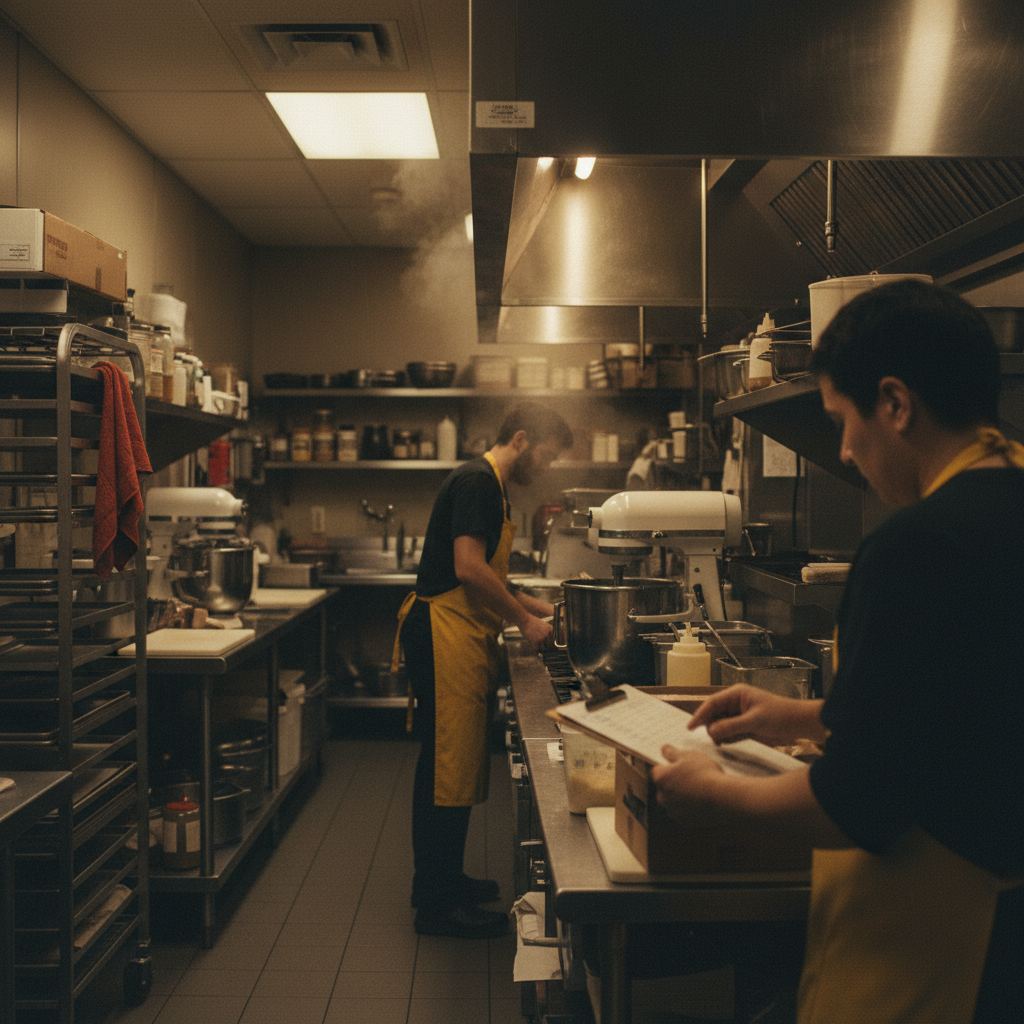
Louisville food service. Illustration generated with AI. Not a photograph of a Foody Finance client or location.
What drives financing conversations in Louisville
Financing here often funds bourbon program buildouts and expanded bar capacity tied to the Kentucky Bourbon Trail's tourism draw, plus event catering equipment for Derby season demand. NuLu and the Highlands both see steady growth pressure that pushes older buildings toward renovation costs a newer commercial strip wouldn't carry.
Revenue and seasonality in Louisville
Kentucky Derby week in early May drives an outsized share of annual tourism revenue downtown and near Churchill Downs, and many operators staff and stock up weeks ahead of it. The rest of the year runs on steadier local traffic in the Highlands and Germantown, so the gap between Derby-week intensity and the calmer months requires deliberate cash flow planning.
What this does to your numbers
Derby week can carry a big share of your year, but you have to spend money to staff up for it before it pays off.
Permitting in Louisville, and what it costs to wait
The Louisville Metro Department of Public Health and Wellness issues food service permits while Louisville Metro Government's Develop Louisville division handles building permits and zoning separately, and older buildings in NuLu and Butchertown sometimes trigger historic renovation requirements. Kentucky's alcohol licensing runs through a separate state and local process, which matters most for bourbon-focused bar concepts that need approval before the Derby crowds arrive.
What the wait actually costs
Older buildings in NuLu can need extra renovation work that adds time before you can open.
What raises the cost of capital here
01Derby week in early May concentrates a large share of annual tourism revenue into a single short window.
02Bourbon Trail tourism pushes bar buildout investment toward premium spirits program capacity.
03Older building renovations in NuLu and Butchertown can trigger historic requirements that add construction cost.
Which program usually fits here
Working capitalcovers the ramp-up before Derby week, while equipment financing supports bigger bourbon and bar programs.
Kentucky outline. Boundary data: US Census Bureau cartographic boundary files, public domain. Simplified for display.
Cash for the everyday gaps: payroll, inventory, rent, and repairs. It is repaid out of daily or weekly sales rather than from one big event.
covers
The number of guests served. Lenders pair it with check average to judge how reliable a month really is.
equipment paper
A loan or lease tied to a specific machine. The machine itself is the security, so approval leans on the value of the hardware more than on your bank statements.
draw
Taking money out of an approved line or loan. Draws tied to construction milestones mean you only start paying interest on each piece as you use it.
SBA loan
A bank loan partly guaranteed by the Small Business Administration. Lowest cost of the options, longest paperwork, and the slowest to fund.
hard credit pull
A formal credit check that shows on your report and can move your score a few points. It happens only after you pick a specific lender, not to get information.
buildout capital
Money for the work that turns a space into a working kitchen: plumbing, electrical, hoods, walls, and permits. It pays for labor and materials you cannot resell, so it is priced differently than money for a fryer.
underwriting
The lender reading your numbers to decide how much risk you are. Bank statements, time in business, and existing debt carry the most weight.
term
How long you have to repay. A longer term lowers the monthly payment and raises what the money costs in total.
How much does Derby week matter for restaurant cash flow in Louisville?
Kentucky Derby week in early May draws a concentrated surge of visitors near Churchill Downs and downtown, and many restaurants staff up and increase inventory in the weeks leading into it. Because that revenue clusters into such a short window, financing built around a flat monthly average understates how important that single stretch is to the annual numbers.
Why do bourbon bar buildouts in Louisville cost more than a standard bar?
Bars built around the Kentucky Bourbon Trail's tourism draw often invest in larger, curated spirits inventories and specialized storage and display fixtures that a standard bar buildout doesn't need. That upfront inventory and fixture cost adds to the typical equipment financing request beyond basic bar equipment.
How does Derby week distort a Louisville restaurant's financial picture for lenders?
A restaurant near Churchill Downs, NuLu, or Downtown can generate a disproportionate share of annual revenue during the two weeks surrounding the Kentucky Derby, then return to ordinary volume for the rest of the year. Bank statements from April and May will look strong on their own but are not representative of a typical month. Lenders reviewing Louisville hospitality applicants should ask specifically what portion of trailing revenue came from Derby week and Thunder Over Louisville, since treating that spike as the new baseline overstates the business's ordinary cash flow for the remaining eleven months.
How do Louisville food businesses start a financing conversation?
Start with a free review by a specialist. You share the basics of the business, the use of funds, and recent bank statements, and you see every program that fits before any credit application exists. Short term options commonly fund in 1 to 3 business days once you choose an offer.
Do you serve areas outside Louisville in Kentucky?
Yes. Every program is available statewide in Kentucky and nationwide.
What is equipment financing, and when does it fit a Louisville operator?
You borrow against a specific machine, and the machine is what backs the loan. Use it when a fryer, a walk-in, an oven, or a vehicle has to be replaced and you would rather keep the cash in the account. Typical size is 5,000 to 500,000, funding runs 1 to 5 business days once you choose an offer, and you repay it as fixed monthly payment. You will be asked for: application, equipment quote, bank statements.
What is working capital, and when does it fit a Louisville operator?
Cash for the everyday gaps, repaid out of sales on a set schedule instead of at the end of a project. Use it for payroll, inventory, a slow stretch, or a job you have to fund before the client pays you. Typical size is 10,000 to 500,000, funding runs 1 to 3 business days once you choose an offer, and you repay it as fixed daily, weekly, or monthly payment. You will be asked for: application, 3 to 6 months of bank statements.
What is sba loans, and when does it fit a Louisville operator?
A bank loan partly guaranteed by the Small Business Administration, which is why the payment is the lowest available. Use it when you can plan months ahead. It is the cheapest money on this page and the slowest to arrive. Typical size is 50,000 to 5,000,000, funding runs 3 to 12 weeks once you choose an offer, and you repay it as amortized interest, lowest payment of any program. You will be asked for: tax returns, interim financials, debt schedule, plan.
Why does the Louisville calendar change what I should borrow?
Derby week can carry a big share of your year, but you have to spend money to staff up for it before it pays off.
What does waiting actually cost me in Louisville?
Older buildings in NuLu can need extra renovation work that adds time before you can open.
Which program do most Louisville operators end up using?
Working capital covers the ramp-up before Derby week, while equipment financing supports bigger bourbon and bar programs. That is a starting point, not a decision. The specialist review looks at your deposits, your time in business, and what the money is for before anything is recommended.
Does asking about financing in Louisville affect my credit?
No. Getting information is a conversation, not an application. There is no credit application and no hard credit pull until you have picked a specific lender and want to move forward.
Start the conversation
Talk to a specialist before you fill out an application.
Start with a free, no-obligation review. We will send the right application only after we know what you actually qualify for.