Lexington restaurants time their busiest stretches around University of Kentucky basketball season and the spring horse racing meets at Keeneland, then absorb a quieter summer.
How do Lexington food businesses get funded?
Lexington operators start with a free review with a specialist, share recent business bank statements, and are matched to the programs that fit the use of funds. Working capital funds in 1 to 3 business days after you choose an offer, equipment in 1 to 5, and buildout capital in 1 to 4 weeks.
Estimates, not offers: Amounts, terms, and funding times are estimates based on programs commonly available in food service. Actual terms vary by program, lender underwriting, time in business, revenue, and credit profile. Nothing here is an offer of credit or a guarantee of approval. See source and method.
How Lexington eats, and what that does to cash
01
Where Lexington eats
Downtown Lexington, centered on Main Street and Cheapside Park, carries bourbon bars and chef-driven restaurants that cater to Keeneland visitors and convention traffic from the Lexington Convention Center. North Limestone, known locally as NoLi, has turned a stretch of older storefronts into a corridor of breweries and casual restaurants pulling a younger, service-industry crowd. Chevy Chase, an older residential neighborhood near Transylvania University, holds higher-priced brunch spots and wine bars serving established Lexington families. South Limestone, running along the University of Kentucky campus, is dense with counter-service pizza, wings, and late-night food built for student budgets under 10 dollars. Southland Drive keeps an older strip of family-owned diners and international restaurants serving longtime residents rather than visitors. Hamburg, on the city's east side, has become the newest growth corridor, filling with chain casual dining tied to its shopping-center development. Each district's traffic depends on a different anchor, university, racetrack, or shopping center, and that anchor's schedule sets each restaurant's slow weeks. Lexington's status as a state capital-adjacent college town keeps overall dining demand steadier than in cities without a large public university anchoring downtown traffic.
02
What Lexington actually orders
Bourbon shapes menus citywide, from bourbon-glazed dishes at downtown restaurants to full bourbon flights served alongside the Kentucky hot brown, an open-faced turkey sandwich that shows up on menus across the city. Horse-country tourism supports higher-end farm-to-table restaurants serving visitors touring the surrounding bluegrass horse farms. NoLi's brewery kitchens pair house beer with elevated pub food, typically running 14 to 20 dollars an entree. Near UK, counter-service pizza, wing, and taco spots dominate, built for fast turns and delivery volume rather than sit-down dining. Fried chicken remains a steady seller across price points, from gas-station counters to sit-down Southern restaurants downtown. Late-night food, driven by UK's student population, clusters along South Limestone and stays open well past midnight during the academic year. Patio dining works most of the year given Kentucky's moderate climate, but restaurants near campus see outdoor seating go largely unused during the slow summer months when students are gone. Menu prices near campus stay compressed by student budgets, while Chevy Chase and downtown restaurants price closer to what horse-farm visitors and bourbon tourists expect to pay.
03
Lexington's calendar
University of Kentucky's academic calendar drives South Limestone and campus-adjacent restaurant traffic, with a hard drop each May when students leave and a slower rebuild each August during move-in. UK men's basketball season, running November through March with games at Rupp Arena, floods downtown bars and restaurants on game nights and creates a predictable weekly spike. Keeneland's spring meet in April and fall meet in October each bring roughly three weeks of heavy tourist and local spending downtown and near the track, with restaurant reservations booked out well in advance. The Toyota assembly plant in nearby Georgetown and UK's medical center campus anchor steady weekday lunch traffic independent of racing or basketball. Summer, once Keeneland's spring meet ends and students leave, is Lexington's clearest slow season, and restaurants that rely heavily on game-day or race-week crowds see a sharp falloff in weekly covers once June arrives. Restaurants that staff up heavily for a single Keeneland meet without a plan for the following slow month often carry payroll they cannot cover from receipts alone.
04
Where Lexington is building and what it costs
New restaurant development concentrates in Hamburg on the east side, where shopping-center outparcels have drawn a wave of chain casual openings over the past several years. Downtown buildout near Main Street often involves century-old buildings that require structural and electrical upgrades before a commercial kitchen can pass inspection, adding time and cost that newer Hamburg sites avoid. The Toyota plant in Georgetown and other manufacturing employers in the surrounding counties pull hourly workers away from restaurant jobs, tightening the labor pool for kitchens across the city. Horse farm and racing-related tourism creates a seasonal staffing crunch around Keeneland's meets, when restaurants near the track need extra help for a concentrated few weeks. Rents in NoLi have climbed as the corridor's brewery and restaurant density has grown, pricing out some of the lower-margin concepts that helped establish the district. Owners opening downtown should expect permitting and buildout delays tied to historic building stock that Hamburg-area projects simply do not face. Owners signing leases in Hamburg should still budget for slower ramp-up periods common to new shopping-center developments before customer traffic fully establishes itself.
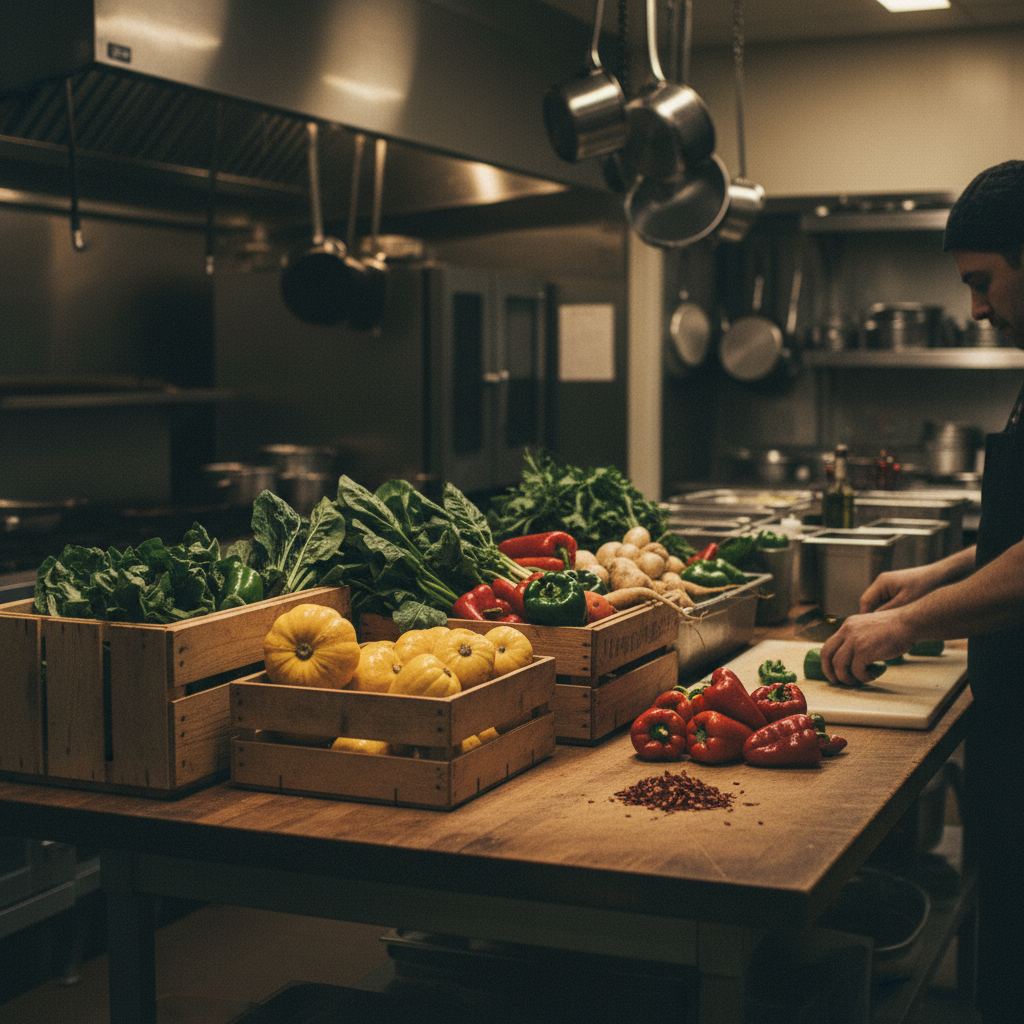
Lexington food service. Illustration generated with AI. Not a photograph of a Foody Finance client or location.
What drives financing conversations in Lexington
Capital here tends to fund bar and kitchen capacity built for UK game-day crowds along with bourbon and spirits inventory that carries real carrying cost for cocktail-forward concepts. A second common use is bridging the gap between Keeneland's spring and fall meets when tourism traffic drops.
Revenue and seasonality in Lexington
UK basketball season and Keeneland's spring and fall meets drive surges in Downtown Lexington and the Distillery District, while Hamburg's retail corridor carries steadier suburban traffic. An event-reliant concept can see a sharp summer slowdown, and bourbon inventory ties up cash a slow stretch makes harder to recover.
What this does to your numbers
Basketball season and the Keeneland race meets bring in strong money, but summer is noticeably quieter for a lot of spots downtown.
Permitting in Lexington, and what it costs to wait
Lexington-Fayette County Health Department issues food service permits while alcohol sales require licensing through the Kentucky Department of Alcoholic Beverage Control, a state process that runs separately from local health inspection. A bourbon-focused concept holding significant spirits inventory should have financing that accounts for ABC approval timing before that inventory can be sold.
What the wait actually costs
The state alcohol license for spirits sales runs on its own schedule and can hold up a bourbon-focused opening.
What raises the cost of capital here
01Kentucky ABC licensing for spirits-heavy concepts runs on a state timeline separate from local health approval
02UK basketball season and Keeneland race meets concentrate revenue into specific weeks rather than spreading it evenly
03Bourbon and premium spirits inventory ties up working capital that a slow summer stretch can leave sitting unsold
Which program usually fits here
A working capital line that covers slow-moving bourbon inventory fits better than a loan sized only around the buildout cost.
Kentucky outline. Boundary data: US Census Bureau cartographic boundary files, public domain. Simplified for display.
Cash for the everyday gaps: payroll, inventory, rent, and repairs. It is repaid out of daily or weekly sales rather than from one big event.
covers
The number of guests served. Lenders pair it with check average to judge how reliable a month really is.
line of credit
A preapproved pool of money you pull from only when you need it, then pay back and reuse. You pay for what you draw, not for the full amount sitting there.
draw
Taking money out of an approved line or loan. Draws tied to construction milestones mean you only start paying interest on each piece as you use it.
buildout capital
Money for the work that turns a space into a working kitchen: plumbing, electrical, hoods, walls, and permits. It pays for labor and materials you cannot resell, so it is priced differently than money for a fryer.
hard credit pull
A formal credit check that shows on your report and can move your score a few points. It happens only after you pick a specific lender, not to get information.
equipment paper
A loan or lease tied to a specific machine. The machine itself is the security, so approval leans on the value of the hardware more than on your bank statements.
term
How long you have to repay. A longer term lowers the monthly payment and raises what the money costs in total.
Why does a bourbon bar in Lexington need financing built around inventory, not just buildout?
A serious bourbon program can tie up significant cash in bottles that sell slowly compared to standard bar inventory, and that capital sits idle until the drinks move. Working capital that accounts for carrying that inventory through slower months, rather than financing that only covers the initial buildout, keeps the concept from running short on operating cash.
How do UK basketball season and Keeneland race meets affect restaurant cash flow in Lexington?
Downtown and Distillery District spots see some of their strongest weeks during UK's basketball season and Keeneland's spring and fall meets, with quieter stretches in between and over the summer. A financing structure that assumes even monthly revenue can understate how thin the off-peak months actually run.
How much does Keeneland's racing calendar actually move Lexington restaurant revenue?
Keeneland runs only two meets a year, three weeks each in April and October, but those six weeks generate an outsized share of downtown Lexington's annual restaurant revenue through hotel-linked dinners, bourbon bar traffic, and reservations booked months ahead. Restaurants near the track or downtown often post their highest weekly covers of the year during meet weeks, then return to a much flatter baseline once racing ends. That concentration means a lender reviewing a downtown Lexington restaurant's monthly statements should expect two sharp spikes rather than smooth, even revenue, and a slow month outside those windows is not automatically a warning sign.
How do Lexington food businesses start a financing conversation?
Start with a free review by a specialist. You share the basics of the business, the use of funds, and recent bank statements, and you see every program that fits before any credit application exists. Short term options commonly fund in 1 to 3 business days once you choose an offer.
Do you serve areas outside Lexington in Kentucky?
Yes. Every program is available statewide in Kentucky and nationwide.
What is working capital, and when does it fit a Lexington operator?
Cash for the everyday gaps, repaid out of sales on a set schedule instead of at the end of a project. Use it for payroll, inventory, a slow stretch, or a job you have to fund before the client pays you. Typical size is 10,000 to 500,000, funding runs 1 to 3 business days once you choose an offer, and you repay it as fixed daily, weekly, or monthly payment. You will be asked for: application, 3 to 6 months of bank statements.
What is business line of credit, and when does it fit a Lexington operator?
An approved limit you pull from only when you need it, then repay and reuse. Use it for a season you can see coming, so you draw before the peak and pay it back out of the peak. Typical size is 10,000 to 250,000, funding runs 2 to 7 business days once you choose an offer, and you repay it as interest on the drawn balance only. You will be asked for: application, bank statements.
What is buildout and expansion, and when does it fit a Lexington operator?
Construction money for the work that turns a space into a working kitchen, usually released in stages as the job progresses. Use it for a second location, a remodel, a patio, or a kitchen conversion, and size it to cover the permit wait, not just the build. Typical size is 50,000 to 2,000,000, funding runs 1 to 4 weeks once you choose an offer, and you repay it as fixed payment, often with a draw schedule. You will be asked for: application, contractor bids, lease, financials.
Why does the Lexington calendar change what I should borrow?
Basketball season and the Keeneland race meets bring in strong money, but summer is noticeably quieter for a lot of spots downtown.
What does waiting actually cost me in Lexington?
The state alcohol license for spirits sales runs on its own schedule and can hold up a bourbon-focused opening.
Which program do most Lexington operators end up using?
A working capital line that covers slow-moving bourbon inventory fits better than a loan sized only around the buildout cost. That is a starting point, not a decision. The specialist review looks at your deposits, your time in business, and what the money is for before anything is recommended.
Does asking about financing in Lexington affect my credit?
No. Getting information is a conversation, not an application. There is no credit application and no hard credit pull until you have picked a specific lender and want to move forward.
Start the conversation
Talk to a specialist before you fill out an application.
Start with a free, no-obligation review. We will send the right application only after we know what you actually qualify for.